
Ise Shrine
- Medium:
- Mokuhanga (Japanese woodblock)
- Image courtesy of
- Saru Gallery
Description
This print of Ise Shrine likely depicts an exterior view of one of the two principal precincts — the Naiku dedicated to Amaterasu, or the Geku dedicated to Toyouke — focusing on a torii gate, the Uji Bridge, or a thatched gate hall set against the shrine's cryptomeria forest. Tokuriki's treatment of the subject would emphasize the unadorned hinoki architecture characteristic of shinmei-zukuri style, using flat washes of muted color rather than the bright pigments deployed for Buddhist temple subjects. Bokashi gradients establish atmosphere in the wooded background and at the horizon, while the keyblock provides crisp definition of post-and-lintel framing and steep thatched roofs. Among Tokuriki's national pilgrimage subjects, Ise occupies a distinct register from his Kyoto temple work, demanding visual restraint to match the site's spiritual character. The print belongs to the broader twentieth-century meisho-e revival in which Tokuriki, Kawase Hasui, and others reframed Japan's religious geography for a domestic and increasingly international postwar audience.
More Prints by Tomikichiro Tokuriki
Heian Shrine in the Spring
Woodblock print
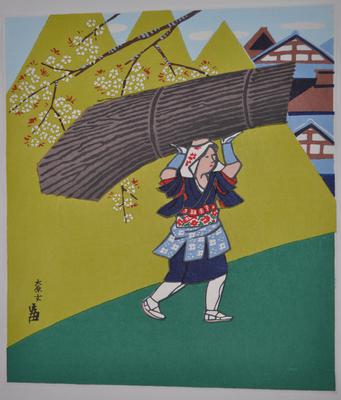
An Oharame Girl Carrying Firewood on Her Head
20th century
Woodblock print, ink and color on paper

April (Arashiyama Park, a Famous Scenic Resort)
四月 (嵐山)
second half 20th century
Woodblock print, ink and color on paper

June (Rainy Scene of the Sen-ke, Japanese Tea Ceremony Founder's House)
六月 (千家雨景)
second half 20th century
Woodblock print, ink and color on paper
More Temples & Shrines Prints
Fushimi Inari Temple
伏見稲荷
Woodblock print

The Compound of the Tenman Shrine at Kameido in the Snow (Kameido Tenmangu keidai no yuki), from the series "Famous Places in the Eastern Capital (Toto meisho)"
c. 1832/38
Color woodblock print; oban
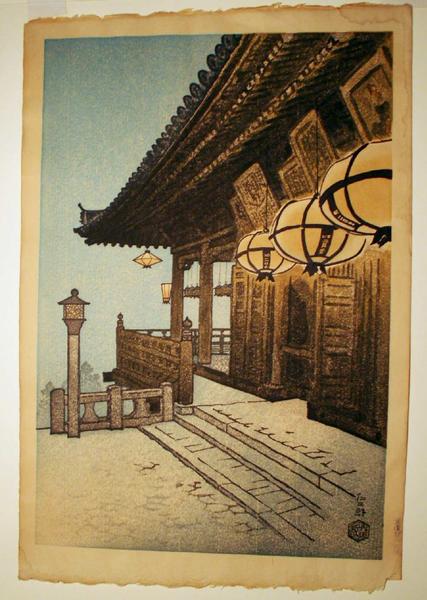
Temple with lanterns
Woodblock print

A Section of the Byodo Temple at Uji (Uji Byodoin no ichibu), from the series "Souvenirs of Travel, Second Series (Tabi miyage dai nishu)"
Uji Byodoin no ichibu
1921
Color woodblock print; oban
Featured in Collections
Curated cross-cuts that include this print.
Frequently Asked Questions
Ise Shrine was created by Tomikichiro Tokuriki (徳力富吉郎).
Ise Shrine depicts temples & shrines.