
Sanjo Bridge
- Medium:
- Mokuhanga (Japanese woodblock)
- Image courtesy of
- Saru Gallery
Description
Sanjo Bridge crosses the Kamo River in central Kyoto and marks the eastern terminus of the historic Tokaido road, making it a long-standing urban landmark. Tokuriki, a lifelong Kyoto resident born a short distance from the river, returned to the bridge across multiple decades, treating it as a meisho-e subject within his broader survey of the old capital. The print is likely composed with the bridge's wooden balustrade and stone piers seen at an angle, with the Higashiyama hills rising as a soft backdrop. Tokuriki's handling of bokashi gradations would give the river its sense of moving water, while flat areas of nishiki-e color define the buildings and bridge structure. Printed from multiple cherrywood blocks pressed by baren onto handmade washi, this image fits within the postwar Kyoto-landscape series that became central to Tokuriki's output as both a shin-hanga colorist and a sosaku-hanga participant who often cut and printed his own designs.
More Prints by Tomikichiro Tokuriki
Heian Shrine in the Spring
Woodblock print
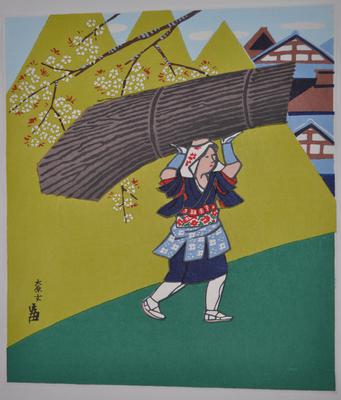
An Oharame Girl Carrying Firewood on Her Head
20th century
Woodblock print, ink and color on paper

April (Arashiyama Park, a Famous Scenic Resort)
四月 (嵐山)
second half 20th century
Woodblock print, ink and color on paper

June (Rainy Scene of the Sen-ke, Japanese Tea Ceremony Founder's House)
六月 (千家雨景)
second half 20th century
Woodblock print, ink and color on paper
More Bridges Prints
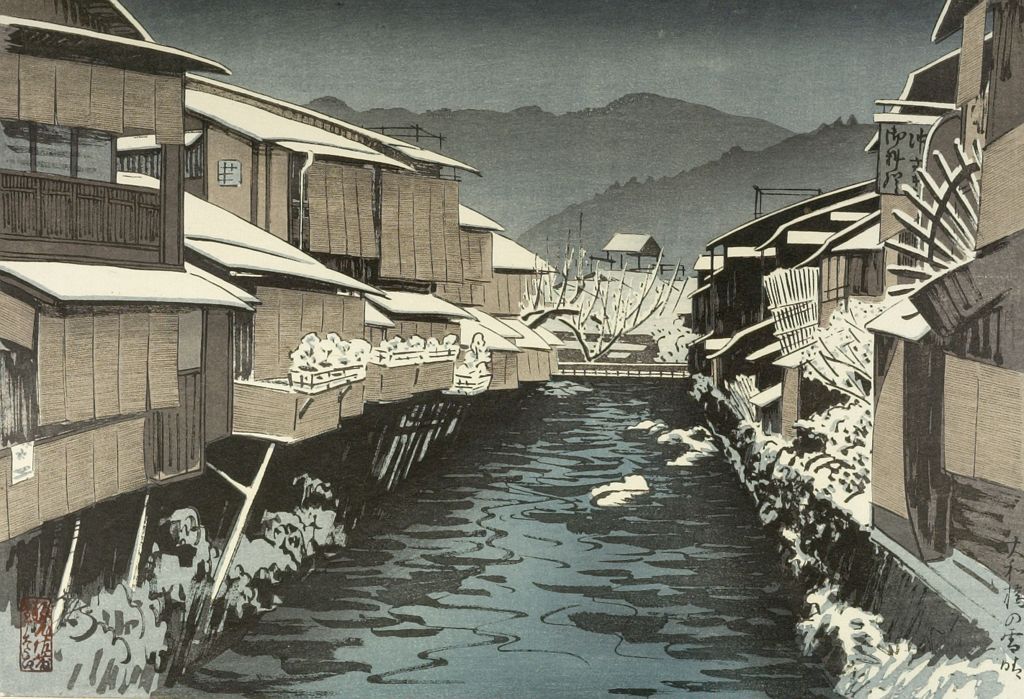
Fair Weather After Snow at Yamato Bridge, Kyoto (Yamato bashi no yukibare), Taishô period, dated 1924
Woodblock print
![Mount Fuji on a Moonlit Night, Kawai Bridge (Tsukiyo no Fuji [Kawaibashi]), from the series "Selection of Views of the Tokaido (Tokaido fukei senshu)" by Kawase Hasui](https://www.artic.edu/iiif/2/d0960668-1e73-339a-b182-fb995a54bff0/full/843,/0/default.jpg)
Mount Fuji on a Moonlit Night, Kawai Bridge (Tsukiyo no Fuji [Kawaibashi]), from the series "Selection of Views of the Tokaido (Tokaido fukei senshu)"
1947
Color woodblock print; oban

Shin Ohashi Bridge (Shin Ohashi), from the series "Twenty View of Tokyo (Tokyu nijukkei)"
1926
Color woodblock print; oban

Sacred Bridge in Nikko (Nikko Shinkyo)
1930
Color woodblock print; oban
Featured in Collections
Curated cross-cuts that include this print.
Frequently Asked Questions
Sanjo Bridge was created by Tomikichiro Tokuriki (徳力富吉郎).
Sanjo Bridge depicts bridges.