
Snow at Kurama
- Medium:
- Mokuhanga (Japanese woodblock)
- Image courtesy of
- Saru Gallery
Description
Mount Kurama rises north of central Kyoto and is the seat of Kuramadera, a temple of mixed esoteric Buddhist and Shinto tradition founded in the eighth century. The mountain is known in winter for the heavy snow that gathers among its cedars and on the steep approach to the temple's main hall. Tokuriki's snow scene likely employs the conventions of yukige imagery in modern Japanese prints: broad reserved areas of unprinted washi to read as accumulated snow, dark sumi or indigo passages defining tree trunks and roof eaves, and bokashi gradations across the sky to suggest a low overcast. The composition fits within his long-running treatment of seasonal Kyoto views, which extended the meisho-e tradition of Hokusai and Hiroshige into the twentieth century. Tokuriki worked across both the shin-hanga and sosaku-hanga modes, and snow subjects of this kind, with their concentrated palette and emphatic tonal contrasts, draw on the technical strengths of mokuhanga in handling broad flat fields against finely carved detail.
More Prints by Tomikichiro Tokuriki
Heian Shrine in the Spring
Woodblock print
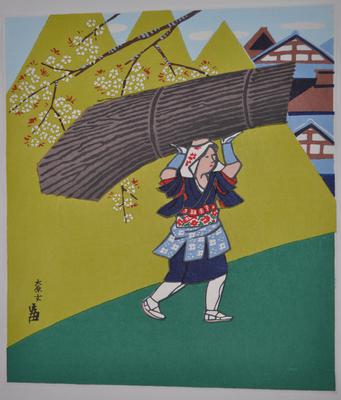
An Oharame Girl Carrying Firewood on Her Head
20th century
Woodblock print, ink and color on paper

April (Arashiyama Park, a Famous Scenic Resort)
四月 (嵐山)
second half 20th century
Woodblock print, ink and color on paper

June (Rainy Scene of the Sen-ke, Japanese Tea Ceremony Founder's House)
六月 (千家雨景)
second half 20th century
Woodblock print, ink and color on paper
More Snow Scenes Prints
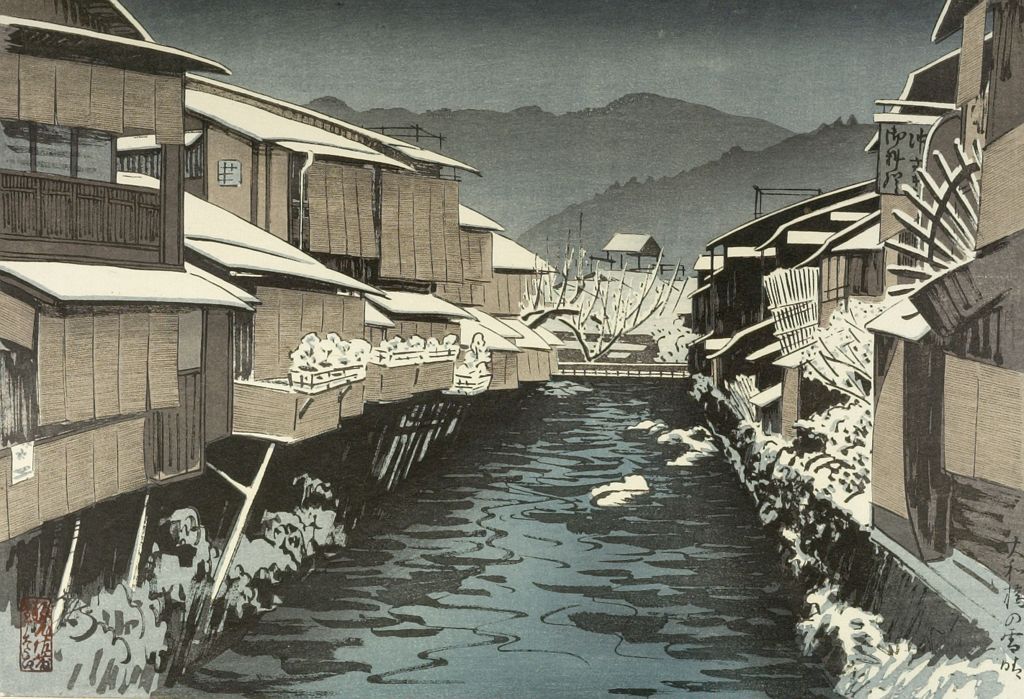
Fair Weather After Snow at Yamato Bridge, Kyoto (Yamato bashi no yukibare), Taishô period, dated 1924
Woodblock print

The Compound of the Tenman Shrine at Kameido in the Snow (Kameido Tenmangu keidai no yuki), from the series "Famous Places in the Eastern Capital (Toto meisho)"
c. 1832/38
Color woodblock print; oban

Miyajima in Snow (Yuki no Miyajima)
Yuki no Miyajima
1929
Color woodblock print; oban
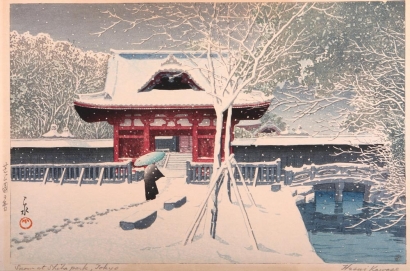
Evening Snow at Shiha Park, Tokyo
1932
Woodblock print
Featured in Collections
Curated cross-cuts that include this print.
Frequently Asked Questions
Snow at Kurama was created by Tomikichiro Tokuriki (徳力富吉郎).
Snow at Kurama depicts snow scenes.