
Sumiyoshi Taisha grand shrine
- Medium:
- Mokuhanga (Japanese woodblock)
- Image courtesy of
- Saru Gallery
Description
Sumiyoshi Taisha in Osaka is one of Japan's older Shinto shrines, distinguished by its Sumiyoshi-zukuri architecture — straight-gabled structures with crossed chigi finials that predate Chinese architectural influence — and by the steeply arched vermilion Sorihashi bridge that crosses its sacred pond. Tokuriki's print most likely centers on the Sorihashi, whose pronounced curve has made it the shrine's defining visual motif, with the bridge's red lacquer registered in saturated impressions against the surrounding greens and the still water beneath. The composition typifies his meisho-e treatment of religious sites, balancing recognizable architecture with seasonal atmosphere generated through bokashi shading on water and sky. As a Kyoto artist deeply engaged with Buddhist and Shinto subjects through both family heritage and personal interest, Tokuriki produced numerous prints of major shrines and temples across the Kansai region. The work sits within the Showa-era continuation of the meisho tradition reaching back to Hokusai and Hiroshige, updated for a twentieth-century audience seeking woodblock images of historically important sites.
More Prints by Tomikichiro Tokuriki
Heian Shrine in the Spring
Woodblock print
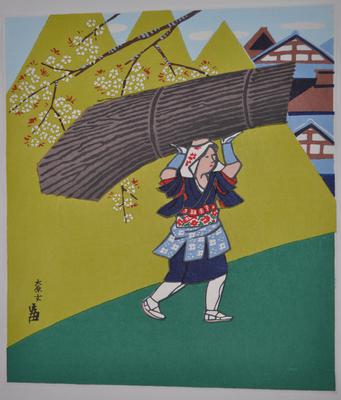
An Oharame Girl Carrying Firewood on Her Head
20th century
Woodblock print, ink and color on paper

April (Arashiyama Park, a Famous Scenic Resort)
四月 (嵐山)
second half 20th century
Woodblock print, ink and color on paper

June (Rainy Scene of the Sen-ke, Japanese Tea Ceremony Founder's House)
六月 (千家雨景)
second half 20th century
Woodblock print, ink and color on paper
More Temples & Shrines Prints
Fushimi Inari Temple
伏見稲荷
Woodblock print

The Compound of the Tenman Shrine at Kameido in the Snow (Kameido Tenmangu keidai no yuki), from the series "Famous Places in the Eastern Capital (Toto meisho)"
c. 1832/38
Color woodblock print; oban
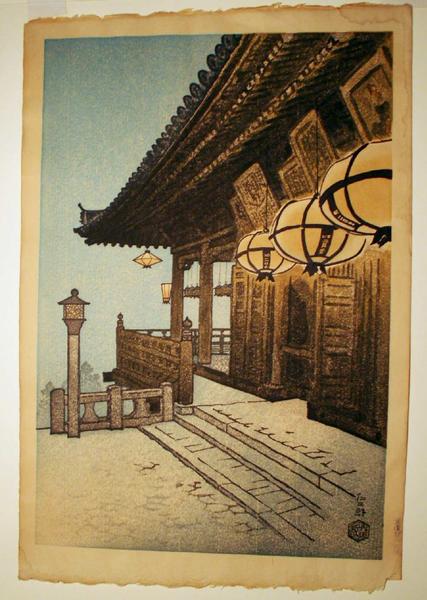
Temple with lanterns
Woodblock print

A Section of the Byodo Temple at Uji (Uji Byodoin no ichibu), from the series "Souvenirs of Travel, Second Series (Tabi miyage dai nishu)"
Uji Byodoin no ichibu
1921
Color woodblock print; oban
Featured in Collections
Curated cross-cuts that include this print.
Frequently Asked Questions
Sumiyoshi Taisha grand shrine was created by Tomikichiro Tokuriki (徳力富吉郎).
Sumiyoshi Taisha grand shrine depicts temples & shrines.