
Summer At Jojuri-ji temple
- Medium:
- Mokuhanga (Japanese woodblock)
- Image courtesy of
- Saru Gallery
Description
A tall stone lantern with an openwork, latticed fire chamber rises from a lily pond, its dark silhouette reflected in the blue-green water among scattered white water lilies and lily pads. Behind it, a bank of green grasses and dark indigo foliage closes off the background beneath a grey sky. Tomikichiro Tokuriki's mokuhanga print "Summer At Jojuri-ji temple" uses flat passages of indigo, jade, and grey with a single band of vermillion accenting the lantern's midsection; the artist's red seal and a vertical column of Japanese characters appear at right, with his signature at lower left.
More Prints by Tomikichiro Tokuriki
Heian Shrine in the Spring
Woodblock print
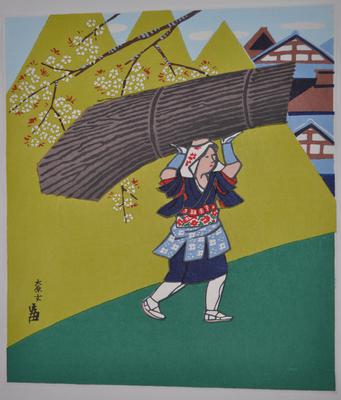
An Oharame Girl Carrying Firewood on Her Head
20th century
Woodblock print, ink and color on paper

April (Arashiyama Park, a Famous Scenic Resort)
四月 (嵐山)
second half 20th century
Woodblock print, ink and color on paper

June (Rainy Scene of the Sen-ke, Japanese Tea Ceremony Founder's House)
六月 (千家雨景)
second half 20th century
Woodblock print, ink and color on paper
More Temples & Shrines Prints
Fushimi Inari Temple
伏見稲荷
Woodblock print

The Compound of the Tenman Shrine at Kameido in the Snow (Kameido Tenmangu keidai no yuki), from the series "Famous Places in the Eastern Capital (Toto meisho)"
c. 1832/38
Color woodblock print; oban
Temple with lanterns
Woodblock print

A Section of the Byodo Temple at Uji (Uji Byodoin no ichibu), from the series "Souvenirs of Travel, Second Series (Tabi miyage dai nishu)"
Uji Byodoin no ichibu
1921
Color woodblock print; oban
Featured in Collections
Curated cross-cuts that include this print.
Frequently Asked Questions
Summer At Jojuri-ji temple was created by Tomikichiro Tokuriki (徳力富吉郎).
Summer At Jojuri-ji temple depicts temples & shrines and summer.