
Temple Of Amon, Luxor
- Medium:
- Mokuhanga (Japanese woodblock)
- Image courtesy of
- Saru Gallery
Description
The Luxor Temple, on the east bank of the Nile in ancient Thebes, was dedicated to the Theban god Amon and built primarily under Amenhotep III and Ramesses II. Tokuriki's depiction of an Egyptian site is unusual within his largely Japan-focused output and suggests participation in the small body of postwar prints in which Japanese artists treated foreign monuments as meisho-e. The composition likely centers on the great colonnade or one of the entrance pylons, rendered through the linear discipline of mokuhanga even as the subject lies far from the genre's traditional repertoire. The translation of weathered sandstone into the language of woodblock printing relies on careful key-block cutting to suggest hieroglyphic relief, with a restrained palette of ochre and brown evoking the stone's color. Such international subjects appeared in Tokuriki's work from the 1950s onward, when increased Japanese travel abroad generated demand for prints documenting heritage sites overseas.
More Prints by Tomikichiro Tokuriki
Heian Shrine in the Spring
Woodblock print
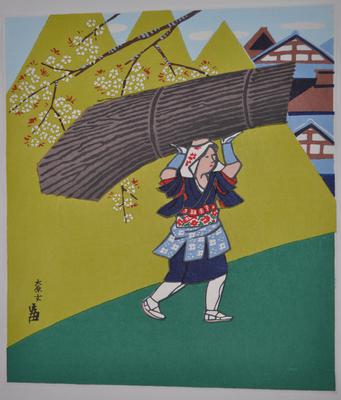
An Oharame Girl Carrying Firewood on Her Head
20th century
Woodblock print, ink and color on paper

April (Arashiyama Park, a Famous Scenic Resort)
四月 (嵐山)
second half 20th century
Woodblock print, ink and color on paper

June (Rainy Scene of the Sen-ke, Japanese Tea Ceremony Founder's House)
六月 (千家雨景)
second half 20th century
Woodblock print, ink and color on paper
More Temples & Shrines Prints
Fushimi Inari Temple
伏見稲荷
Woodblock print

The Compound of the Tenman Shrine at Kameido in the Snow (Kameido Tenmangu keidai no yuki), from the series "Famous Places in the Eastern Capital (Toto meisho)"
c. 1832/38
Color woodblock print; oban
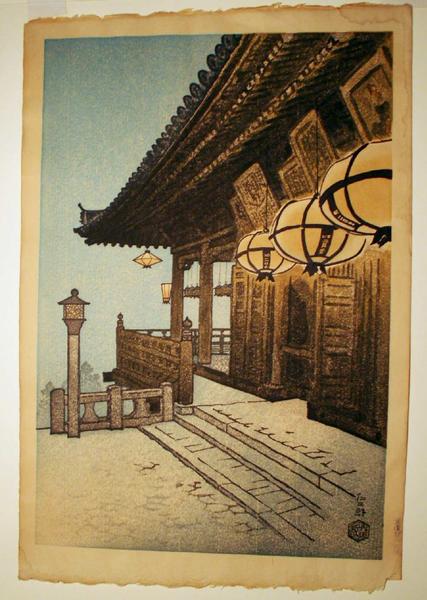
Temple with lanterns
Woodblock print

A Section of the Byodo Temple at Uji (Uji Byodoin no ichibu), from the series "Souvenirs of Travel, Second Series (Tabi miyage dai nishu)"
Uji Byodoin no ichibu
1921
Color woodblock print; oban
Featured in Collections
Curated cross-cuts that include this print.
Frequently Asked Questions
Temple Of Amon, Luxor was created by Tomikichiro Tokuriki (徳力富吉郎).
Temple Of Amon, Luxor depicts temples & shrines.