
Yasukuni Jinsha Shrine
- Medium:
- Mokuhanga (Japanese woodblock)
- Image courtesy of
- Saru Gallery
Description
Yasukuni Shrine in the Kudan district of Tokyo was founded in 1869 to enshrine the spirits of those who died in service of the modern Japanese state, and is approached through a sequence of large torii, including a monumental steel daiichi torii at the entrance. Tokuriki's print likely shows the main approach with its gate, the haiden, or worship hall, in middle distance, and groves of cherry trees that bloom along the precinct in spring. As a meisho-e of a shrine site, the work fits within his extensive treatment of Japanese religious architecture, though the subject extends beyond his characteristic Kyoto temples to a Tokyo institution central to modern national identity. The print's compositional logic—a strong vertical or diagonal axis along the approach, flat washi grounds for sky and gravel, and concentrated detail in the gate's joinery—is typical of twentieth-century shin-hanga shrine views, executed in mokuhanga with bokashi softening the transitions between tonal fields.
More Prints by Tomikichiro Tokuriki
Heian Shrine in the Spring
Woodblock print
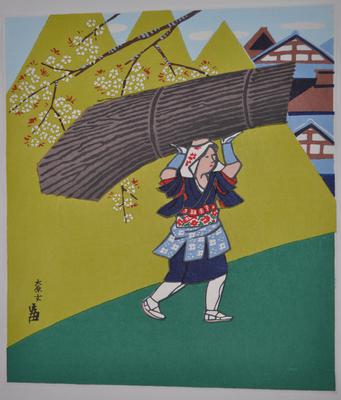
An Oharame Girl Carrying Firewood on Her Head
20th century
Woodblock print, ink and color on paper

April (Arashiyama Park, a Famous Scenic Resort)
四月 (嵐山)
second half 20th century
Woodblock print, ink and color on paper

June (Rainy Scene of the Sen-ke, Japanese Tea Ceremony Founder's House)
六月 (千家雨景)
second half 20th century
Woodblock print, ink and color on paper
More Temples & Shrines Prints
Fushimi Inari Temple
伏見稲荷
Woodblock print

The Compound of the Tenman Shrine at Kameido in the Snow (Kameido Tenmangu keidai no yuki), from the series "Famous Places in the Eastern Capital (Toto meisho)"
c. 1832/38
Color woodblock print; oban
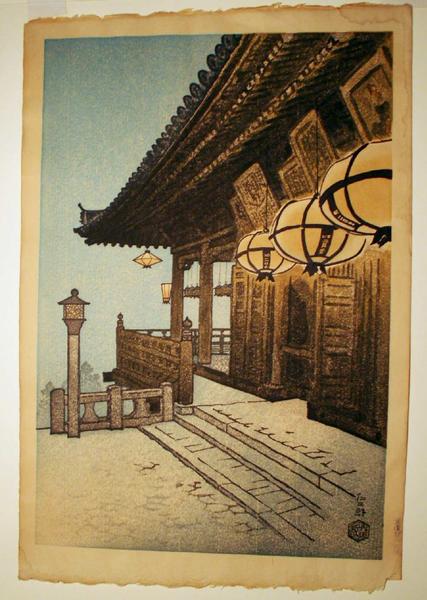
Temple with lanterns
Woodblock print

A Section of the Byodo Temple at Uji (Uji Byodoin no ichibu), from the series "Souvenirs of Travel, Second Series (Tabi miyage dai nishu)"
Uji Byodoin no ichibu
1921
Color woodblock print; oban
Featured in Collections
Curated cross-cuts that include this print.
Frequently Asked Questions
Yasukuni Jinsha Shrine was created by Tomikichiro Tokuriki (徳力富吉郎).
Yasukuni Jinsha Shrine depicts temples & shrines.