Biography
Hiroshi Yoshida (1876–1950) was a Japanese painter and woodblock print artist widely regarded, alongside Kawase Hasui, as one of the greatest artists of the shin-hanga movement. Distinguished by his fusion of Western oil painting techniques with traditional Japanese woodblock printmaking, Yoshida created approximately 260 print designs over his career, many depicting landscapes from his extensive travels across Asia, Europe, and North America.
Born Hiroshi Ueda on September 19, 1876, in Kurume, Fukuoka Prefecture on the island of Kyushu, he came from a family that had been of samurai rank. At age fifteen, his exceptional painting talent was discovered by Kasaburo Yoshida, a junior high school art teacher who, together with his wife Rui, adopted the boy into the Yoshida family. Around 1893, at approximately seventeen, Yoshida traveled to Kyoto to study Western-style oil painting under Tamura Soryu and Miyake Kokki. After two years, he moved to Tokyo and entered the Fudosha, a private painting school run by the leading yoga painter Koyama Shotaro, where he studied for approximately three years. He also joined the Meiji Bijutsukai, the first Western-style art organization in Japan, and established himself as an accomplished oil painter before the age of twenty-five.
Yoshida's extraordinary career was defined by travel. In October 1899, he and fellow painter Nakagawa Hachiro departed for the United States, exhibiting at the Detroit Museum of Art and the Museum of Fine Arts, Boston. The sales success financed onward travel to Europe, where Yoshida attended the Paris Exposition Universelle of 1900 and won a prize. He returned to Japan around 1901 and was among the founders of the Taiheiyo Gakai (Pacific Painting Association), a successor to the Meiji Fine Arts Society. A second major trip to the United States and Europe followed from 1904 to 1907, during which he exhibited at the Rhode Island School of Design and the St. Louis World Exposition, and traveled extensively through Switzerland, Spain, North Africa, and Egypt. Upon his return to Japan in 1907, he married Fujio Yoshida, who was herself a distinguished artist.
Yoshida's transition to woodblock printmaking came around 1920, at the age of forty-four, when he produced his first prints at the Watanabe Print Workshop under the publisher Watanabe Shozaburo. The Great Kanto Earthquake of September 1, 1923, destroyed Watanabe's workshop along with Yoshida's original woodblocks. Following a trip to the United States and Europe from late 1923 through August 1925—partly to raise funds for earthquake victims—Yoshida was deeply impressed by the Western esteem for Japanese woodblock prints. This experience galvanized his commitment to the medium, and in 1925 he established his own independent workshop in Tokyo, employing professional carvers and printers under his direct supervision.
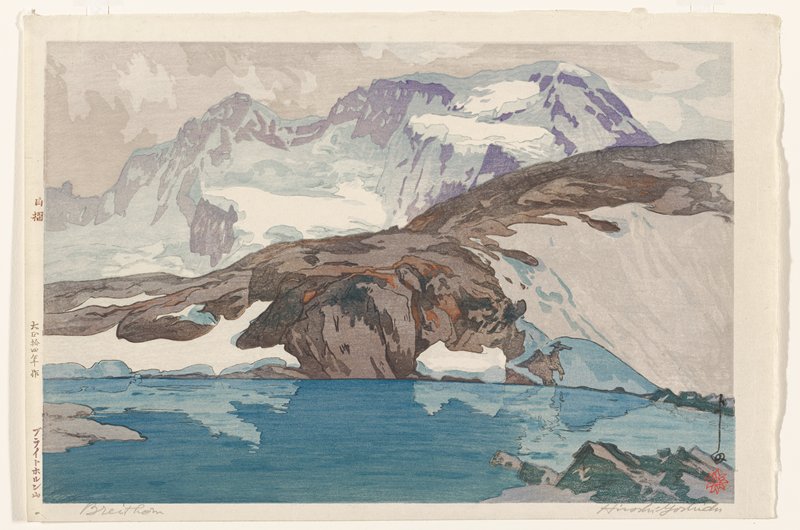
The period from 1925 to 1941 marked Yoshida's peak printmaking years. His 1926 output was especially remarkable — forty-one prints in a single year, the most he ever produced in one year — including several of his most celebrated series. The Twelve Scenes in the Japan Alps, completed in 1926, is considered among his finest achievements, capturing the grandeur of the Japanese mountains he loved and climbed annually for over thirty years. The Seto Inland Sea series, also from 1926, includes the famous Sailing Boats set, in which six prints depict the same maritime scene at morning, forenoon, afternoon, evening, night, and in mist, demonstrating his innovative betsuzuri technique of reusing the same woodblocks with different color schemes to portray changing light conditions. The Ten Views of Mount Fuji, begun in 1926 and completed in 1928, further cemented his reputation as a master landscape artist.
Yoshida's travels continued to inspire major bodies of work. From late 1929 through early 1931, he journeyed through India and Southeast Asia, visiting Agra, Delhi, Jaipur, Lahore, Benares, Madurai, and Ellora. This trip produced thirty-two prints including six celebrated variations of the Taj Mahal shown at different times of day. A 1936 sketching trip to Korea and Manchuria with his son Toshi yielded five additional works the following year.
Yoshida's artistic approach occupied a unique position between the shin-hanga and sosaku-hanga movements. While he employed professional carvers and printers in the traditional collaborative model of shin-hanga, he supervised every step of production personally and occasionally carved blocks himself to better understand and direct the craft. He applied a jizuri seal to prints made under his direct supervision as a guarantee of quality, and signed his prints in pencil in the Western manner. His style blended French Impressionist light and color with Japanese woodcut methods, and he was particularly fascinated by how lighting transformed landscapes at different times of day. He experimented with oversized prints as large as fifty-five by eighty-four centimeters and tried different papers, silk printing, alternative woods, and zinc plates.
During the Second World War, Yoshida served as an official war painter for the Japanese Department of Military Affairs, making three trips to central China in 1938, 1939, and 1940. No new prints were produced during the war years, and in his final years he largely set aside printmaking to continue painting in oils and watercolors until his death.
The Yoshida family represents one of the most influential artistic dynasties in Japanese printmaking, spanning four generations. His wife Fujio was a distinguished artist in her own right. His eldest son, Toshi Yoshida, inherited the family studio and became a prominent printmaker. His second son, Hodaka Yoshida, pursued a more abstract artistic direction, and subsequent generations including Hodaka's wife Chizuko and daughter Ayomi continued the family tradition.
Yoshida fell ill during a final sketching trip to Izu in 1949 and died on April 5, 1950, at his home in Tokyo. He is buried at Ryuun-in Temple in Koishikawa. His works are held in collections worldwide, including the Metropolitan Museum of Art, the British Museum, the Art Institute of Chicago, the Museum of Fine Arts Boston, and the National Museum of Modern Art in Tokyo. His unique hybrid approach to printmaking—bridging East and West, traditional and modern—continues to influence artists and captivate collectors around the world.
Key Facts
- Active Period
- 1876–1950
- Nationality
- 🇯🇵Japan
- Movement
- Shin-hanga
- Works Indexed
- 334
Frequently Asked Questions
Hiroshi Yoshida (1876–1950) was a Japanese painter and woodblock print artist widely regarded, alongside Kawase Hasui, as one of the greatest artists of the shin-hanga movement. Distinguished by his fusion of Western oil painting techniques with traditional Japanese woodblock printmaking, Yoshida created approximately 260 print designs over his career, many depicting landscapes from his extensive travels across Asia, Europe, and North America.
Hiroshi Yoshida was active from 1876 to 1950. They were associated with the Shin-hanga movement.
Hiroshi Yoshida's work was shaped by the Shin-hanga tradition in Japanese woodblock printmaking. Shin-hanga: ## What is Shin-hanga? Shin-hanga (新版画), literally "new prints," is the early twentieth-century revival of the collaborative Japanese woodblock workshop, organized between roughly 1915 and 1960 by the Tokyo publisher Watanabe Shōzaburō (1885–1962) and a handful of competing houses.
Hiroshi Yoshida's prints frequently feature landscapes, rivers & lakes, seascapes, mountains, night scenes, temples & shrines.
Original prints by Hiroshi Yoshida can be found in collections including ukiyo-e.org, Minneapolis Institute of Art, Art Gallery of Greater Victoria, Japanese Art Open Database.
Based on 2055 recorded auction sales from 2009–2025, most Hiroshi Yoshida prints sold in the $325–$900 range, with a median around $550. Top results exceeded $1,600. Actual prices vary widely with edition, condition, and subject.
External Resources
Series by Hiroshi Yoshida
Europe
1925–1925
Ten Views of Mount Fuji
1926–1928 · 10 prints
Seto Inland Sea
1926–1926 · 6 prints
Twelve Scenes of Tokyo
1926–1928 · 12 prints
Twelve Scenes of Japanese Alps
1926–1926 · 12 prints
India and Southeast Asia
1931–1931
Eight Scenes of Cherry Blossoms
1935–1935 · 8 prints
At the Zoological Garden
2 prints
Abuto
1 print
Kansai District
Twelve Themes from the Japan Alps
1 print
Hotei #85
1 print
Sailboat Boats
1 print
Woodblock Prints by Hiroshi Yoshida (334)

Bamboo Wood
1939
Color woodblock print

Koko
1939
Color woodblock print

Lushan
1939
Woodblock print, ink and color on paper
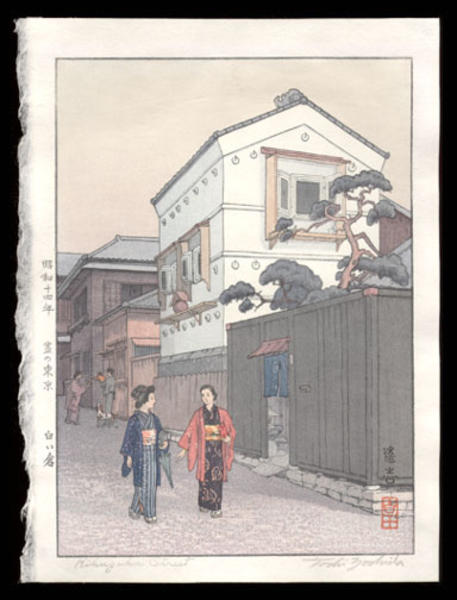
Kikuzaka Street
1939
Woodblock print
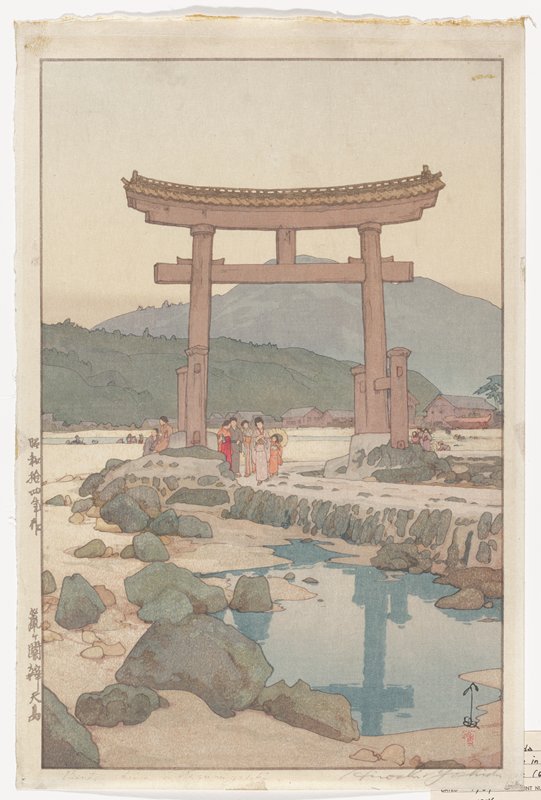
Benten Torii at Nezugaseki
1939
Woodblock print, ink and color on paper

Shokozan
1939
Color woodblock print
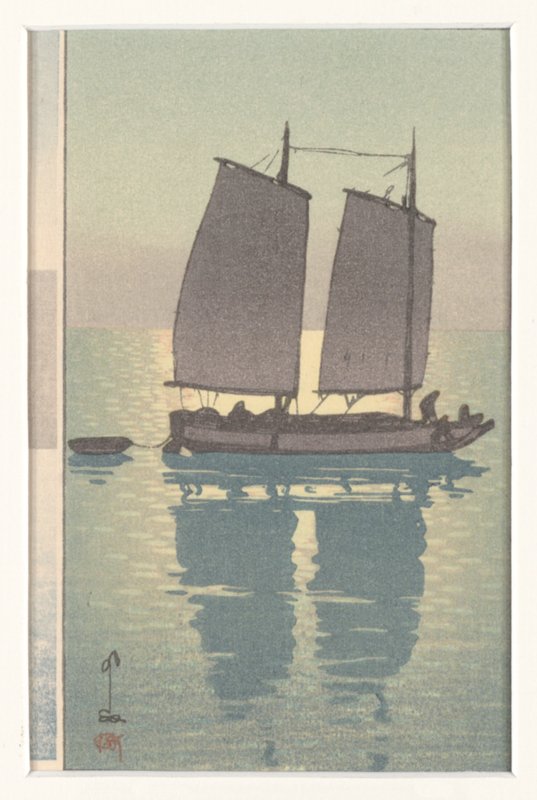
A Junk, printing order no. 2
1939
Woodblock print, ink and color on paper
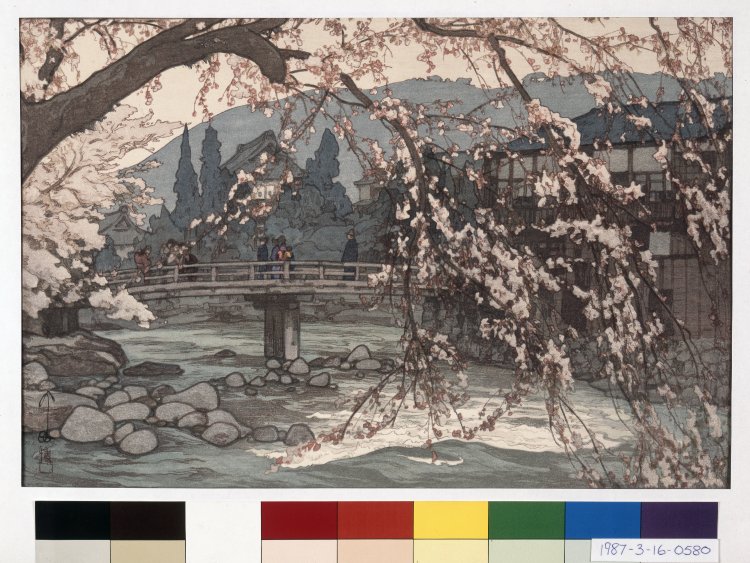
Spring at a Spa
1940
Woodblock print

Diabutsu Temple Gate
1940
Color woodblock print
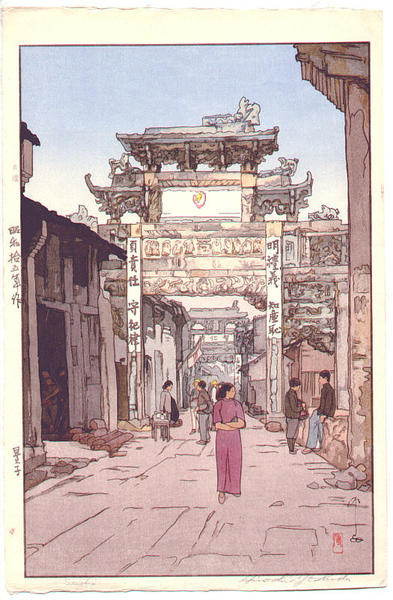
Seishi
1940
Woodblock print

A Spa in Spring
1940
Color woodblock print
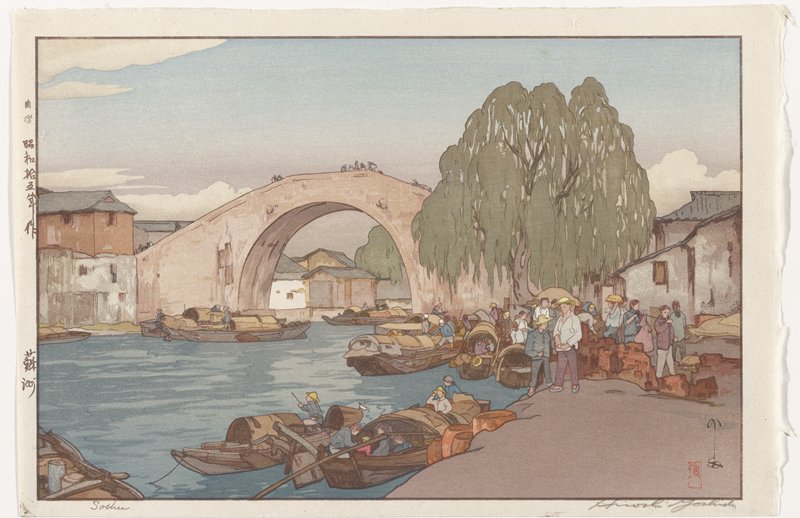
Suzhou
1940
Woodblock print, ink and color on paper
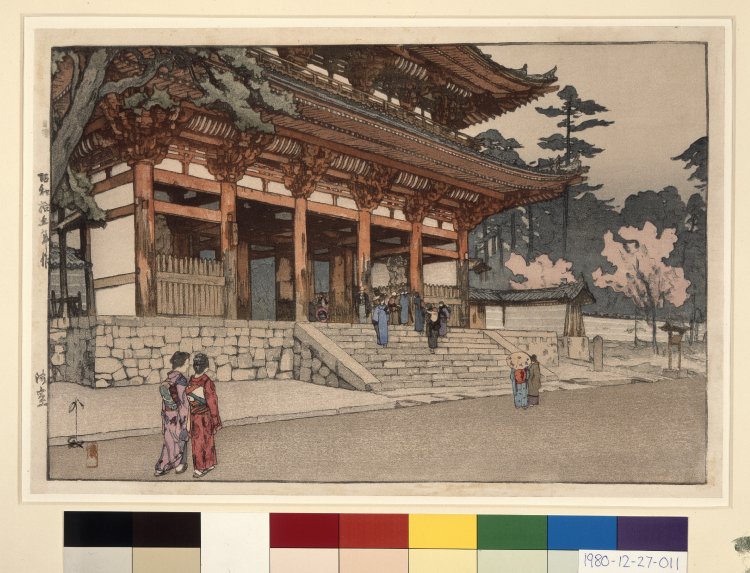
Omuro
Woodblock print

Grapes and Apples (Budo to ringo)
Budo to ringo
1940
Color woodblock print
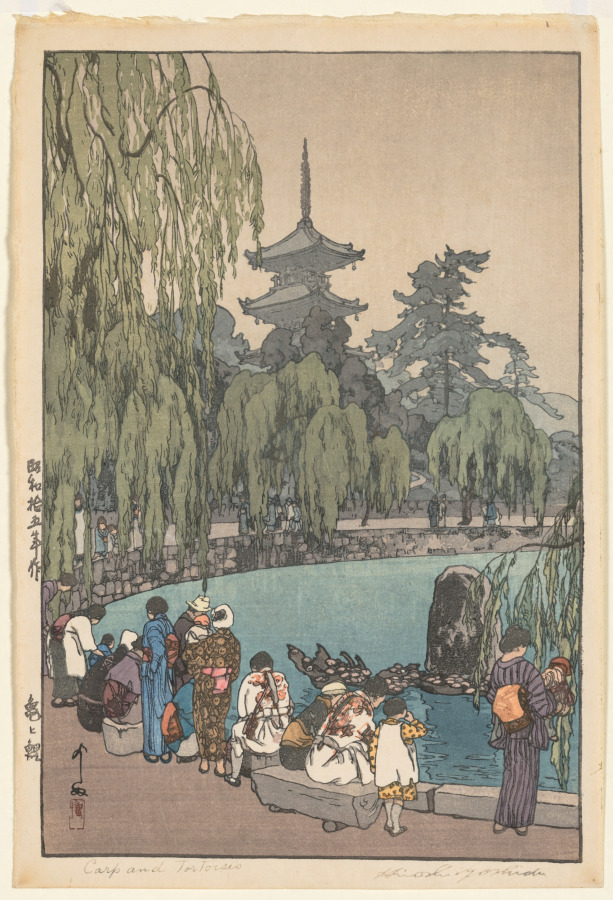
Carp and Tortoises
after 1940
Color woodblock print

Little Harbor
1941
Woodblock print, ink and color on paper
Park in Canton
1941
Woodblock print

An Osaka Canal
1941
Woodblock print, ink and color on paper

A Park in Guangzhou
1941
Woodblock print, ink and color on paper
Sanko Island
1941
Woodblock print

New Moon
1941
Color woodblock print
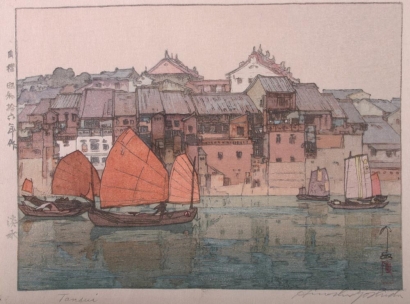
Tansui
1941
Woodblock print
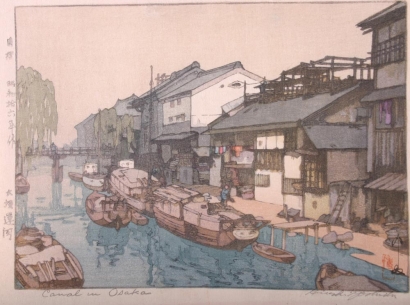
Canal in Osaka
1941
Woodblock print
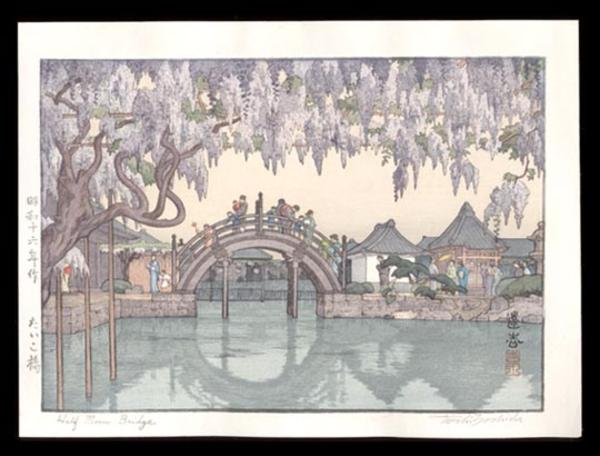
Half Moon Bridge
1941
Woodblock print
Signature Techniques
Mokuhanga techniques most associated with Hiroshi Yoshida.
Compare With
Yoshida and Hasui were the two defining shin-hanga landscape artists; comparing their treatments of the same subjects rewards close study.