
Biography
Ishikawa Toyonobu (1711-1785) stands as one of the most graceful and influential figures of mid-Edo ukiyo-e, a master of bijin-ga whose elegant figural compositions bridge the primitive vigor of early urushi-e and the polychromatic refinement that would soon transform Japanese woodblock prints. Working at the precise hinge moment when ukiyo-e shifted from monochrome and hand-colored sheets toward true color printing, Toyonobu produced a body of work that defines the Edo print aesthetic of the 1740s and 1750s: tall, statuesque beauties rendered with long sinuous lines, hashira-e pillar prints whose narrow proportions force inventive compositional solutions, and benizuri-e color woodblock prints whose pink-and-green tonal economy remains one of the great chromatic signatures of the entire ukiyo-e tradition.
Born in Edo in 1711, Toyonobu belonged to the merchant world of the rapidly expanding Tokugawa capital; by his common name Nukaya Shichibei he was the proprietor of a lodging house, and he appears to have pursued print design as an artistic vocation alongside that trade rather than as a strictly commercial craft. He trained under Nishimura Shigenaga, a versatile and influential Edo designer of the Kyoho era whose pupils helped shape the next generation of the city's print scene. From Shigenaga he absorbed the tall, slender figural ideal that would become his hallmark, along with a sophisticated approach to interior space, screen compositions, and the elegant deployment of textile patterns. Early prints signed Nishimura Shigenobu are traditionally attributed to him as well, though scholars differ over whether Shigenobu and Toyonobu were truly the same hand; by the late 1740s he was signing his work Ishikawa Toyonobu, the name by which he is known today.
Toyonobu's output spans the most consequential decades of mid-Edo ukiyo-e. His earliest works of the late 1730s and early 1740s are hand-colored prints in the urushi-e and beni-e modes, where the printed black outlines were enriched with brushed pigments and the lustrous black lacquer-like accents that gave urushi-e its name. He took with particular enthusiasm to the hashira-e, or pillar print, a tall narrow format roughly 70 by 12 centimeters intended for display on the supporting pillars of Edo town houses. The hashira-e demanded compositional invention: figures had to be elongated, cropped, or stacked in ways that violated conventional proportions but generated the rhythmic vertical elegance for which Toyonobu became famous. His habahiro hashira-e, wide pillar prints, allowed somewhat more breathing room and let him develop full-length bijin and beautiful young men in a format perfectly suited to interior architecture.
The pivotal technical development of Toyonobu's career was the rise of benizuri-e in the mid-to-late 1740s. Benizuri-e employed two or three printed colors, characteristically a rose pink derived from safflower (beni) paired with grass green or yellow, replacing the laborious hand-coloring of earlier prints with a true multi-block printing technique. Toyonobu was among the first generation of designers to embrace this innovation, and his benizuri-e sheets of the late 1740s and 1750s remain canonical examples of the form. The kento registration guides that made such multi-block color printing possible helped establish the working standards that would underpin Suzuki Harunobu's full nishiki-e revolution of 1765.
The Edo demimonde supplied Toyonobu's most enduring subjects. Courtesans of the Yoshiwara licensed quarter, reading letters or holding pipes, and beautiful young men of the kabuki stage figure repeatedly in his work. Among his actor subjects was Sanogawa Ichimatsu I, the celebrated young onnagata whose checkered kimono pattern gave Japanese the word ichimatsu, still used for the checkerboard motif today. Prints of this kind capture the cross-gender allure that defined mid-eighteenth-century kabuki and the fashion world of wakashu youths. Toyonobu also worked in the sanpukutsui format of three related sheets, organizing his beauties into the loose triadic compositions that would influence later designers from Harunobu through Kiyonaga.
Unlike the prolific Torii designers, Toyonobu worked at a measured pace and concentrated on single-sheet prints and the demanding hashira-e format rather than on illustrated books. His output diminished sharply in the mid-1760s, just as the nishiki-e revolution was beginning, and he appears to have withdrawn from active print design as the new generation around Harunobu took over the field following the appearance of the full-color print in 1765. He lived roughly two more decades and died in 1785.
The reputation of Ishikawa Toyonobu is firmly established in the canon of Japanese woodblock prints. His works are held in major collections including the Art Institute of Chicago, the Museum of Fine Arts in Boston, the Metropolitan Museum of Art, the British Museum, and the Honolulu Museum of Art. Connoisseurs prize his hashira-e for their inventive vertical compositions, his urushi-e for their gem-like hand coloring, and his benizuri-e for the chromatic restraint that makes the pink-and-green palette feel both archaic and inexhaustibly modern. Among collectors of mid-Edo ukiyo-e, his prints are essential, and his influence on the generations that followed, from Suzuki Harunobu's nishiki-e beauties to Torii Kiyonaga's stately processions, secures his standing as one of the foundational masters of the Japanese print tradition.
Key Facts
- Active Period
- 1711–1785
- Nationality
- 🇯🇵Japan
- Movement
- Ukiyo-e
- Subjects
- Birds & FlowersSummer
- Works Indexed
- 35
Frequently Asked Questions
Ishikawa Toyonobu (1711-1785) stands as one of the most graceful and influential figures of mid-Edo ukiyo-e, a master of bijin-ga whose elegant figural compositions bridge the primitive vigor of early urushi-e and the polychromatic refinement that would soon transform Japanese woodblock prints. Working at the precise hinge moment when ukiyo-e shifted from monochrome and hand-colored sheets toward true color printing, Toyonobu produced a body of work that defines the Edo print aesthetic of the 1740s and 1750s: tall, statuesque beauties rendered with long sinuous lines, hashira-e pillar prints whose narrow proportions force inventive compositional solutions, and benizuri-e color woodblock prints whose pink-and-green tonal economy remains one of the great chromatic signatures of the entire ukiyo-e tradition.
Ishikawa Toyonobu was active from 1711 to 1785. They were associated with the Ukiyo-e movement.
Ishikawa Toyonobu's work was shaped by the Ukiyo-e tradition in Japanese woodblock printmaking. Ukiyo-e: ## What is ukiyo-e? Ukiyo-e ([浮世絵](/glossary/ukiyo-e)) — literally "pictures of the floating world" — is the Edo-period Japanese print and painting tradition that flourished from roughly 1660 to 1868, depicting the pleasures of urban life in Edo (modern Tokyo): courtesans, kabuki actors, sumo wrestlers, famous landscapes, and seasonal beauties.
Ishikawa Toyonobu's prints frequently feature birds & flowers, summer.
Original prints by Ishikawa Toyonobu can be found in collections including Art Institute of Chicago, Metropolitan Museum of Art, Cleveland Museum of Art, Victoria and Albert Museum.
Woodblock Prints by Ishikawa Toyonobu (35)
A Young Couple Visiting a Shrine
18th century
Color woodblock print; hashira-e

Young Man on a Horse
c. 1760s
Color woodblock print; oban

The Yoshiwara in Edo - A Set of Three (Edo Yoshiwara sanpukutsui)
c. 1736/44
Hand-colored woodblock print; left sheet of toku-oban triptych, beni-e

Young Woman Reading Tanzaku Tied to a Cherry Tree
c. 1741
Hand-colored woodblock print; kakemono-e, urushi-e

Young Woman and Hotei
c. 1741
Hand-colored woodblock print; wide hashira-e, sumizuri-e
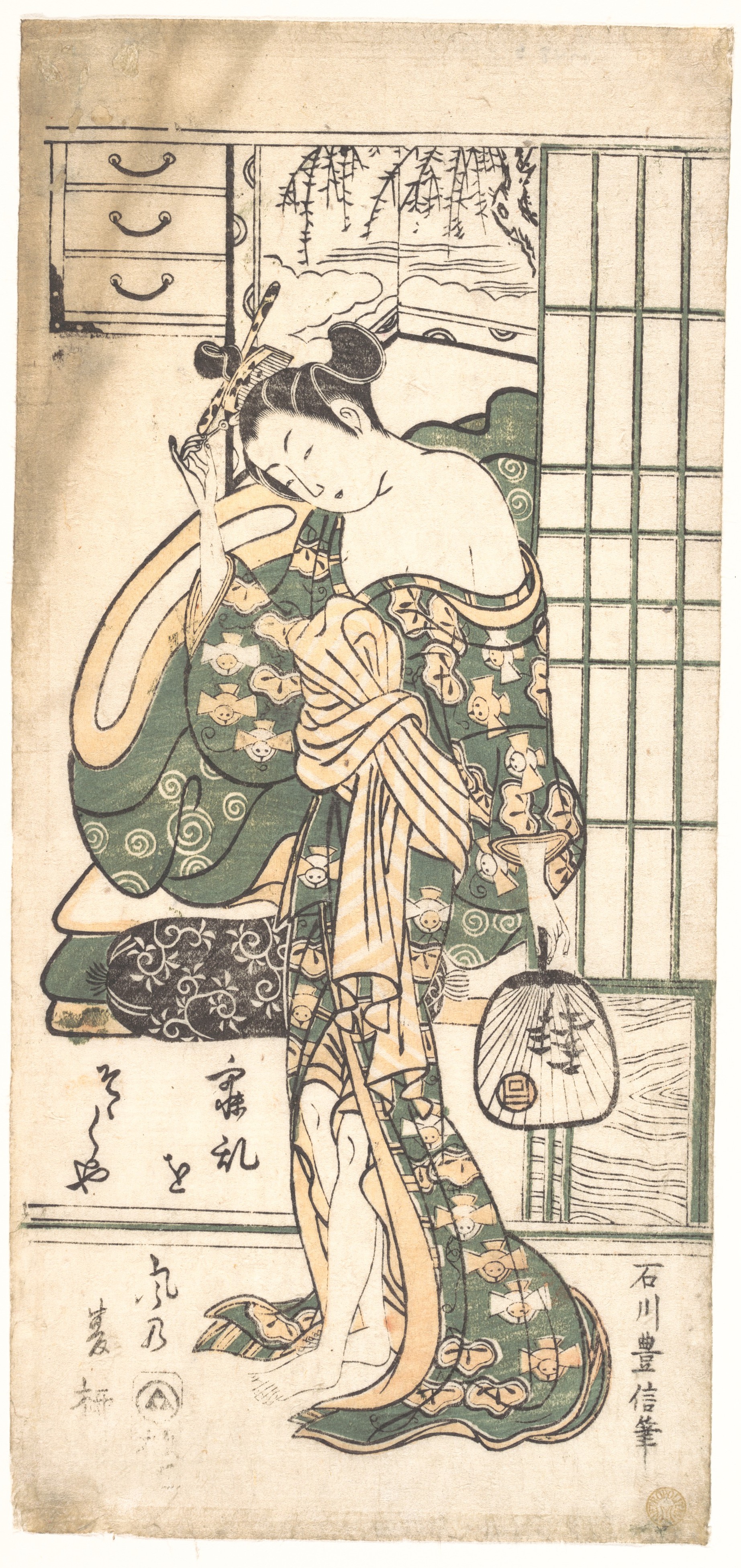
Summer Willow in the Breeze
ca. 1748
Woodblock print; ink and color on paper

The Shop of Sanogawa Ichimatsu
c. 1743
Color woodblock print; oban yoko-e, benizuri-e

Courtesan Holding a Long Pipe
c. 1743
Hand-colored woodblock print; habahiro hashira-e
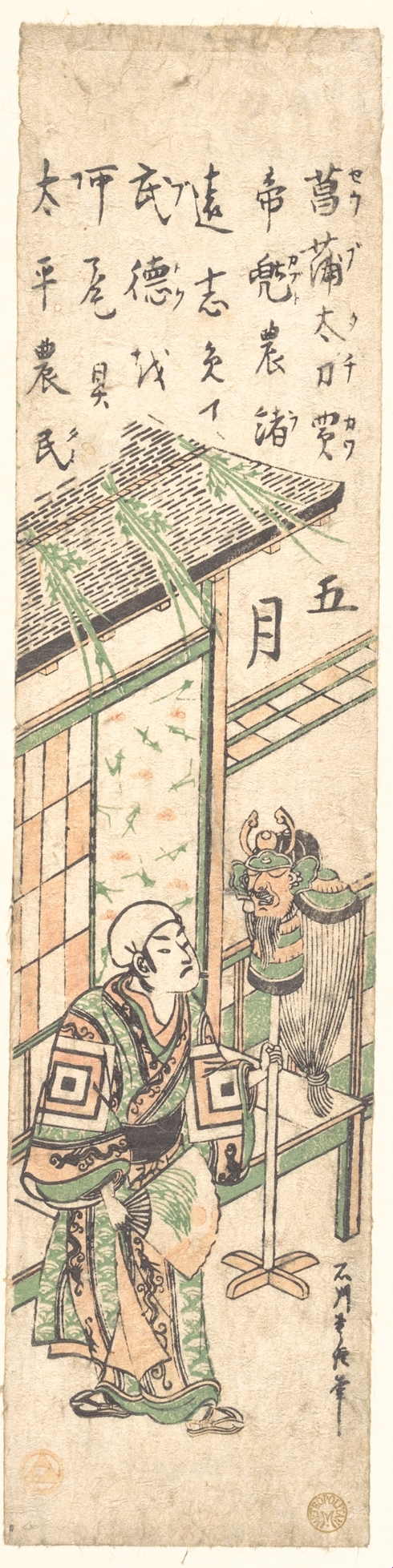
The Fifth Month
ca. 1748
Woodblock print; ink and color on paper

Youth Carrying a Lantern and an Umbrella
1740s
Hand-colored woodblock print; hashira-e, beni-e

Young Woman with Umbrella
c. 1740s
Hand-colored woodblock print; wide hashira-e, urushi-e

The Actor Onoe Kikugoro I holding a puppet of the Actor Sanogawa Ichimatsu I
c. 1740s
Hand-colored woodblock print; vertical oban diptych, sumizuri-e

Woman Writing a Letter in Front of a Screen
early 1740s
Hand-colored woodblock print; hashira-e, sumizuri-e

Young Woman after a Bath
c. 1745
Hand-colored woodblock print; wide hashira-e, beni-e

The Actors Sanogawa Ichimatsu I and Segawa Kikunojo I as lovers under an umbrella
c. 1740s
Color woodblock print; oban, benizuri-e

A Courtesan Holding a Lantern and a Fan
c. 1745
Hand-colored woodblock print; wide hashira-e, urushi-e

Courtesan of Osaka and Her Attendant, left sheet of a triptych of beauties of the three capitals (Sanpukutsui Osaka hidari)
c. 1745
Hand-colored woodblock print; wide hashira-e, beni-e
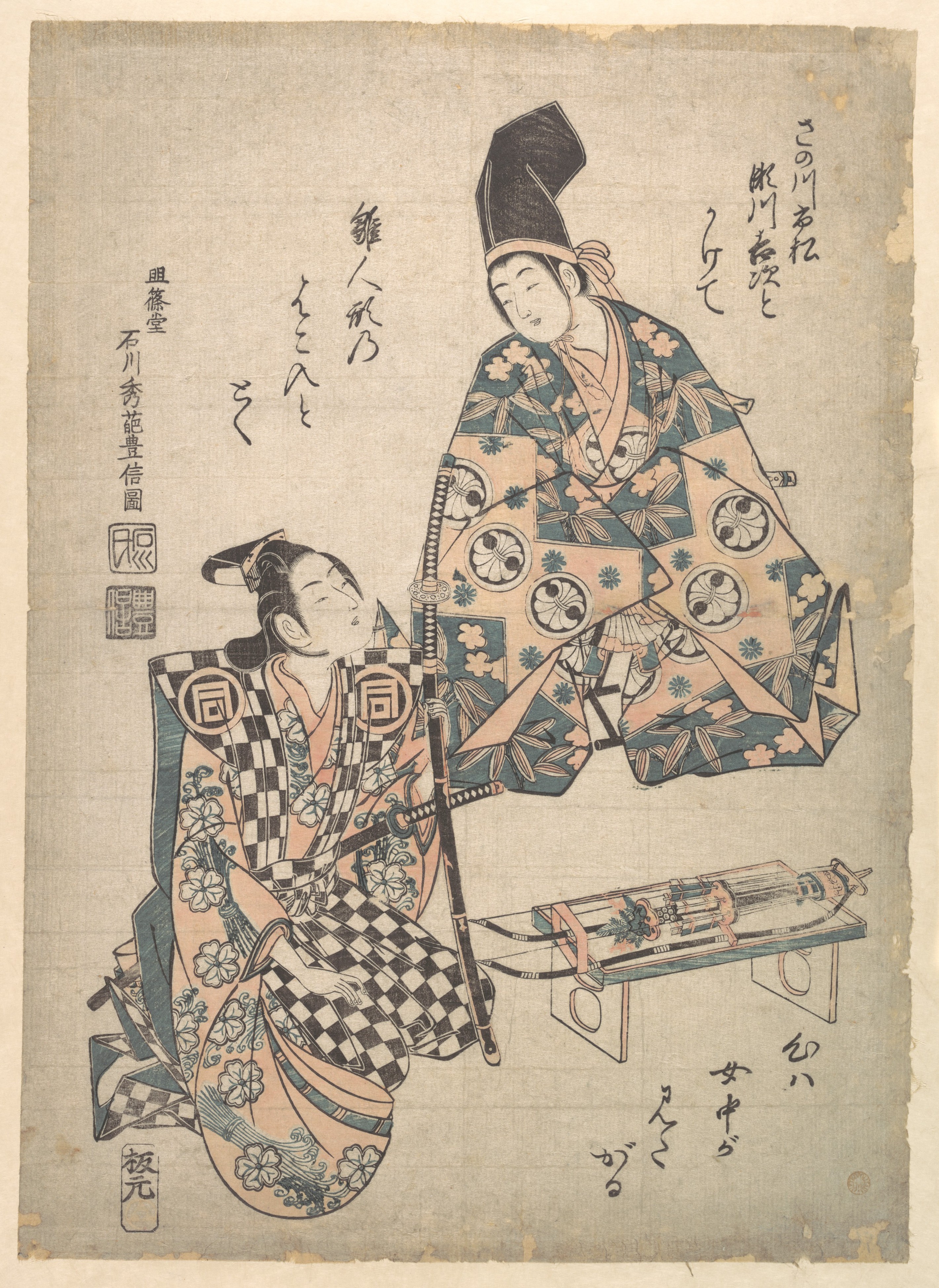
The Actor Segawa Kichiji as a Daimyo's Young Son, and Sanogawa Ichimatsu as a Samurai Attendant
ca. 1750
Woodblock print; ink and color on paper

Courtesan Reading a Letter
c. 1745
Hand-colored woodblock print; toku-oban, urushi-e
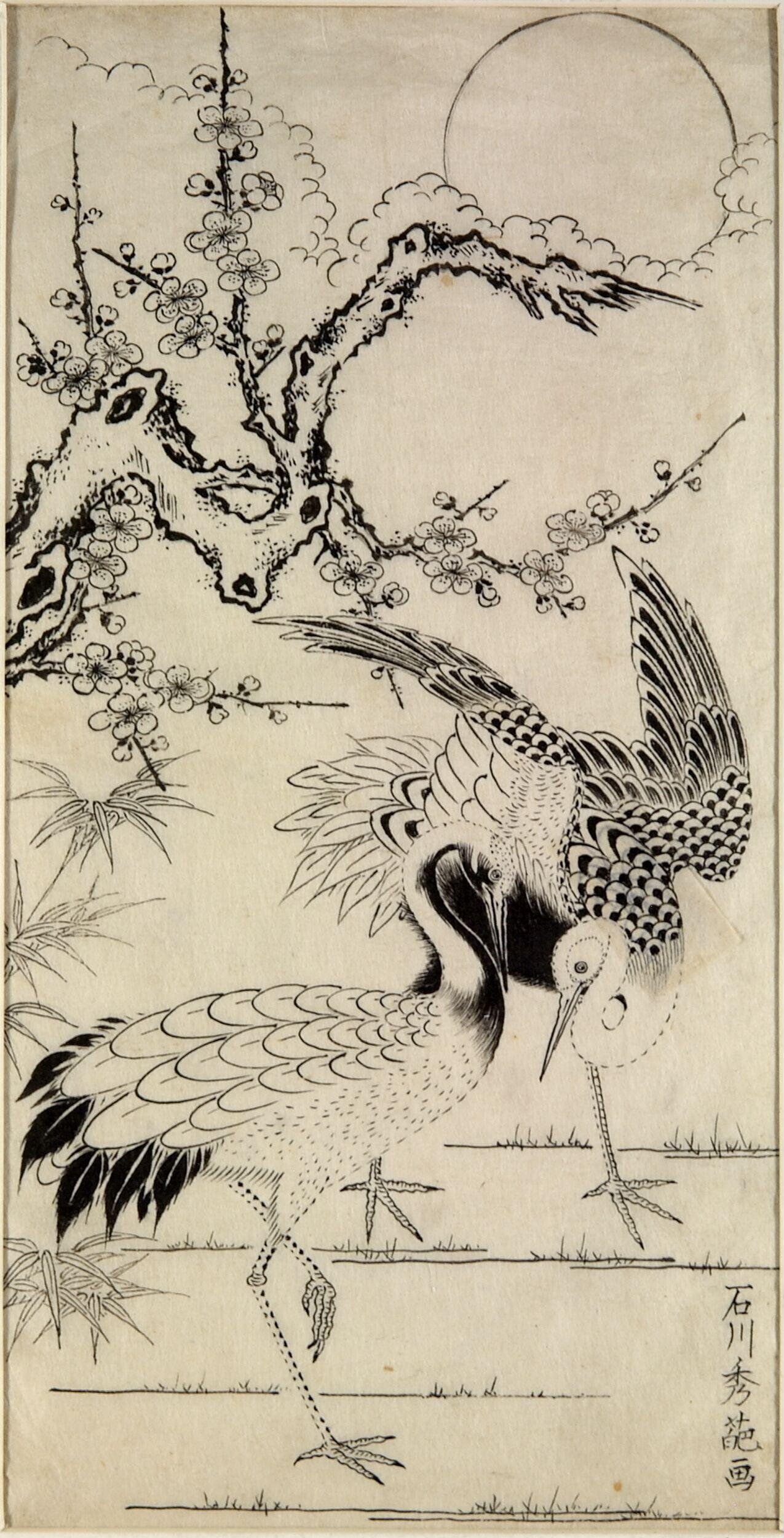
Two Cranes and a Plum Tree
ca.1741 to ca.1764

The Actor Segawa Kikunojo I as a courtesan
c. 1747
Hand-colored woodblock print; vertical oban diptych, beni-e
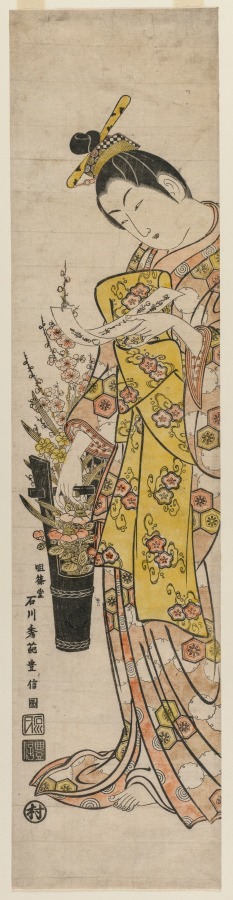
Courtesan Reading a Poem Slip Tied to Flowers in a Vase
mid-1740s
color woodblock print

The Actor Sanogawa Ichimatsu I as a young man holding an umbrella and a lantern
c. 1748
Hand-colored woodblock print; toku-oban, beni-e

The Actor Sanogawa Ichimatsu I as Hisamatsu
c. 1748
Hand-colored woodblock print; habahiro hashira-e, urushi-e