Biography
Keisuke Yamamoto (born 1961) is a Japanese lithographer whose mature practice has been organized since the early 1990s around a single sustained title — "Light, Time, Silence" — a series of monochrome stone lithographs that takes wooden chairs, staircases, doorways, and other quietly inhabited interior architecture as its principal subject. The series was begun in 1992 and is still ongoing, growing into a long sequence of numbered variations on the title, and he works in parallel on related bodies of monochrome interior and landscape prints.
Yamamoto trained in oil painting rather than printmaking, studying oil painting at Kanazawa College of Art, and took up lithography afterwards through training at a print studio. The discipline of working from stone — where the drawn marks cannot easily be revised once made — has shaped the deliberate, planning-heavy character of his practice; as he has put it, lithography allows no redos and demands a great deal of systematic planning. He has described his aim as rendering not the depicted objects themselves but the air, time, and light surrounding them, a phrase that captures the mood of his empty interiors and unoccupied chairs.
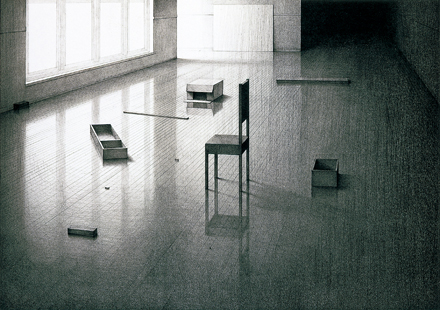
The "Light, Time, Silence" compositions are typically vertical or square monochrome lithographs rendered in soft greys and blacks on cream paper; the printed image often centres on a single domestic object — a wooden chair, a staircase landing, an arched cloister — set within an architectural frame rendered with the same careful tonal modelling. The idea of "time" to which the title refers is conveyed through the gradation of light, tracing its slow course from a bright source into the surrounding darkness. The cumulative effect is close to a still photograph: the suggestion that the room held a person a moment ago, who might be about to return but is for now absent.
Yamamoto's work is held in institutional collections including the print archive of the Pyramid Atlantic Art Center, and in the United States he is represented by Gallery No.85 in Seattle (formerly Davidson Galleries), which carries his "Light, Time, Silence" series and related work. His lithographs have also been written about in the online architecture journal Socks Studio. He continues to live and work in Kyoto, where he maintains an atelier producing hand-drawn stone lithographs.
Within contemporary Japanese lithography Yamamoto occupies a quiet but distinctive position: a printmaker working in monochrome on a sustained single-series project whose interiors of empty wooden chairs and architectural details have a meditative, contemplative quality reminiscent of the paintings of Vilhelm Hammershøi, the still lifes of Giorgio Morandi, and the architectural photography of Hiroshi Sugimoto. His decision to focus on a single mature subject over three decades, refining variations within a tightly constrained compositional vocabulary, distinguishes him from printmakers of his generation working in more graphic or chromatically diverse modes.
Key Facts
- Active Period
- 1961
- Nationality
- 🇯🇵Japan
- Movement
- Contemporary Mokuhanga
- Works Indexed
- 24
Frequently Asked Questions
Keisuke Yamamoto (born 1961) is a Japanese lithographer whose mature practice has been organized since the early 1990s around a single sustained title — "Light, Time, Silence" — a series of monochrome stone lithographs that takes wooden chairs, staircases, doorways, and other quietly inhabited interior architecture as its principal subject. The series was begun in 1992 and is still ongoing, growing into a long sequence of numbered variations on the title, and he works in parallel on related bodies of monochrome interior and landscape prints.
Keisuke Yamamoto was active born in 1961. They were associated with the Contemporary Mokuhanga movement.
Keisuke Yamamoto's work was shaped by the Contemporary Mokuhanga tradition in Japanese woodblock printmaking. Contemporary Mokuhanga: Contemporary mokuhanga (literally "wood-block print") encompasses artists working from approximately 1970 to the present who continue or reinvent traditional Japanese woodblock printing techniques.
Keisuke Yamamoto's prints frequently feature still life, landscapes, trees, architecture.
Woodblock Prints by Keisuke Yamamoto (24)
Light, Time, Silence No.15
光、時間、静寂 NO.15
Lithograph

Light Time Silence #18
Lithograph

Light Time Silence #26
Lithograph

The Sunshine Filtering through Foliage #2
Lithograph

A Cloister
Lithograph

Sea Breeze B
Lithograph

Sea Breeze C
Lithograph

Two Chairs #3
Lithograph

Light Time Silence m - E
Lithograph

Light Time Silence #12
Lithograph

Light Time Silence #15
Lithograph

Light Time Silence #23
Lithograph

Light Time Silence #25
Lithograph

Light Time Silence #27
Lithograph

Light Time Silence #28
Lithograph

Light Time Silence #30
Lithograph

Light Time Silence M - C
Lithograph

Nostalgic Scenery #1
Lithograph

The Sunshine Filtering Through Foliage #3
Lithograph

The Sunshine Filtering Through Foliage #4
Lithograph

The Sunshine Filtering through Foliage #5
Lithograph

Apple Tree
Lithograph

Sea Breeze A
Lithograph

Staircase J
Lithograph