
Biography
Totoya Hokkei (1780-1850) ranks among the most prolific and technically refined surimono designers of the late Edo period, a leading figure of the Hokusai school whose privately commissioned prints helped set the standard for the genre during its golden age. He was born in Edo in 1780 as Iwakubo Tatsuyuki, and his early life unfolded not in an artist's studio but behind the counter of a fishmonger's shop, a plebeian background preserved in his art name, since "Totoya" literally means "fish seller." He carried this trade-name throughout his career, affixing it beneath some of the most luxurious privately printed images ever produced in Japan.
Hokkei's artistic education began with study under the Kano-school painter Kano Yosen'in Korenobu, head of the Kobikicho branch of the Kano school. His direction changed decisively, however, when he entered the studio of Katsushika Hokusai around the turn of the nineteenth century, becoming one of Hokusai's first and best-known pupils. He absorbed his master's restless curiosity about the natural world, classical literature, popular theater, and the technical possibilities of the woodblock medium. Where Hokusai pursued public-edition landscapes and figure prints with broad commercial appeal, Hokkei increasingly specialized in surimono, the privately commissioned deluxe prints that flourished in Edo's kyoka poetry circles during the first decades of the nineteenth century.
Surimono occupied a unique position in the Japanese print world. Commissioned by amateur poets, samurai households, merchant clubs, and theatrical fan groups rather than published for the open market, these small editions allowed designers, blockcarvers, and printers to push the technical envelope without commercial constraint. The near-square shikishiban format, a sheet roughly 21 by 18 centimeters, became Hokkei's preferred canvas. Working with the finest paper, deep pigments, lavish metallic dusting in gold and silver, and gauffrage embossing that gave the prints sculptural texture, he produced designs that paired refined imagery with kyoka verses inscribed in elegant calligraphy. The collaboration between poet patrons and artist was intimate: his compositions had to leave room for poetry, harmonize with handwritten texts, and engage in the playful intertextual games that defined the kyoka aesthetic.
By the 1820s and 1830s, after the death of the older surimono master Kubo Shunman and Hokusai's own withdrawal from major surimono commissions, Hokkei and his contemporary Gakutei had established themselves as the leading surimono designers of their generation. Hokkei designed for the major Edo kyoka circles, including the Yomo and Asakusa groups and the Shippo-ren, or Seven Treasures club, producing hundreds of individual designs alongside numerous full series, many made for the New Year as elegant gifts exchanged among poetry-group members. Among his documented series are the Seven Gods of Good Fortune and the Twelve Shrines at Yotsuya (Yotsuya Juniso), and his subjects ranged as far as the heroes of the Chinese Water Margin (Suikoden). Such prints demonstrate his command of mitate-e and yatsushi-e, the witty allusive imagery that disguises classical or historical subjects in contemporary dress. Their pleasure lay in decoding the layered references, a parlor game for the kyoka literati who commissioned and exchanged them.
Hokkei's draftsmanship combined the structural clarity of his Hokusai training with a softer, more decorative sensibility tuned to the intimate surimono format. His figures are slender and elegant, his still-life arrangements meticulously balanced, his compositions often reserving generous space above for inscribed poetry. He was particularly adept at the auspicious New Year themes that dominated surimono commissions, the gods of good fortune, emblems of celebration and longevity, and sunrise views of famous places, and he drew freely on classical Japanese literature, theater, and legend, bringing that repertoire into dialogue with the witty, cosmopolitan voice of Edo kyoka poetry.
Beyond surimono, Hokkei was a productive book illustrator, contributing to roughly a hundred kyoka anthologies and ehon (picture books) over his career. He also produced occasional commercial nishiki-e, including the landscape series Famous Places from Various Provinces (about 1835-36), though such open-market prints never displaced surimono as his central preoccupation. His designs were widely admired and collected even as the surimono tradition itself declined after the Tenpo Reforms of the early 1840s curtailed luxury printing.
Hokkei died in Edo in 1850, having seen the high tide of surimono recede into history. His prints often survived in unusually fine condition because they had been treasured as poetry-group gifts rather than circulated commercially, kept in albums, protected from light, preserved as the intimate documents of a literary culture. When Western collectors and museums began acquiring Japanese prints, Hokkei's surimono entered major public collections, including the Art Institute of Chicago, the Metropolitan Museum of Art, and the British Museum. Today he is recognized not merely as one of Hokusai's many pupils but as a defining voice of the Edo surimono tradition: a fishmonger's son who became a favored designer of the refined poetry circles of his age, whose small luxurious sheets remain among the most beautiful objects produced by the Japanese woodblock medium.
Key Facts
- Active Period
- 1780–1850
- Nationality
- 🇯🇵Japan
- Movement
- Ukiyo-e
- Works Indexed
- 161
Frequently Asked Questions
Totoya Hokkei (1780-1850) ranks among the most prolific and technically refined surimono designers of the late Edo period, a leading figure of the Hokusai school whose privately commissioned prints helped set the standard for the genre during its golden age. He was born in Edo in 1780 as Iwakubo Tatsuyuki, and his early life unfolded not in an artist's studio but behind the counter of a fishmonger's shop, a plebeian background preserved in his art name, since "Totoya" literally means "fish seller." He carried this trade-name throughout his career, affixing it beneath some of the most luxurious privately printed images ever produced in Japan.
Totoya Hokkei was active from 1780 to 1850. They were associated with the Ukiyo-e movement.
Totoya Hokkei's work was shaped by the Ukiyo-e tradition in Japanese woodblock printmaking. Ukiyo-e: ## What is ukiyo-e? Ukiyo-e ([浮世絵](/glossary/ukiyo-e)) — literally "pictures of the floating world" — is the Edo-period Japanese print and painting tradition that flourished from roughly 1660 to 1868, depicting the pleasures of urban life in Edo (modern Tokyo): courtesans, kabuki actors, sumo wrestlers, famous landscapes, and seasonal beauties.
Totoya Hokkei's prints frequently feature fish, spring, children, autumn foliage, bridges, waterfalls.
Original prints by Totoya Hokkei can be found in collections including Art Institute of Chicago, Metropolitan Museum of Art, Victoria and Albert Museum.
Woodblock Prints by Totoya Hokkei (161)

Daikoku, from the series of "Seven Gods of Luck (Shichi fuku jin no uchi)"
early 19th century
Color woodblock print; surimono

Women Watching Children Flying Kites
early 19th century
Color woodblock print; surimono

Carp Swiming Upstream
early 19th century
Color woodblock print
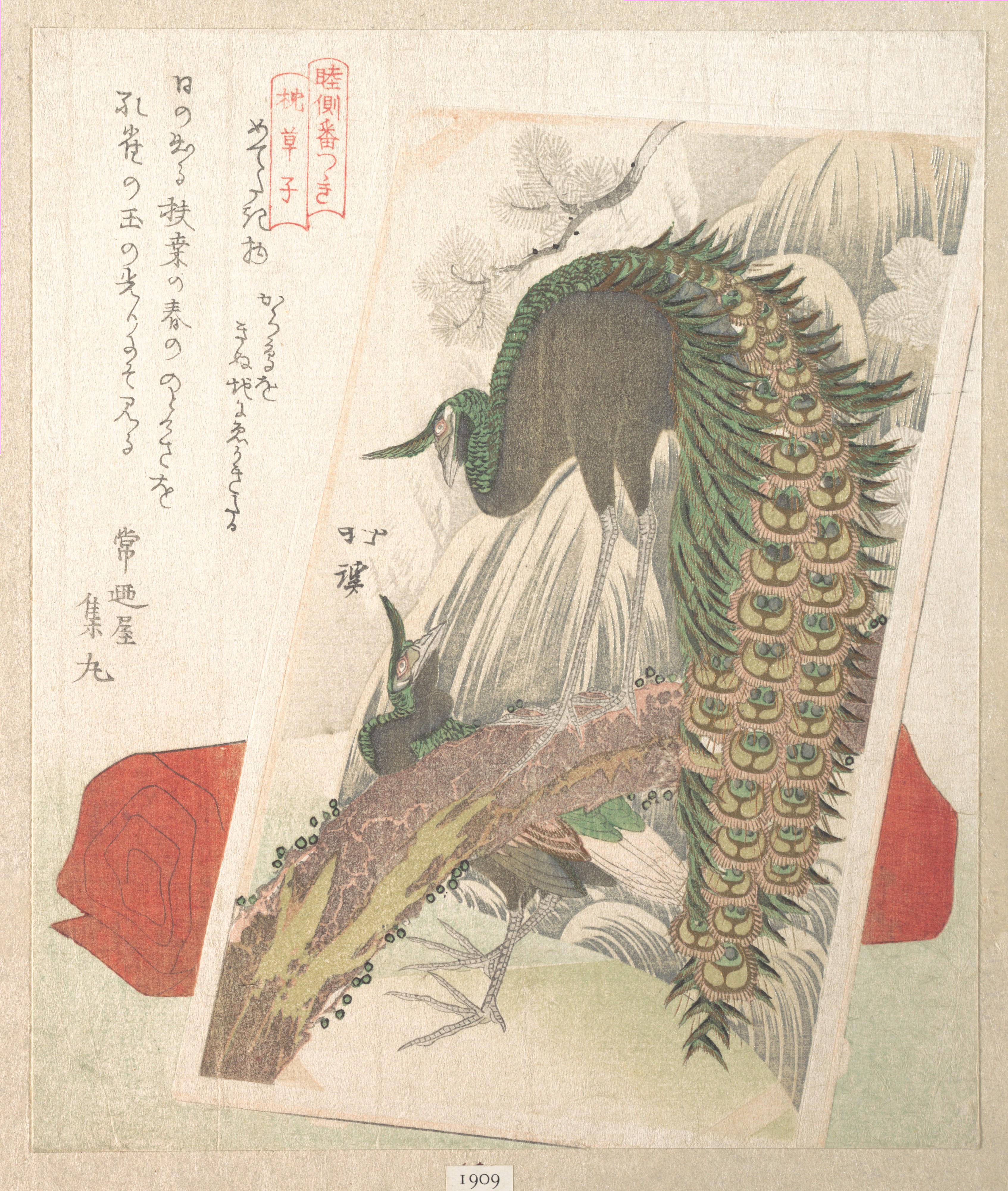
Painting of Peacocks, Pines, a Waterfall, and a Roll of Red Fabric
ca. 1818
Woodblock print (surimono); ink and color on paper

Inland Sea near Tosa
ca. 1820
Woodblock print (surimono); ink and color on paper

Courtesan watching foreign ship from balcony
c. 1818/44
Color woodblock print; shikishiban, surimono

A New Selection of Fifty Kyôka Poets (Shinsen kyôka gojûnin isshu)
1819
Woodblock- printed book

Courtesan sitting on a veranda next to a lantern
1814
Color woodblock print; shikishiban, surimono
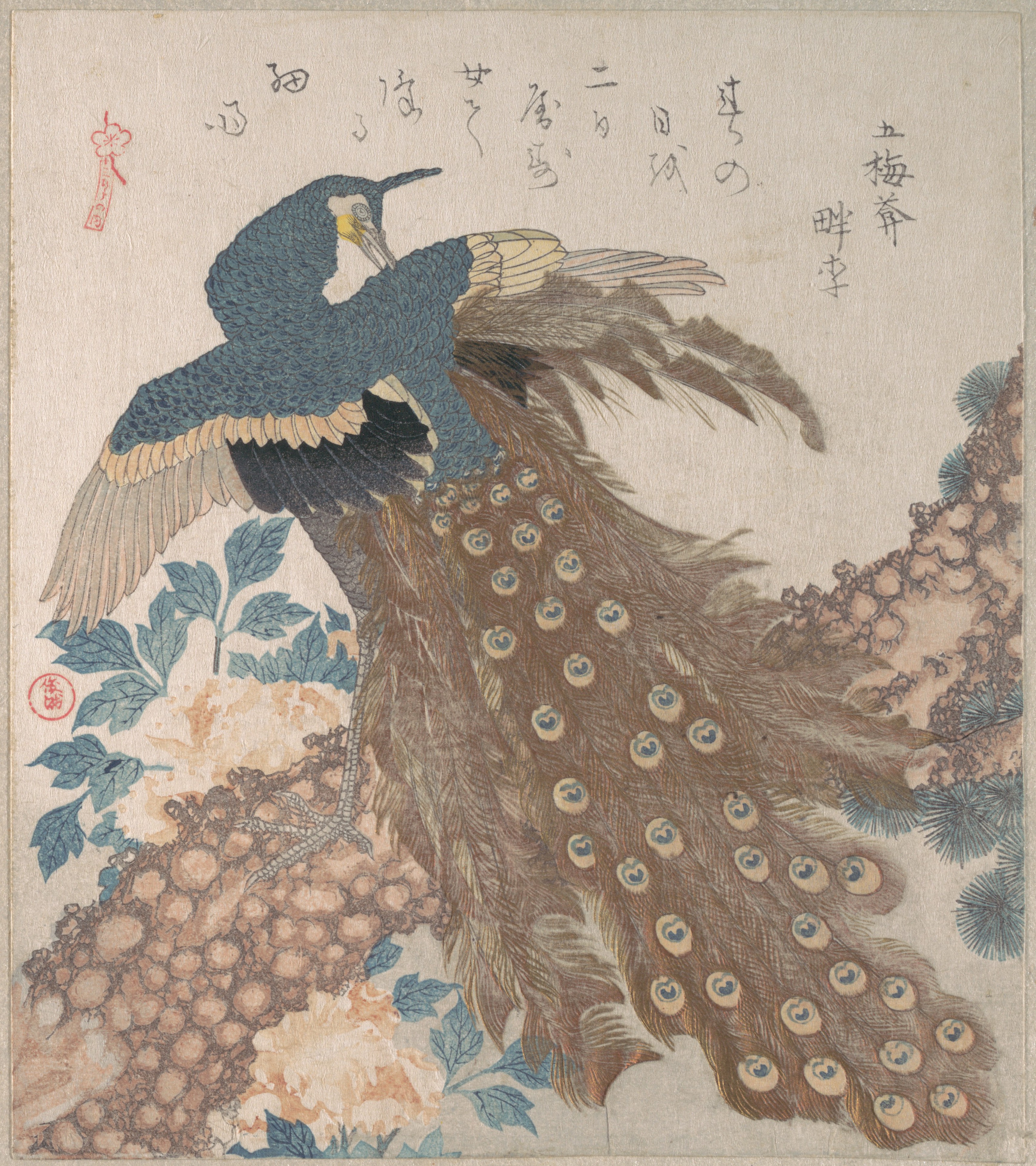
Peacock on Pine Tree and Peonies, from the series Three Sheets (Mihira no uchi)
mid- 1810s
Part of an album of woodblock prints (surimono); ink and color on paper

Ono no Tofu, from the series "A Gathering of the Elders of Poetry (Shoshikai bantsuzuki)"
c. 1820
Color woodblock print; shikishiban, surimono
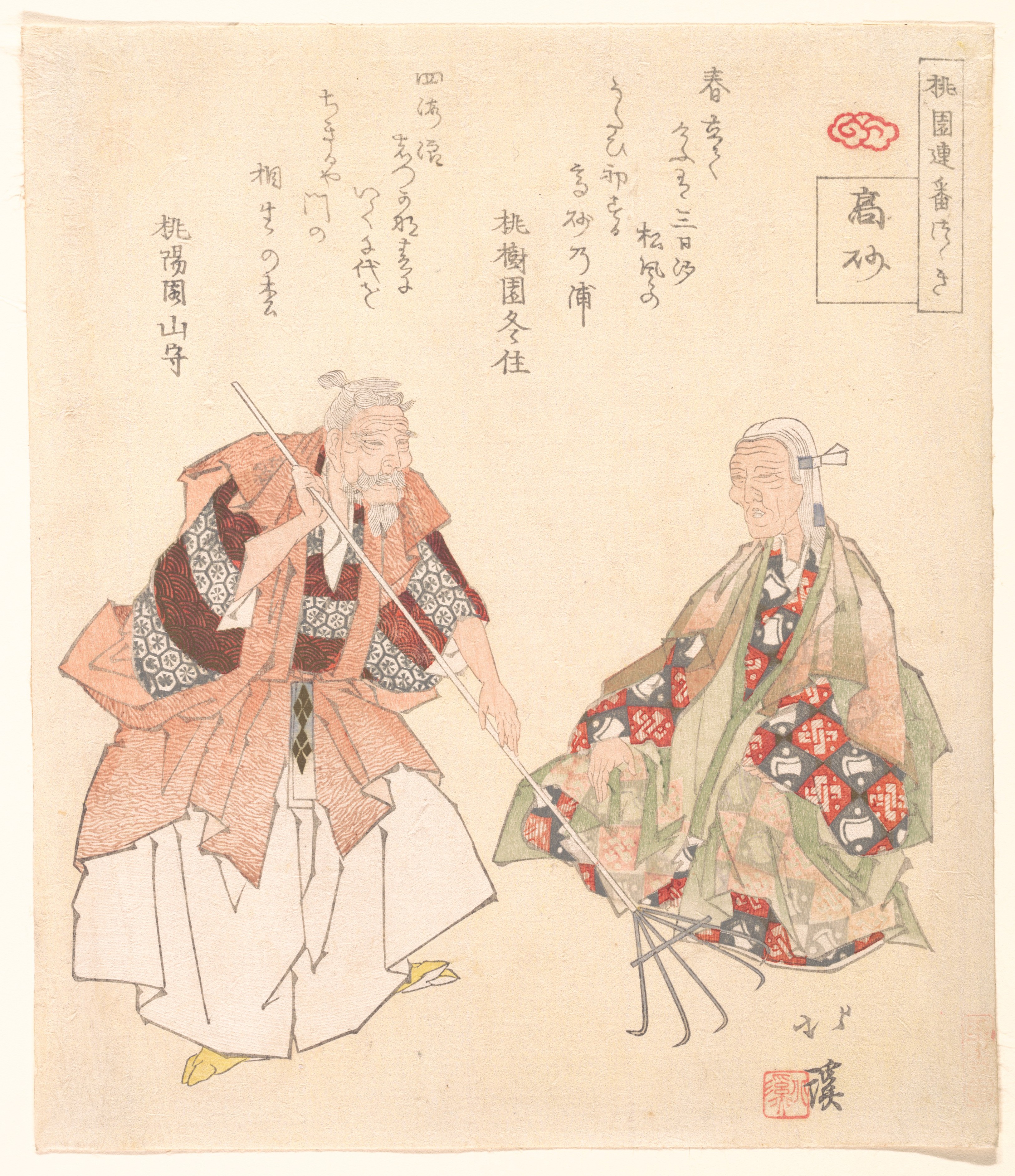
The Noh play, "Takasago"
ca. 1825
Woodblock print (surimono); ink and color on paper
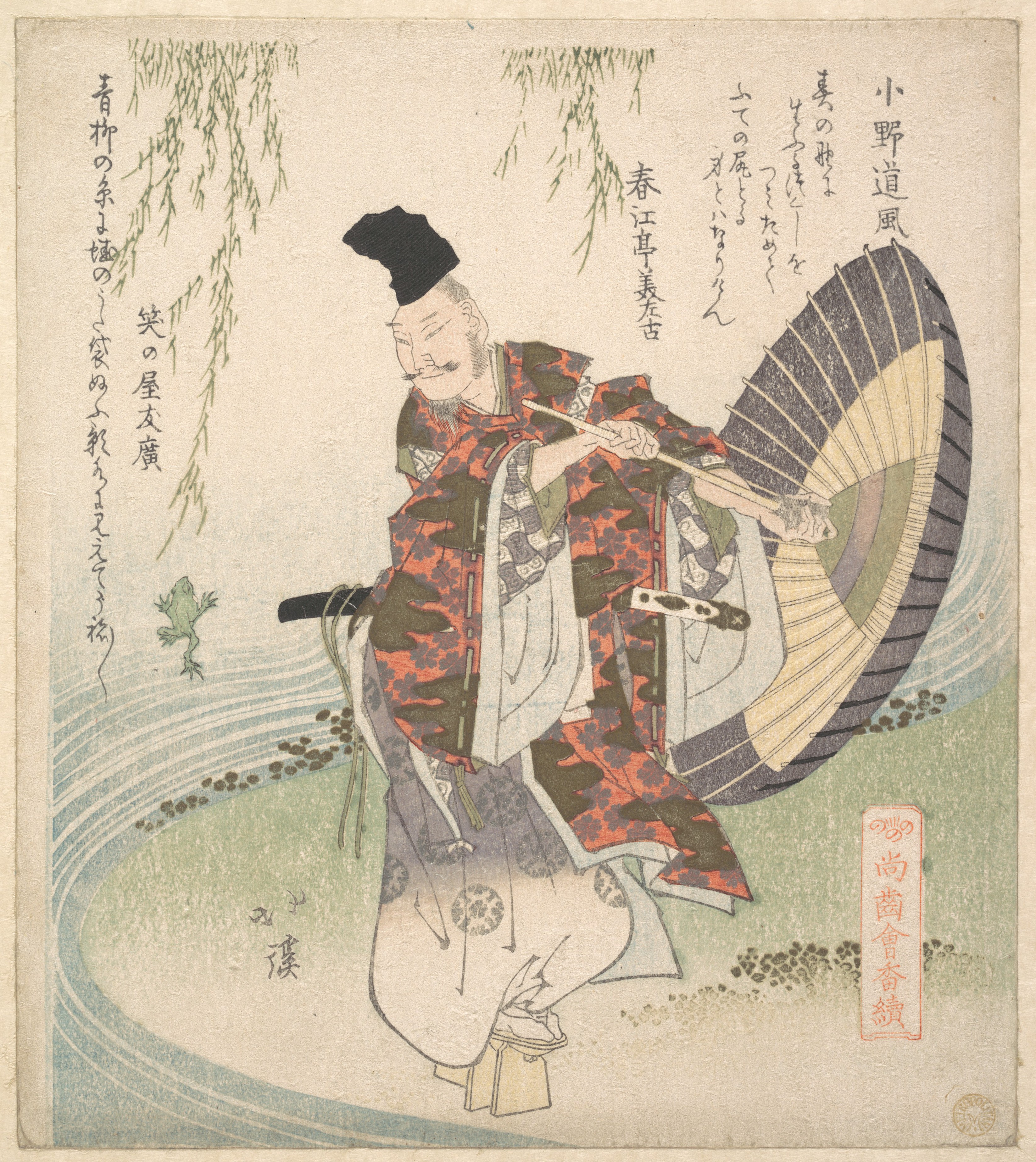
Ono no Tofu Standing on the Bank of a Stream and Watching a Frog Leap to Catch a Willow Branch
ca. 1825
Woodblock print (surimono); ink and color on paper
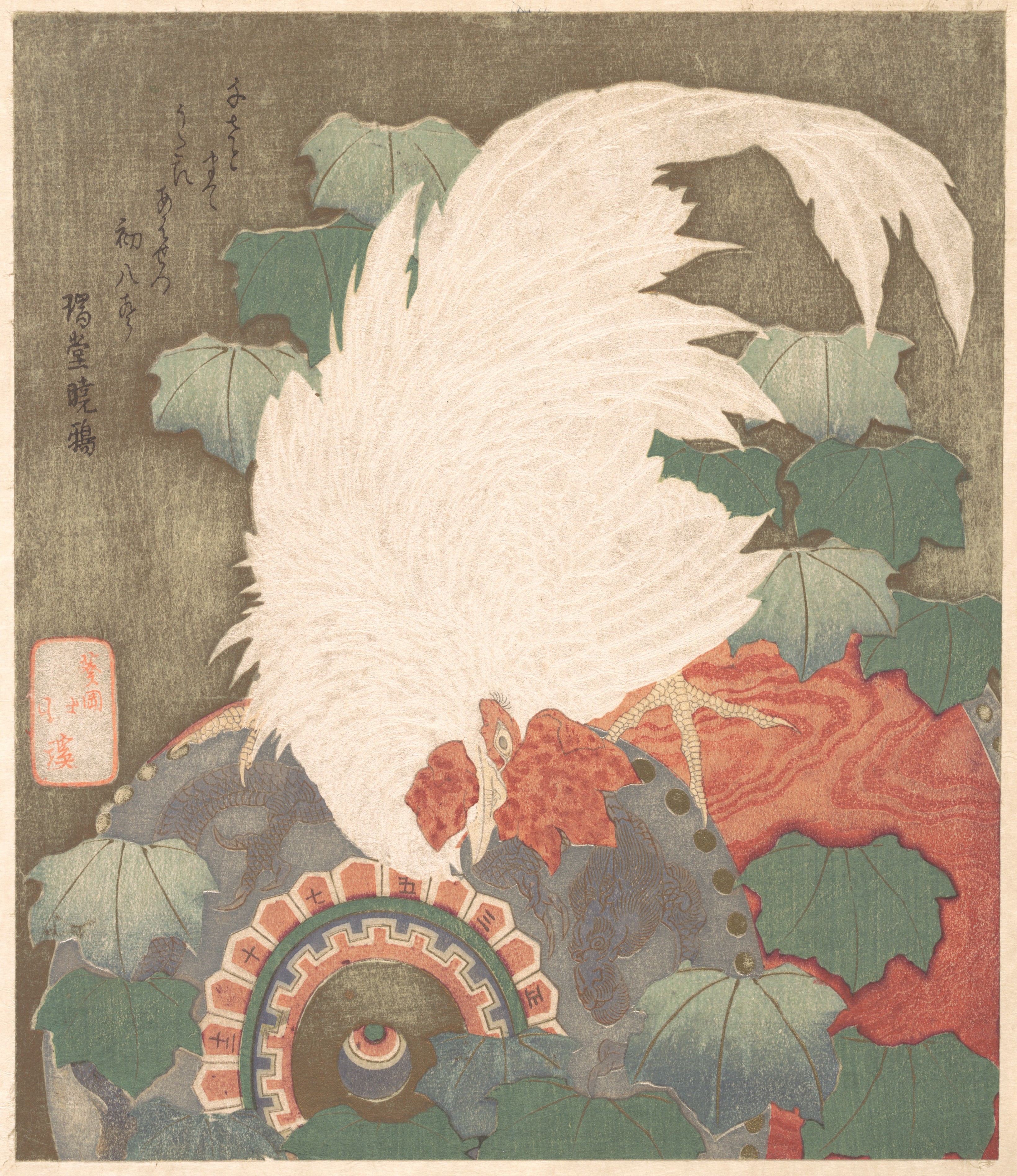
Cock on Drum
ca. 1825
Woodblock print (surimono); ink and color on paper

Xiangru (Jp: Shojo), from the series "Meng Qiu (Jp: Mogyu)"
c. 1821
Color woodblock print; shikishiban, surimono
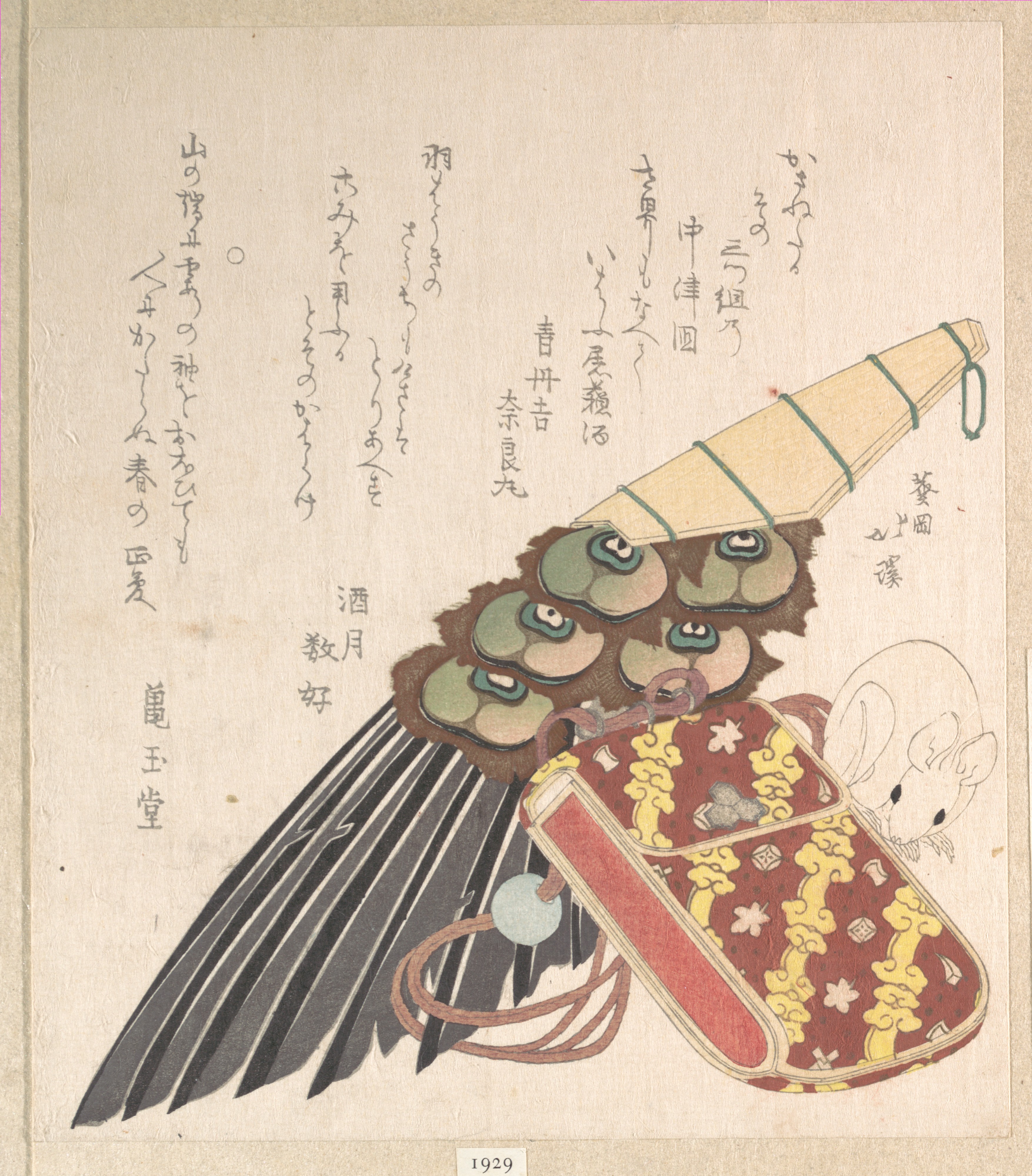
Feather-Brush and Doran (a Kind of Medicine Case) with a Netsuke of a Rat
probably 1816
Woodblock print (surimono); ink and color on paper

Woman with book sitting next to a New Year pull toy
late 1810s
Color woodblock print; shikishiban, surimono

The Salt Dragon
1832
Color woodblock print with metallic pigments; surimono shikishiban

Tray with Noshi Paper (Noshi Indicates a Present)
1816
Part of an album of woodblock prints (surimono); ink and color on paper

Still-Life with Monkey Mask
1824
Color woodblock print with metallic pigments; surimono shikishiban

The Theater Outing
mid–1820s
Color woodblock print with metallic pigments; surimono shikishiban

It is good to cut one's fingernails (Tsume tori yoshi), from the series "A Series for the Hanazono Group (Hanazono bantsuzuki)"
c. 1822
Color woodblock print; shikishiban, surimono

It is good to do the first archery (Yumi hajime yoshi), from the series "A Series for the Hanazono Group (Hanazono bantsuzuki)"
c. 1822
Color woodblock print; shikishiban, surimono

It is good to open for business (Akinai hajime yoshi), from the series "A Series for the Hanazono Group (Hanazono bantsuzuki)"
c. 1822
Color woodblock print; shikishiban, surimono

Two dancing karako, from the series "Happiness and Long Life for the Mimasu Group (Mimasu fukurokuju)"
c. 1823
Color woodblock print; left sheet of shikishiban diptych, surimono