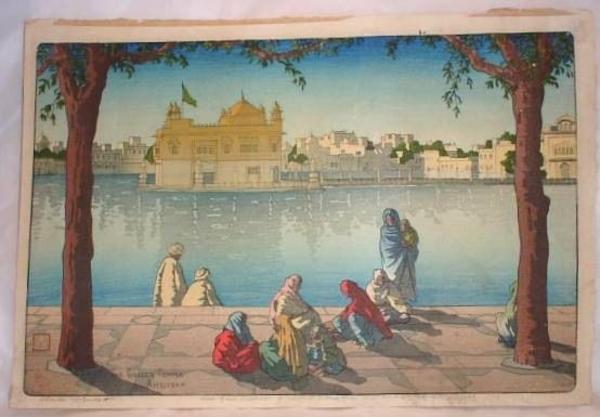
The Golden Temple Amritsar
- Medium:
- Woodblock print
- Source:
- Japanese Art Open Database
- Image courtesy of
- Japanese Art Open Database
Description
Charles William Bartlett (1860–1940) was a British watercolorist and printmaker who collaborated with the Watanabe Shôzaburô workshop in Tokyo to produce woodblock prints depicting Asian scenes beyond Japan. Bartlett's prints adapted Western compositional traditions and naturalistic light rendering to the woodblock medium, resulting in hybrid works that occupy an unusual position within shin-hanga production. This print depicts the Harmandir Sahib—the Golden Temple—in Amritsar, Punjab, the holiest shrine in Sikhism, its gold-clad structure surrounded by the sacred pool of the Amrit Sarovar. The temple's gilded upper stories and white marble lower structure, reflected in the pool's surface, would have required the workshop's printers to achieve luminous gold effects through careful pigment layering. Bartlett traveled extensively in India and Asia, and his Watanabe-published prints represent a distinctive instance of shin-hanga techniques applied to the documentation of non-Japanese sacred architecture and pilgrimage sites.
More Prints by Charles W. Bartlett

More Temples & Shrines Prints
Fushimi Inari Temple
伏見稲荷
Woodblock print

The Compound of the Tenman Shrine at Kameido in the Snow (Kameido Tenmangu keidai no yuki), from the series "Famous Places in the Eastern Capital (Toto meisho)"
c. 1832/38
Color woodblock print; oban
Temple with lanterns
Woodblock print

A Section of the Byodo Temple at Uji (Uji Byodoin no ichibu), from the series "Souvenirs of Travel, Second Series (Tabi miyage dai nishu)"
Uji Byodoin no ichibu
1921
Color woodblock print; oban
Featured in Collections
Curated cross-cuts that include this print.
Frequently Asked Questions
The Golden Temple Amritsar was created by Charles W. Bartlett.
The Golden Temple Amritsar depicts temples & shrines.