
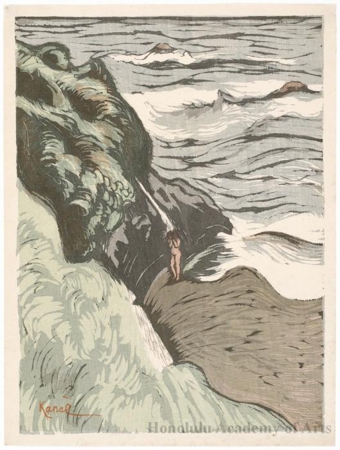
Bathing
- Date:
- 1918
- Medium:
- Color woodblock print
- Edition:
- Self-printed
- Source:
- Art Institute of Chicago
Description
A small nude figure stands at the edge of a rocky shoreline where dark green cliffs meet a churning grey-and-white sea, rendered in bold, simplified outlines. The composition is dominated by the diagonal sweep of moss-toned rock in the foreground against choppy wave patterns rendered in curling black linework, with a muted, earthy palette of greens, greys, and tan. "Kanae" is signed in red at the lower left. *Bathing*, a color woodblock print by Kanae Yamamoto, 1918.
More Prints by Kanae Yamamoto

More Nude Prints

Tsuta Hot Springs in Mutsu Province (Mutsu Tsuta onsen), from the series "Souvenirs of Travel, First Series (Tabi miyage dai isshu)"
Mutsu Tsuta onsen
1919
Color woodblock print; oban

Namari Spa, Iwate Prefecture (Iwate ken Namari onsen)
1943
Color woodblock print

Autumn at the Arayu Hot Spring, Shiobara
Autumn 1920
Woodblock print, ink and color on paper

Arifuku Spa, Iwami, from the series "Souvenirs of Travel, Third Series" (Tabi miyage dai sanshu, Iwami Arifuku onsen)
1924
Color woodblock print
Featured in Collections
Curated cross-cuts that include this print.
Frequently Asked Questions
Bathing was created by Kanae Yamamoto (山本鼎) in 1918.
Bathing depicts nude.