
A Corridor at Miyajima (Miyajima no kairo)
Miyajima no kairo
by Kawase Hasui
- Date:
- 1949
- Medium:
- Color woodblock print
- Format:
- Oban
- Dimensions:
- 36.6 × 24.2 cm
- Publisher:
- Watanabe Shozaburo
- Edition:
- Published by Watanabe Shozaburo
- Source:
- Art Institute of Chicago
Description
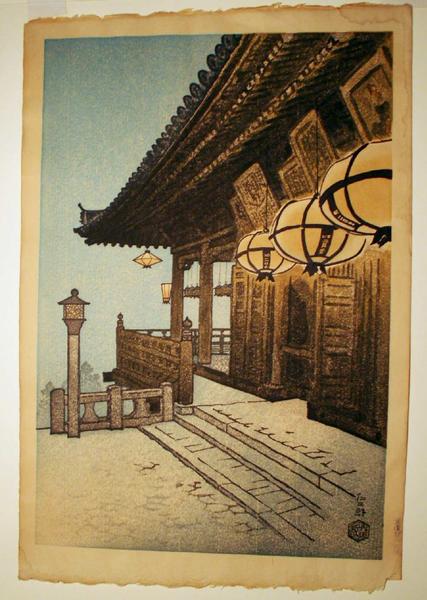
A covered vermillion-pillared corridor with a grey-shingled roof extends across the foreground, hanging lanterns suspended from its beams, opening onto a view of connected shrine buildings with white walls and grey roofs over water; pine trees and pale blue mountains are visible in the distance under a light sky. A lone figure in blue stands beneath the corridor on the left. Kawase Hasui, "A Corridor at Miyajima (Miyajima no kairo)," 1949, color woodblock print.
More Prints by Kawase Hasui

More Temples & Shrines Prints
Fushimi Inari Temple
伏見稲荷
Woodblock print

The Compound of the Tenman Shrine at Kameido in the Snow (Kameido Tenmangu keidai no yuki), from the series "Famous Places in the Eastern Capital (Toto meisho)"
c. 1832/38
Color woodblock print; oban
Temple with lanterns
Woodblock print

A Section of the Byodo Temple at Uji (Uji Byodoin no ichibu), from the series "Souvenirs of Travel, Second Series (Tabi miyage dai nishu)"
Uji Byodoin no ichibu
1921
Color woodblock print; oban
Featured in Collections
Curated cross-cuts that include this print.
Frequently Asked Questions
A Corridor at Miyajima (Miyajima no kairo) (Miyajima no kairo) was created by Kawase Hasui (川瀬巴水) in 1949.
A Corridor at Miyajima (Miyajima no kairo) uses Bokashi, Nishiki-e, and Moku-hanga, on color woodblock print.
A Corridor at Miyajima (Miyajima no kairo) was published by Watanabe Shozaburo (1949).
A Corridor at Miyajima (Miyajima no kairo) depicts temples & shrines, seascapes, and architecture, set at Miyajima.
A Corridor at Miyajima (Miyajima no kairo) measures 36.6 × 24.2 cm (Oban format).