![Arashiyama, Kyoto by Kawase Hasui — Japanese Color woodblock print, n.d. [1952]](https://www.artic.edu/iiif/2/c4955953-e084-6146-7246-7277f3a1949d/full/843,/0/default.jpg)
Arashiyama, Kyoto
by Kawase Hasui
- Date:
- n.d. [1952]
- Medium:
- Color woodblock print
- Format:
- Oban
- Dimensions:
- 36.4 × 24.2 cm
- Publisher:
- Watanabe Shozaburo
- Edition:
- Published by Watanabe Shozaburo
- Source:
- Art Institute of Chicago
Description
Arashiyama in Kyoto, dated circa 1952, depicts the celebrated district on the western outskirts of Kyoto where the Oi River (Hozu River in its upper reaches) passes through a mountain gap flanked by the famous bamboo groves and the classical temple gardens of Tenryu-ji. Arashiyama in any season — cherry blossoms in spring, brilliant maple in autumn — is among Japan's most visited landscape destinations, and Hasui's postwar composition likely captures the river's sweeping curve through the wooded valley. The undated attribution (circa 1952) places this among Hasui's final-decade revisits to Kansai's celebrated landscapes.
More Prints by Kawase Hasui
More Rivers & Lakes Prints

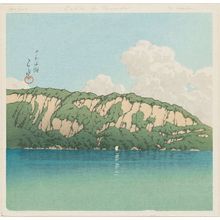
Lake Chuzenji, Nikko (Nikko Chuzenjiko)
Nikko Chuzenjiko
1930
Color woodblock print; oban

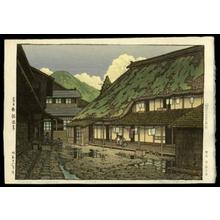
Lake Kugushi in Wakasa Province (Wakasa Kugushiko), from the series Souvenirs of Travel I (Tabi miyage dai isshu)"
Wakasa Kugushiko
1920
Color woodblock print; oban

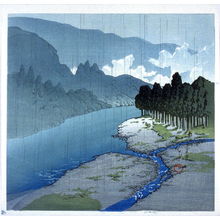
Gosai Canal in Niigata (Niigata Gosaibori), from the series "Souvenirs of Travel, Second Series (Tabi miyage dai nishu)"
Niigata Gosaibori
1921
Color woodblock print; oban

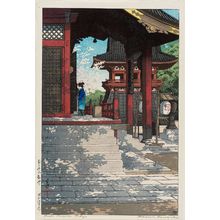
The Hori River at Obama (Obama Horikawa), from the series "Souvenirs of Travel, First Series (Tabi miyage dai isshu)"
Obama Horikawa
1920
Color woodblock print; oban
Featured in Collections
Curated cross-cuts that include this print.
Frequently Asked Questions
Arashiyama, Kyoto was created by Kawase Hasui (川瀬巴水) in n.d. [1952].
Arashiyama, Kyoto uses Moku-hanga, Nishiki-e, and Bokashi, on color woodblock print.
Arashiyama, Kyoto was published by Watanabe Shozaburo (n.d. [1952]).
Arashiyama, Kyoto depicts rivers & lakes, trees, and mountains, set at Kyoto, Arashiyama.
Arashiyama, Kyoto measures 36.4 × 24.2 cm (Oban format).