![Nara Park by Kawase Hasui — Japanese Color woodblock print, n.d. [1952]](https://www.artic.edu/iiif/2/9c6030fd-88c9-ff1d-1c72-dd1000bb180f/full/843,/0/default.jpg)
Nara Park
by Kawase Hasui
- Date:
- n.d. [1952]
- Medium:
- Color woodblock print
- Format:
- Oban
- Dimensions:
- 36.5 × 24.1 cm
- Publisher:
- Watanabe Shozaburo
- Edition:
- Published by Watanabe Shozaburo
- Source:
- Art Institute of Chicago
Description
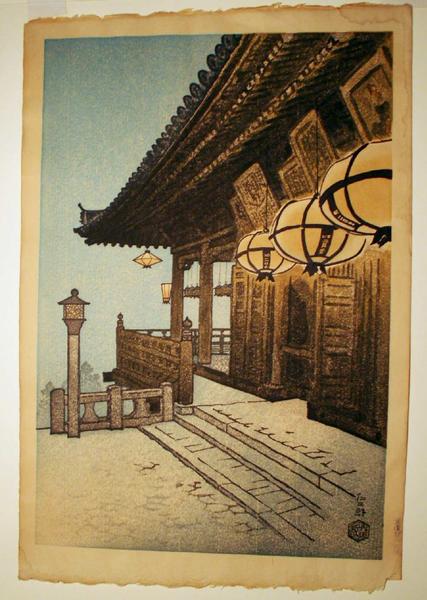
Nara Park, depicted in a print dated circa 1952, is the expansive public park surrounding the great temple complexes of Nara — Todai-ji with its giant bronze Buddha, Kasuga Grand Shrine with its thousands of stone lanterns, and the Kofuku-ji pagoda — set within a landscape of ancient cryptomeria and freely roaming sacred deer. Nara Park's combination of monumental architecture, ancient forest, and the distinctive presence of the tame deer browsing among temple precincts gives the site an atmosphere unmatched anywhere in Japan. Hasui's postwar visit captures the park's enduring atmosphere, likely emphasizing seasonal elements such as cherry blossoms, autumn maples, or winter snow.
More Prints by Kawase Hasui

More Temples & Shrines Prints
Fushimi Inari Temple
伏見稲荷
Woodblock print

The Compound of the Tenman Shrine at Kameido in the Snow (Kameido Tenmangu keidai no yuki), from the series "Famous Places in the Eastern Capital (Toto meisho)"
c. 1832/38
Color woodblock print; oban
Temple with lanterns
Woodblock print

A Section of the Byodo Temple at Uji (Uji Byodoin no ichibu), from the series "Souvenirs of Travel, Second Series (Tabi miyage dai nishu)"
Uji Byodoin no ichibu
1921
Color woodblock print; oban
Featured in Collections
Curated cross-cuts that include this print.
Frequently Asked Questions
Nara Park was created by Kawase Hasui (川瀬巴水) in n.d. [1952].
Nara Park uses Bokashi, Nishiki-e, and Moku-hanga, on color woodblock print.
Nara Park was published by Watanabe Shozaburo (n.d. [1952]).
Nara Park depicts temples & shrines, gardens, and animals, set at Nara.
Nara Park measures 36.5 × 24.1 cm (Oban format).