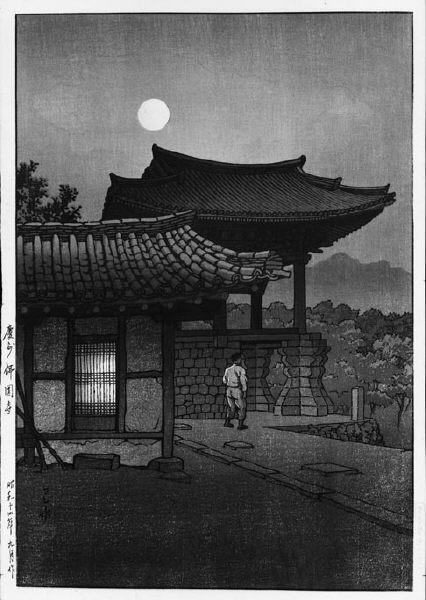
The Pulguksa Temple, Kyongju — 慶州 佛国寺
by Kawase Hasui
- Medium:
- Woodblock print
- Source:
- Japanese Art Open Database
- Image courtesy of
- Japanese Art Open Database
Description
A full moon glows above a tiled temple gate roof with upturned eaves, rendered in dark blue-black tones against a paler night sky. A single robed figure stands on the stone path before the whitewashed gatehouse wall, with distant hills silhouetted beyond; a red seal and vertical title text appear at the lower left. Woodblock print, "The Pulguksa Temple, Kyongju" (慶州 佛国寺), by Kawase Hasui, year unknown.
More Prints by Kawase Hasui

More Temples & Shrines Prints
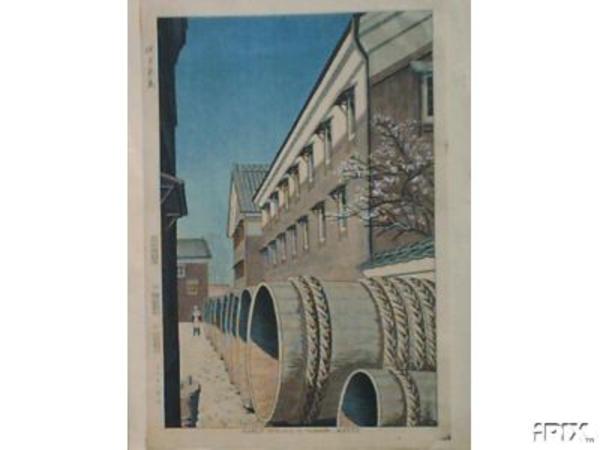
Fushimi Inari Temple
伏見稲荷
Woodblock print

The Compound of the Tenman Shrine at Kameido in the Snow (Kameido Tenmangu keidai no yuki), from the series "Famous Places in the Eastern Capital (Toto meisho)"
c. 1832/38
Color woodblock print; oban
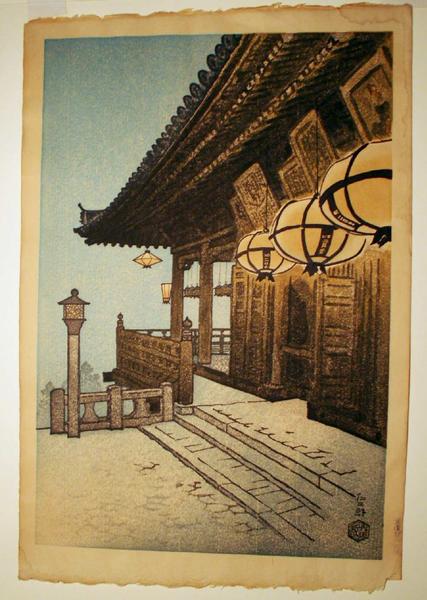
Temple with lanterns
Woodblock print

A Section of the Byodo Temple at Uji (Uji Byodoin no ichibu), from the series "Souvenirs of Travel, Second Series (Tabi miyage dai nishu)"
Uji Byodoin no ichibu
1921
Color woodblock print; oban
Featured in Collections
Curated cross-cuts that include this print.
Frequently Asked Questions
The Pulguksa Temple, Kyongju — 慶州 佛国寺 was created by Kawase Hasui (川瀬巴水).
The Pulguksa Temple, Kyongju — 慶州 佛国寺 depicts temples & shrines.