
Biography
Oda Kazuma (織田一麿, 1882–1956) was a Tokyo-born painter, lithographer, and woodblock-print designer whose career straddled the two great currents of early-twentieth-century Japanese modern printmaking: the artisanal shin-hanga ('new prints') movement built around publisher commissions and the artist-driven sōsaku-hanga ('creative prints') movement that prized self-drawn, self-carved, self-printed work. Born in 1882 in Tokyo into a family with samurai roots, Oda studied Western-style painting (yōga) with Kawamura Kiyo-o (1852–1934), one of the most prominent first-generation yōga teachers in Japan, and learned the unusual specialty of lithography from his elder brother Oda Tōu, a painter and lithographer active in Osaka, and from Kaneko Masajirō, an Osaka-trained lithographer working from 1884 into the early 1900s. By 1903 he was working as a designer at the Koshiba lithography studio in Tokyo, where, around the same time, he is thought to have encountered the Prague-born painter-printmaker Emil Orlik (1870–1932), then immersed in his own study of Japanese woodblock methods; Orlik's combination of Western draftsmanship and an interest in printmaking as fine art seems to have helped shape Oda's lifelong commitment to the print as an autonomous expressive medium. Between 1916 and 1919 Oda produced two of the most ambitious lithograph series of the early Taishō period: the 'Collection of prints of scenes in Tokyo' (Tōkyō fūkei hanga-shū, 1916–17) and the 'Collection of prints of scenes in Osaka' (Ōsaka fūkei hanga-shū, 1917–19), depicting harbors, theaters, canals, geisha quarters, and night streets in soft tonalities and atmospheric grays that adapted European urban-view conventions to specifically Japanese subjects. In keeping with sōsaku-hanga principles he drew, transferred to stone, and printed these editions himself in small runs of roughly twenty to fifty impressions — strikingly modest numbers compared with the thousands of impressions a commercial Edo-style woodblock workshop could produce, and a clear declaration that he was treating the lithograph as a fine-art object rather than a mass commodity. On the strength of that work he became a founding member of the Nihon Sōsaku-Hanga Kyōkai (Japan Creative Print Association) at its establishment in 1918, serving as its sole representative of the lithographic medium within a circle otherwise dominated by woodblock artists — in effect the early movement's leading voice for lithography. During the 1920s Oda also worked across the aisle into shin-hanga, designing a small group of woodblock prints for publisher Watanabe Shōzaburō (1885–1962); in 1924 he supplied six shin-hanga designs, which Watanabe's artisans carved and printed from Oda's paintings in the publisher's polished house style, showing how his painterly tonalism translated into the woodblock format. He continued to organize the field through the interwar decades, helping found the Yōfū Hangakai (Western-style Print Society) in 1929–30 — an offshoot devoted to print artists working from a yōga background — and then the Nihon Hanga Kyōkai (Japan Print Association) in 1931, the body that has remained the principal exhibiting society for Japanese fine-art printmaking down to the present. Beyond his own editions, Oda contributed to early Japanese print scholarship with books on ukiyo-e published in 1926 and 1931, helping establish a critical literature for the modern print in Japan, and in 1953 he opened a private workshop, the Oda Lithography Studio, in Tokyo, where he pursued lithography during his last years. He died in 1956. His prints are held in major public collections, including the British Museum, the Museum of Fine Arts in Boston, the Art Institute of Chicago, and the University of Michigan Museum of Art, which holds his print 'Interior of a Cinema Theater.' Among collectors and historians Oda is valued as one of the very few Japanese modern artists of his generation to make lithography rather than woodblock his principal medium, and as a quiet but consequential bridge between sōsaku-hanga's experimental ethos and the more commercial machinery of shin-hanga publishing.
Key Facts
- Active Period
- 1882–1956
- Nationality
- 🇯🇵Japan
- Movements
- Shin-hangaSōsaku-hanga
- Works Indexed
- 121
Frequently Asked Questions
Oda Kazuma (織田一麿, 1882–1956) was a Tokyo-born painter, lithographer, and woodblock-print designer whose career straddled the two great currents of early-twentieth-century Japanese modern printmaking: the artisanal shin-hanga ('new prints') movement built around publisher commissions and the artist-driven sōsaku-hanga ('creative prints') movement that prized self-drawn, self-carved, self-printed work. Born in 1882 in Tokyo into a family with samurai roots, Oda studied Western-style painting (yōga) with Kawamura Kiyo-o (1852–1934), one of the most prominent first-generation yōga teachers in Japan, and learned the unusual specialty of lithography from his elder brother Oda Tōu, a painter and lithographer active in Osaka, and from Kaneko Masajirō, an Osaka-trained lithographer working from 1884 into the early 1900s. By 1903 he was working as a designer at the Koshiba lithography studio in Tokyo, where, around the same time, he is thought to have encountered the Prague-born painter-printmaker Emil Orlik (1870–1932), then immersed in his own study of Japanese woodblock methods; Orlik's combination of Western draftsmanship and an interest in printmaking as fine art seems to have helped shape Oda's lifelong commitment to the print as an autonomous expressive medium. Between 1916 and 1919 Oda produced two of the most ambitious lithograph series of the early Taishō period: the 'Collection of prints of scenes in Tokyo' (Tōkyō fūkei hanga-shū, 1916–17) and the 'Collection of prints of scenes in Osaka' (Ōsaka fūkei hanga-shū, 1917–19), depicting harbors, theaters, canals, geisha quarters, and night streets in soft tonalities and atmospheric grays that adapted European urban-view conventions to specifically Japanese subjects. In keeping with sōsaku-hanga principles he drew, transferred to stone, and printed these editions himself in small runs of roughly twenty to fifty impressions — strikingly modest numbers compared with the thousands of impressions a commercial Edo-style woodblock workshop could produce, and a clear declaration that he was treating the lithograph as a fine-art object rather than a mass commodity. On the strength of that work he became a founding member of the Nihon Sōsaku-Hanga Kyōkai (Japan Creative Print Association) at its establishment in 1918, serving as its sole representative of the lithographic medium within a circle otherwise dominated by woodblock artists — in effect the early movement's leading voice for lithography. During the 1920s Oda also worked across the aisle into shin-hanga, designing a small group of woodblock prints for publisher Watanabe Shōzaburō (1885–1962); in 1924 he supplied six shin-hanga designs, which Watanabe's artisans carved and printed from Oda's paintings in the publisher's polished house style, showing how his painterly tonalism translated into the woodblock format. He continued to organize the field through the interwar decades, helping found the Yōfū Hangakai (Western-style Print Society) in 1929–30 — an offshoot devoted to print artists working from a yōga background — and then the Nihon Hanga Kyōkai (Japan Print Association) in 1931, the body that has remained the principal exhibiting society for Japanese fine-art printmaking down to the present. Beyond his own editions, Oda contributed to early Japanese print scholarship with books on ukiyo-e published in 1926 and 1931, helping establish a critical literature for the modern print in Japan, and in 1953 he opened a private workshop, the Oda Lithography Studio, in Tokyo, where he pursued lithography during his last years. He died in 1956. His prints are held in major public collections, including the British Museum, the Museum of Fine Arts in Boston, the Art Institute of Chicago, and the University of Michigan Museum of Art, which holds his print 'Interior of a Cinema Theater.' Among collectors and historians Oda is valued as one of the very few Japanese modern artists of his generation to make lithography rather than woodblock his principal medium, and as a quiet but consequential bridge between sōsaku-hanga's experimental ethos and the more commercial machinery of shin-hanga publishing.
Oda Kazuma was active from 1882 to 1956. They were associated with the Shin-hanga and Sōsaku-hanga movements.
Oda Kazuma's work was shaped by the Shin-hanga and Sōsaku-hanga traditions in Japanese woodblock printmaking. Shin-hanga: ## What is Shin-hanga? Shin-hanga (新版画), literally "new prints," is the early twentieth-century revival of the collaborative Japanese woodblock workshop, organized between roughly 1915 and 1960 by the Tokyo publisher Watanabe Shōzaburō (1885–1962) and a handful of competing houses. Sōsaku-hanga: ## What is sōsaku-hanga? Sōsaku-hanga (創作版画, "creative prints") was a twentieth-century Japanese print movement defined by a single commitment: the artist must design, carve, and print every work alone.
Oda Kazuma's prints frequently feature urban scenes, landscapes, abstract, lithograph, rivers & lakes, night scenes.
Original prints by Oda Kazuma can be found in collections including The Art of Japan, Japanese Art Open Database, Hara Shobo, Art Institute of Chicago.
External Resources
Series by Oda Kazuma
Views of Tokyo (Tokyo fukei)
1 print
Pictures of Ginza, First Series (Gashu Ginza dai isshu)
1 print
Scenery of Niigata (Gashu Niigata fukei)
1 print
Landscapes Prints (Gashu fukei hanga)
1 print
Pictures of Ginza
5 prints
Scenery of Tokyo
1 print
Scenery of Shinjuku
1 print
Picture Album of the Famous Mountains of Japan (Nihon meisan gafu)
1 print
Tokyo fûkei hangashû
1 print
Woodblock Prints by Oda Kazuma (121)

Landscape of Susaki (Susaki no kei), from the series "Views of Tokyo (Tokyo fukei)"
1916
Lithograph on paper

Fruit
1918
Color lithograph
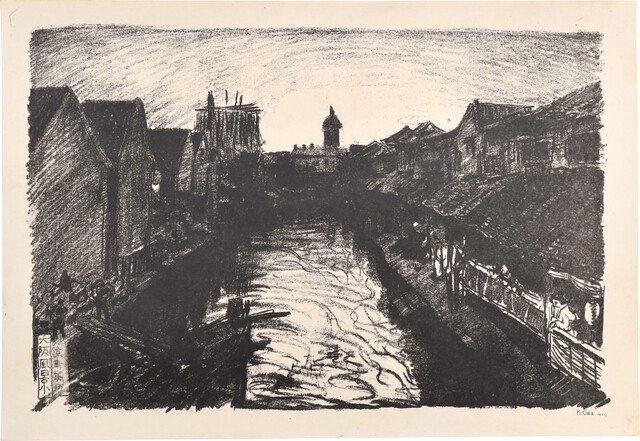
Views of Osaka: Kyomachi Canal
1919
Lithograph
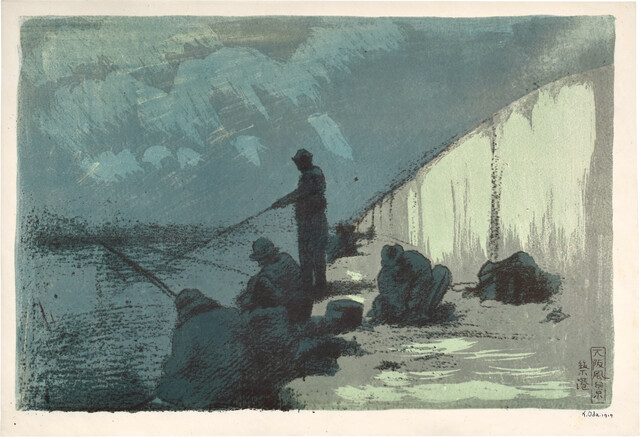
Views of Osaka: Harbour (Moonlit Night)
1919
Lithograph

Carnation
1922
Color lithograph

Peonies
1924
Woodblock print, ink and color on paper

Yūfuku Hot Spring in Iwami
1925
Woodblock print, ink and color on paper
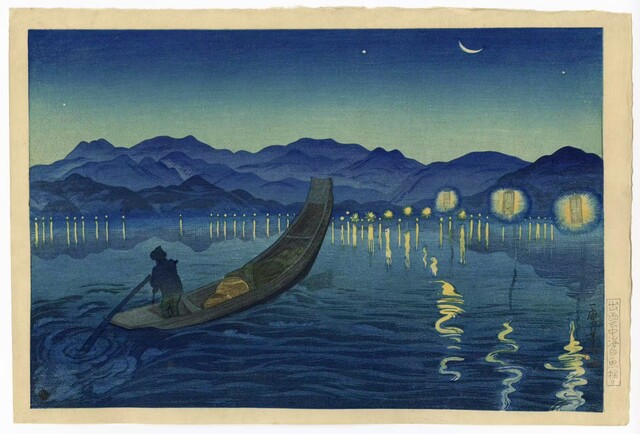
Catching Whitebait at Nakaumi (出雲中海白魚採り)
1925
Woodblock Print

View of Kabuki Theater from Matsuya (Ginza Matsuya yori Kabukiza), no. 3 from the series "Pictures of Ginza, First Series (Gashu Ginza dai isshu)"
1928
Color lithograph

Bar Bacchus in Ginza, from the series Pictures of Ginza, First Series
January 1929
Color lithograph

Ijin Pond in Autumn (Ijin ike shukei), from the series "Scenery of Niigata (Gashu Niigata fukei)"
1929
Color lithograph

Bar Sourire, no. 3 from the series Pictures of Ginza, Second Series
1929
Color lithograph

Shinjuku Station (Shinjuku eki), from the series "Scenery of Shinjuku (Gashu Shinjuku fukei)"
1930
Color lithograph

Sumida Park
1930
Color woodblock print

Distant View of Mitsukoshi Movie Theater in Shinjuku from the Sixth Floor of Hoteiya (Hoteiya rokkai kara Shinjuku Mitsukoshi Musashi no kan enbo zu), no. 1 from the series "Scenery of Shinjuku (Gashu Shinjuku fukei)"
1930
Color lithograph

Shichiri Beach (Shichirigahama), from the series "Landscapes Prints (Gashu fukei hanga)"
1932
Color lithograph

Nude
1932
Color lithograph on paper; edition 15/20

Spring Rain at Mount Tsukuba (Tsukuba-san shun'u), from the series "Picture Album of the Famous Mountains of Japan (Nihon meisan gafu)"
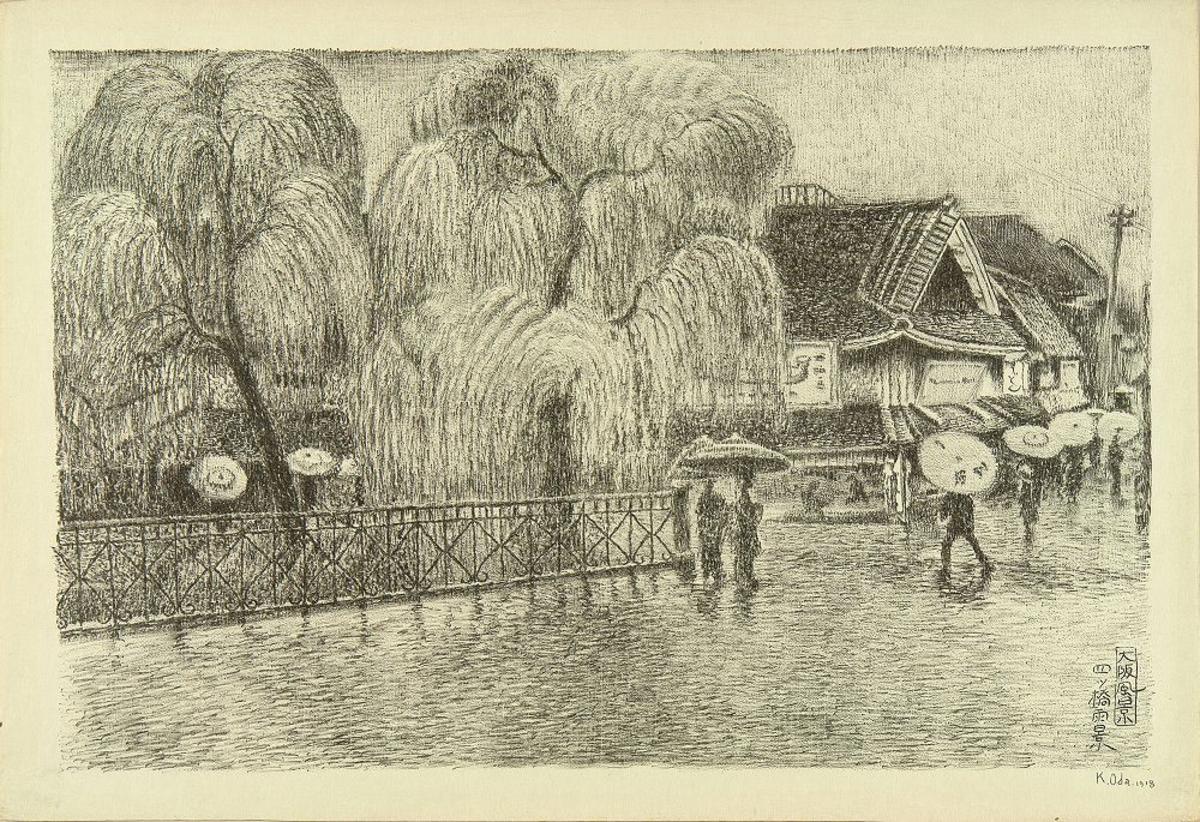
View of Yotsuhashi in rain
Woodblock print
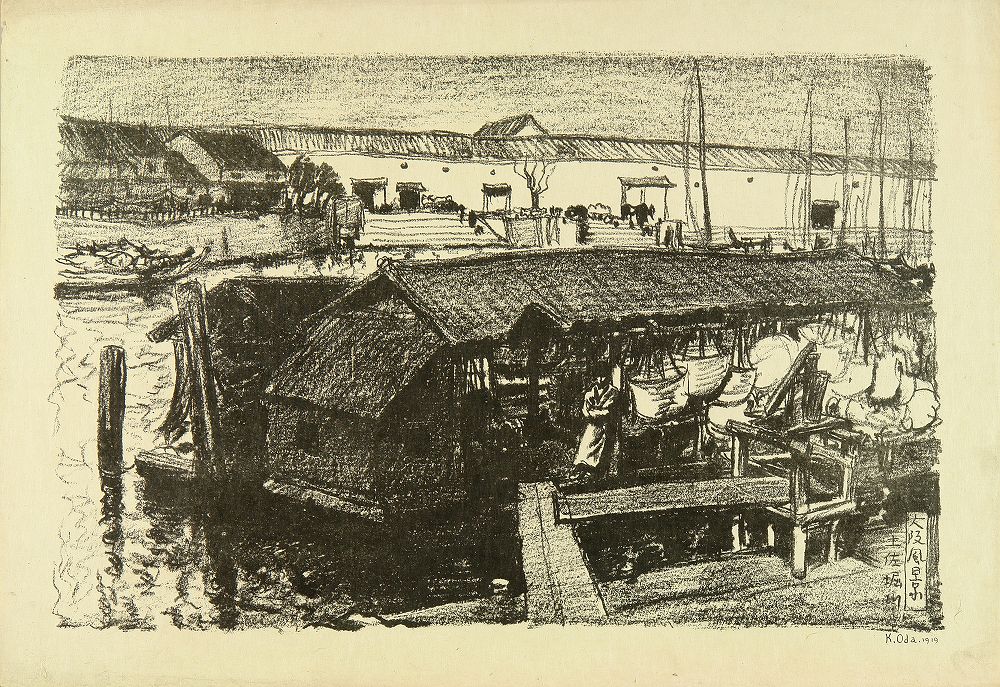
Tosabori River, from
Woodblock print
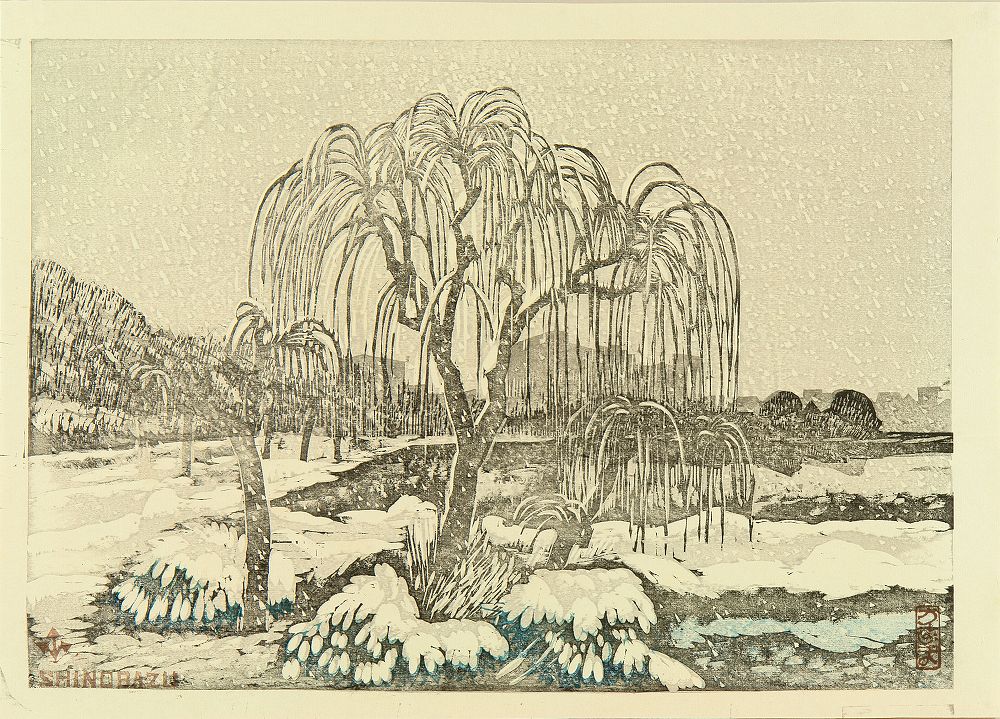
Shonobazu Pond, c.1930
Woodblock print
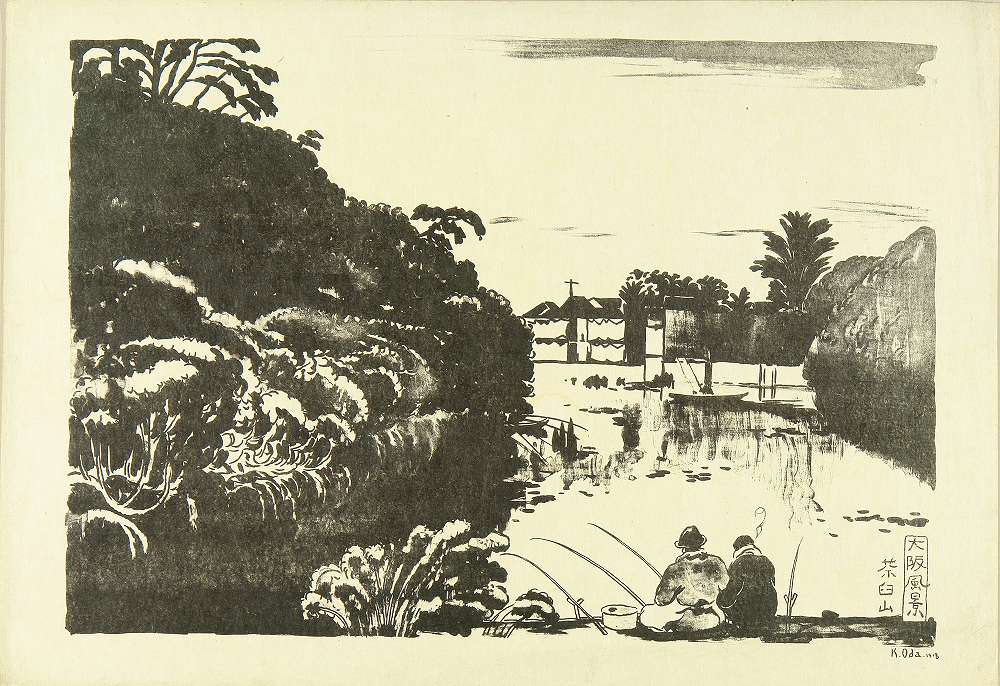
Mount Chausu, from
Woodblock print

View of Yotsuhashi in rain, from
Woodblock print
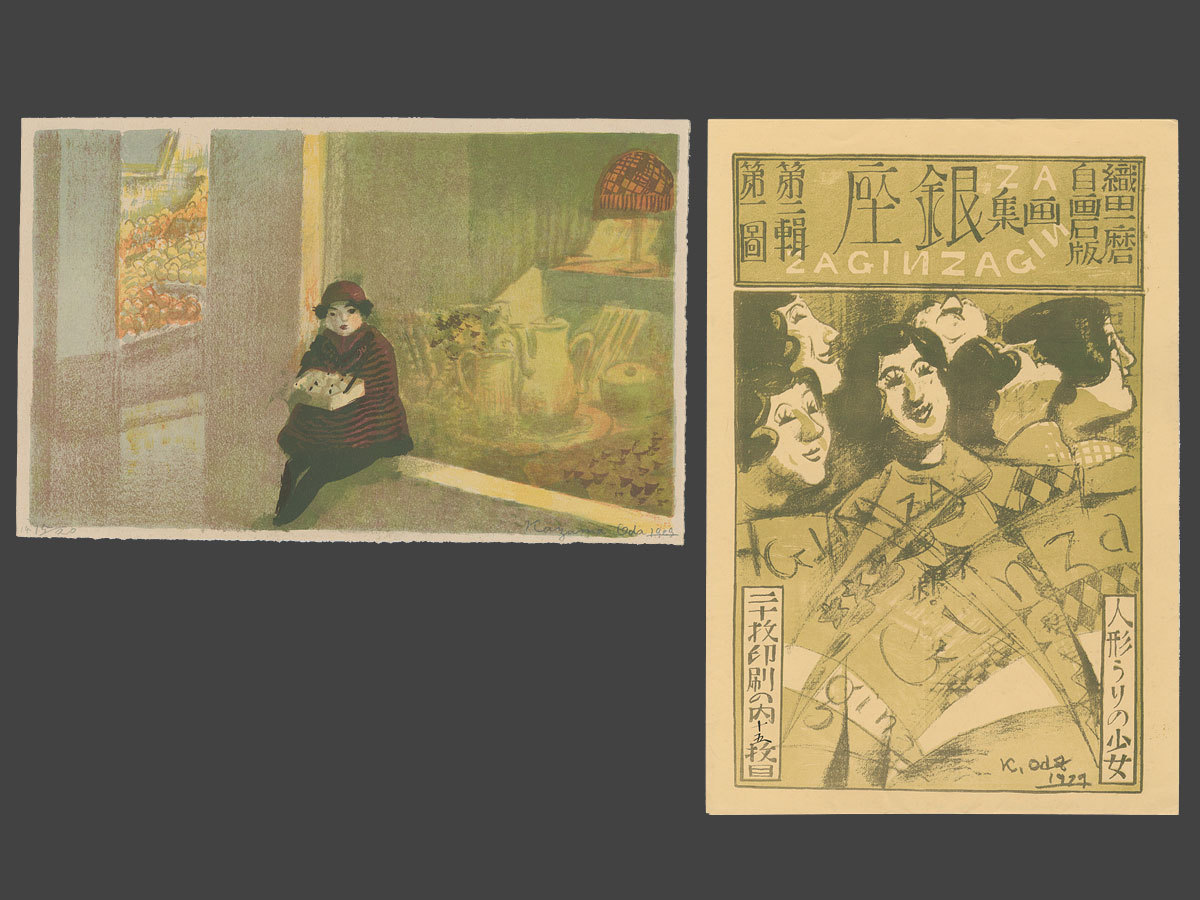
#1 Girl Selling Dolls (To be Sold as a Complete Set of 6)
Woodblock print