Biography
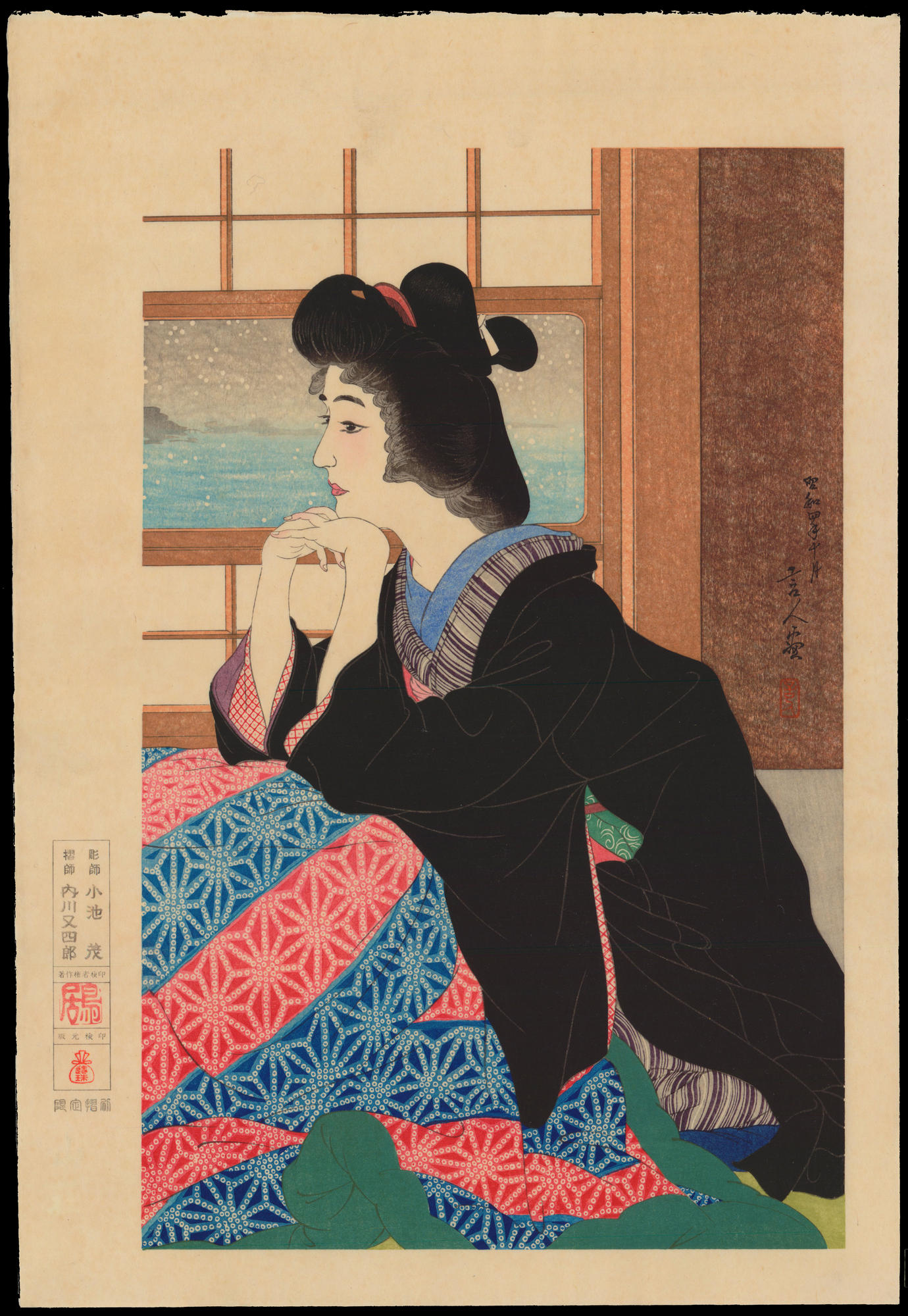
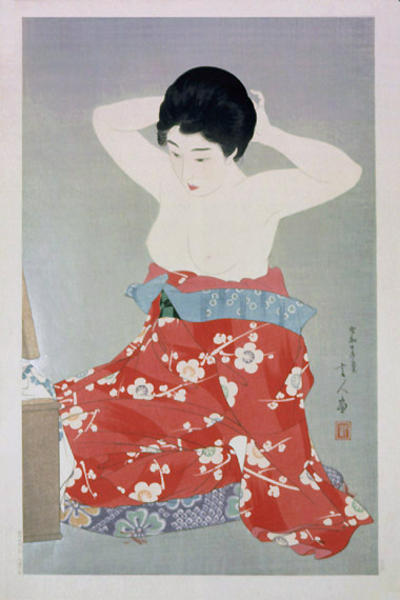
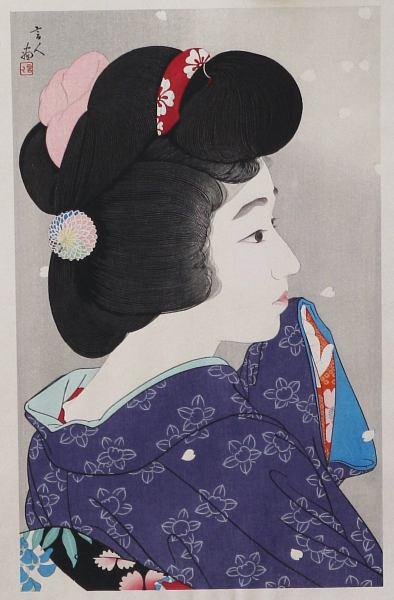
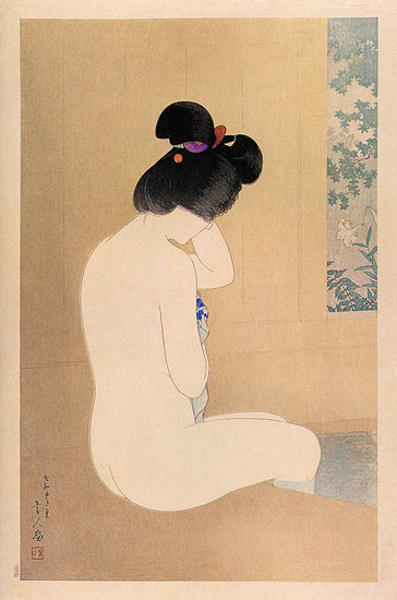
Torii Kotondo, born in 1900 in Tokyo, was a Japanese woodblock print artist and painter who created one of the most exquisite and rarified bodies of work in the entire shin-hanga movement. Known for his luminous bijin-ga (beautiful women prints), Kotondo produced only approximately twenty-one woodblock prints during his lifetime — a remarkably small output that has made his works among the rarest and most sought-after of all modern Japanese prints. Despite this limited production, the extraordinary quality and refined beauty of his prints have secured him a place among the most admired artists of the twentieth century.
Kotondo was born into the Torii school, one of the oldest and most distinguished lineages of Japanese painting and printmaking. The Torii school had been associated with the Kabuki theater since the late seventeenth century, producing generations of artists who specialized in yakusha-e (actor prints) and theatrical posters and billboards. Kotondo was adopted into the Torii family and designated as the successor to the school's headship, eventually becoming Torii Kiyotada V. This distinguished artistic lineage placed Kotondo within a direct line of descent from some of the most important artists in the history of Japanese printmaking, and it gave him access to centuries of accumulated knowledge about the woodblock print medium.
Kotondo's artistic training was comprehensive and rigorous. He studied under Torii Kiyomine, the head of the Torii school, learning the traditional techniques of Japanese painting and the conventions of yakusha-e and bijin-ga that had defined the Torii school for generations. He also studied nihonga (Japanese-style painting) and was exposed to Western art, developing a broad artistic foundation that informed his mature work. However, it was his training in the Torii school's distinctive approach to depicting the human figure — with its emphasis on graceful line, elegant proportion, and refined decorative sense — that most profoundly shaped his artistic identity.
Kotondo's first woodblock print was produced around 1924, when he was approximately twenty-four years old. From the outset, his prints demonstrated an exceptional level of refinement and technical quality. Working primarily with the publisher Watanabe Shozaburo, Kotondo had access to the finest carvers and printers in Tokyo, and his designs exploited the full range of woodblock printing techniques. His earliest prints already showed the qualities that would define his mature work: luminous flesh tones, exquisitely rendered hair and textiles, and a psychological subtlety in the depiction of his subjects that went far beyond mere idealized beauty.
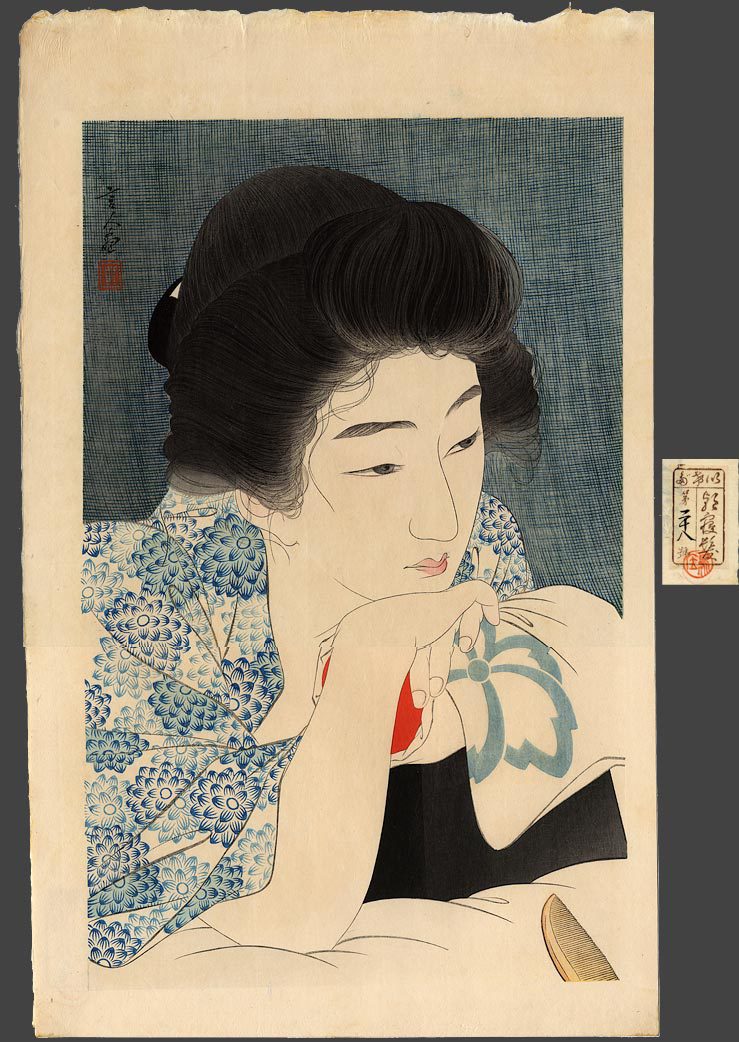
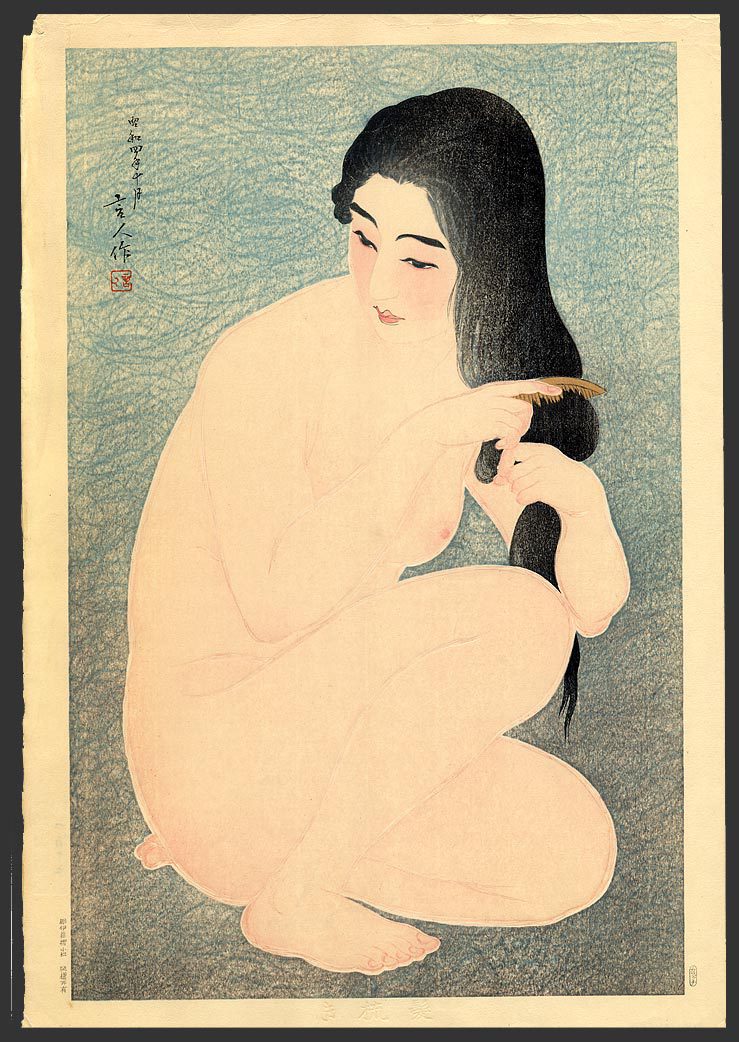
Kotondo's most celebrated print, "Morning Hair" (Asa no kami), created around 1930, depicts a woman adjusting her hair after sleeping, the tousled strands creating a contrast with the composed elegance more typical of bijin-ga. The print is remarkable for its naturalistic depiction of a private, unguarded moment, capturing a quality of informal, early-morning beauty that is both intimate and universal. The woman's expression — slightly sleepy, slightly self-conscious — gives the image a psychological depth that transcends the conventions of the bijin-ga genre. "Morning Hair" has become one of the most recognized and valuable prints of the shin-hanga movement, commanding extraordinary prices when it appears at auction.
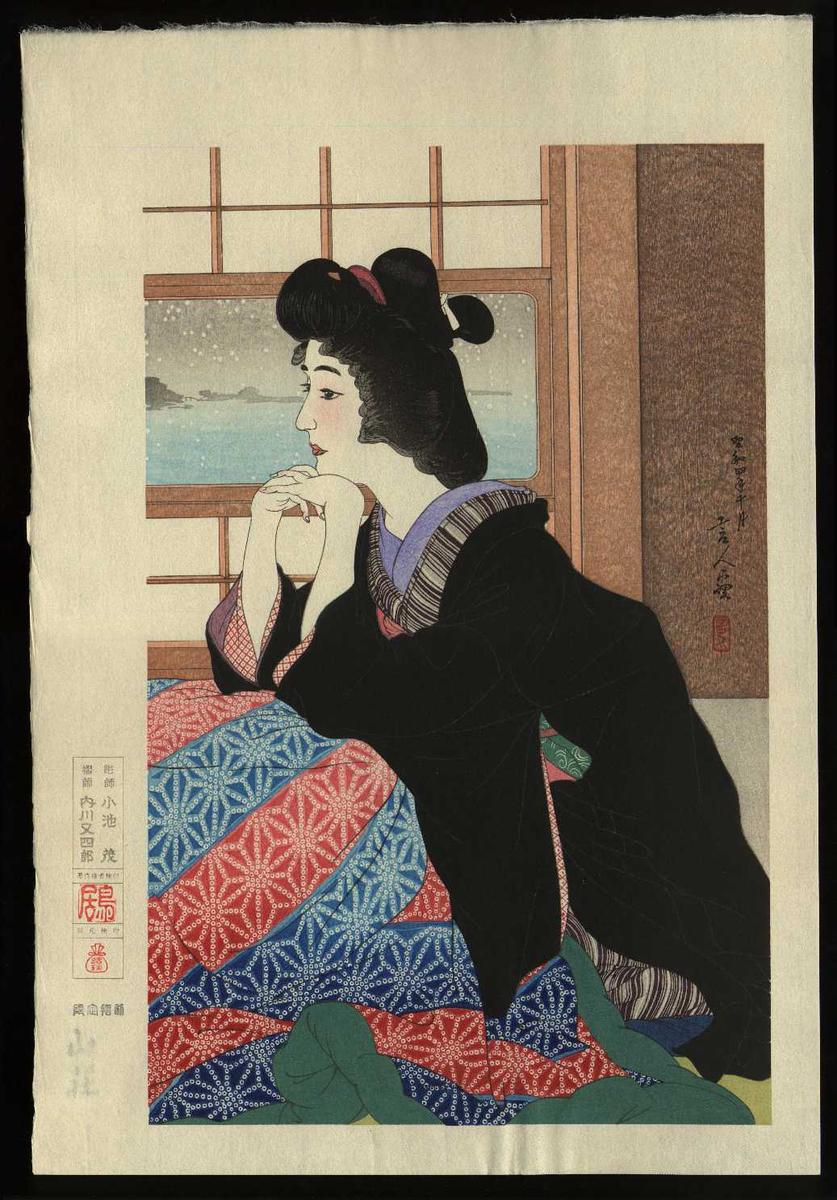
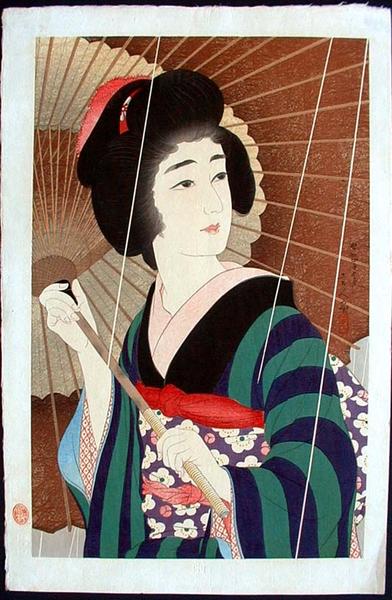
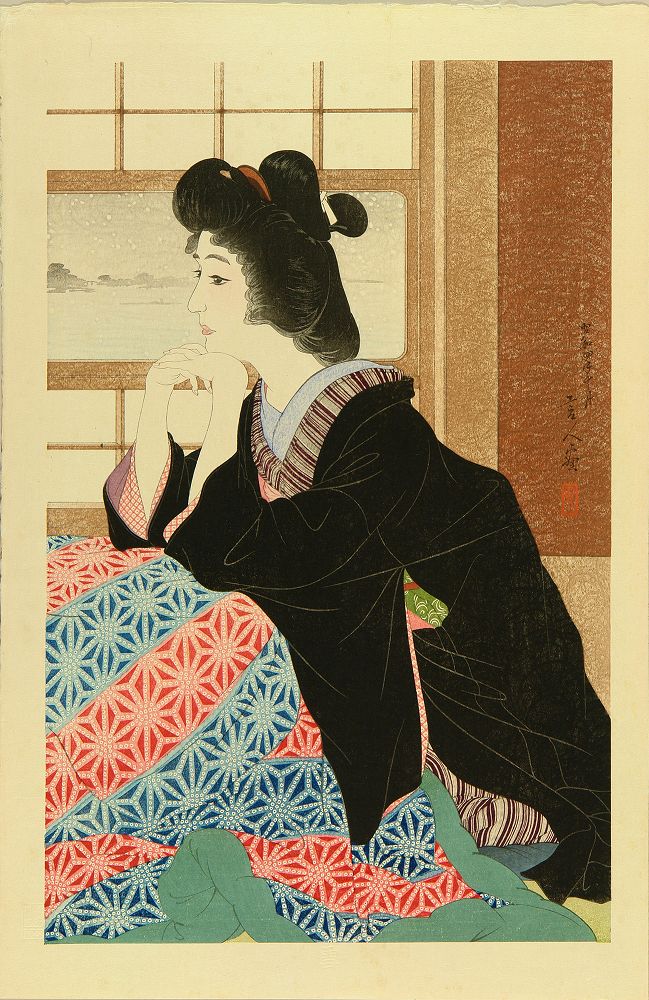
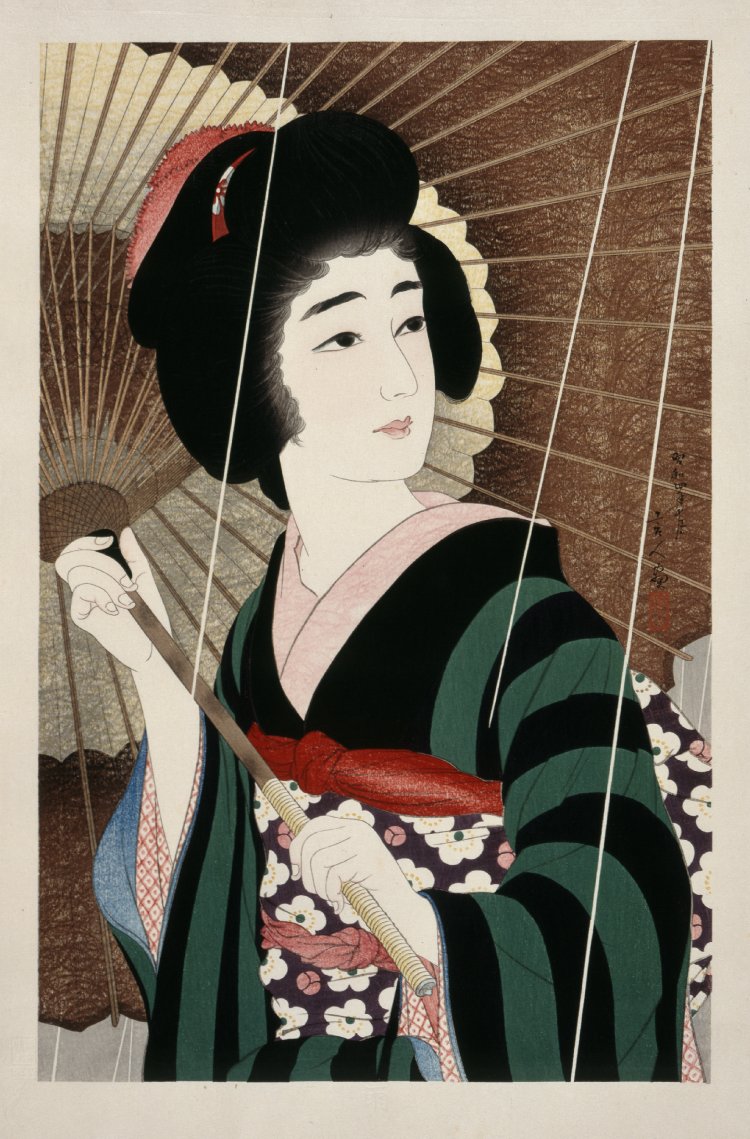
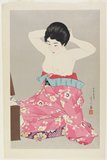
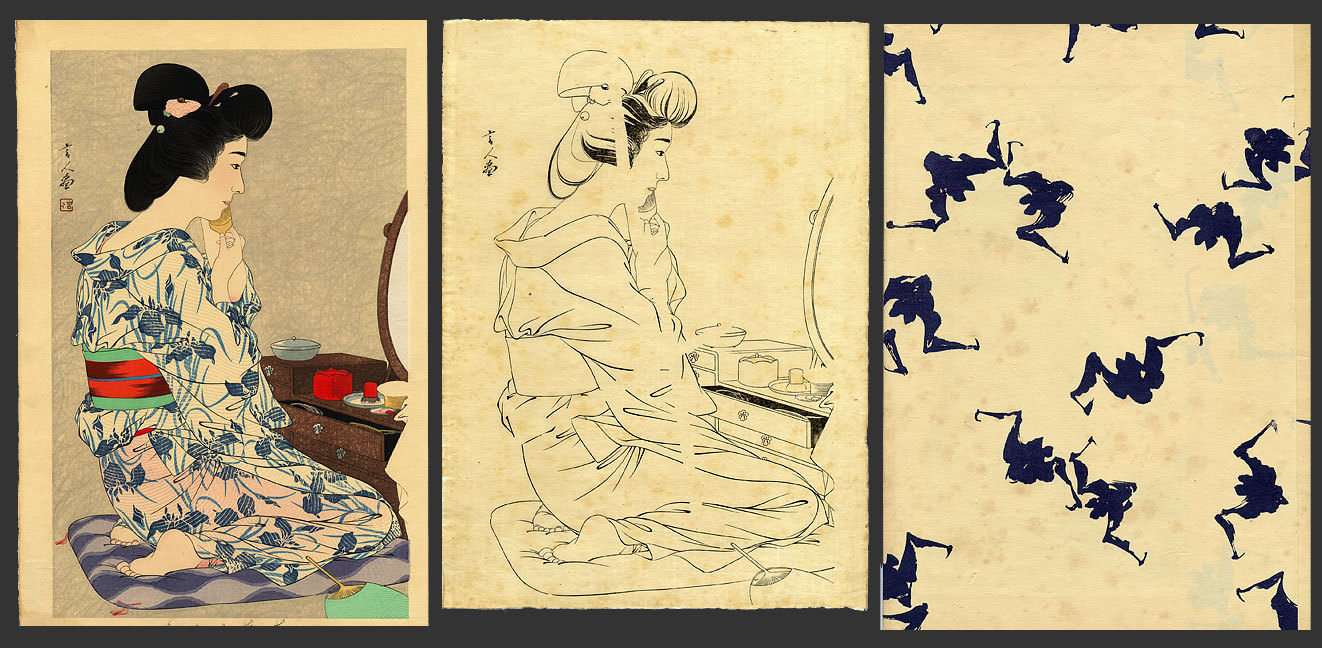
Other major works by Kotondo include "Rain" (Ame), depicting a woman in a rain-soaked kimono clutching an umbrella; "Makeup" (Kesho), showing a woman applying cosmetics before a mirror; "Snow" (Yuki), a woman standing in falling snow; and "Autumn Leaves" (Momiji), a woman framed by brilliant autumn foliage. Each of these prints demonstrates Kotondo's ability to use seasonal settings and atmospheric conditions to create emotional resonance and aesthetic depth. The rain in "Rain" is not merely a weather effect but a metaphor for emotional states; the snow in "Snow" suggests both physical chill and a purity of spirit; the autumn leaves in "Autumn Leaves" evoke the traditional Japanese sensitivity to the beauty of impermanence.
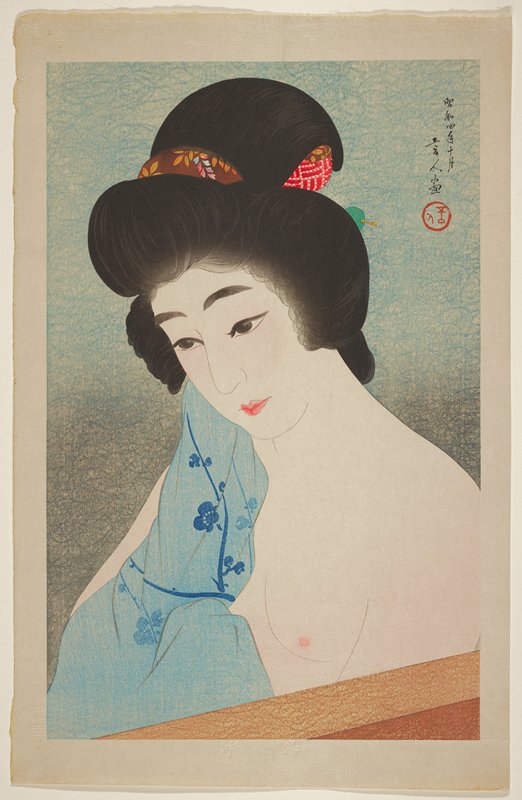
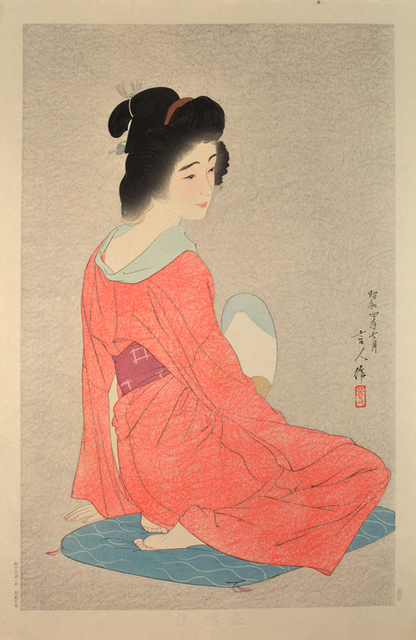
Technically, Kotondo's prints are among the finest produced in the shin-hanga era. The flesh tones in his bijin-ga are achieved through the application of multiple layers of translucent pigment, each carefully graduated to create the illusion of warmth and luminosity. His hair rendering — always one of the most technically demanding aspects of bijin-ga printing — is exceptionally refined, with individual strands suggested through precise carving and careful application of sumi ink. The textile patterns in his prints are rendered with extraordinary detail and accuracy, reflecting both his deep knowledge of traditional Japanese dress and the exceptional skill of Watanabe's carving team.
The decision to limit his print production appears to have been deliberate. Unlike more prolific shin-hanga artists such as Kawase Hasui or Ohara Koson, who produced hundreds of designs, Kotondo seems to have approached each print as a major artistic statement, devoting considerable time and attention to every design. The small size of his edition runs — typically fewer than two hundred impressions per design — further contributed to the rarity and collectibility of his work. Some evidence suggests that Kotondo may have been dissatisfied with some of his designs and chose not to allow them to be editioned, preferring to maintain an extremely high standard of quality even at the cost of a smaller body of work.
In addition to his work with Watanabe, Kotondo also self-published some of his prints, personally supervising the carving and printing process. These self-published editions tend to be even rarer than the Watanabe-published works and are among the most sought-after of all shin-hanga prints. The self-published works show slight differences in printing quality and technique compared to the Watanabe editions, reflecting Kotondo's personal aesthetic preferences in matters of paper selection, pigment application, and embossing.
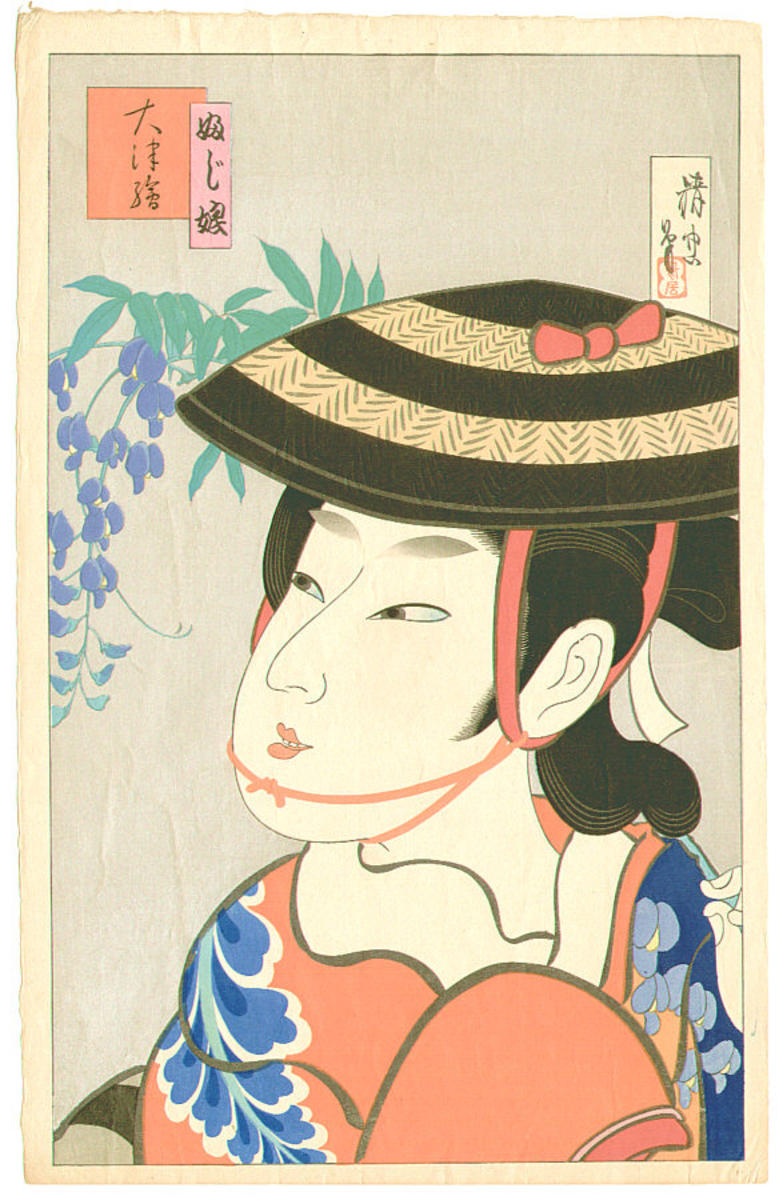
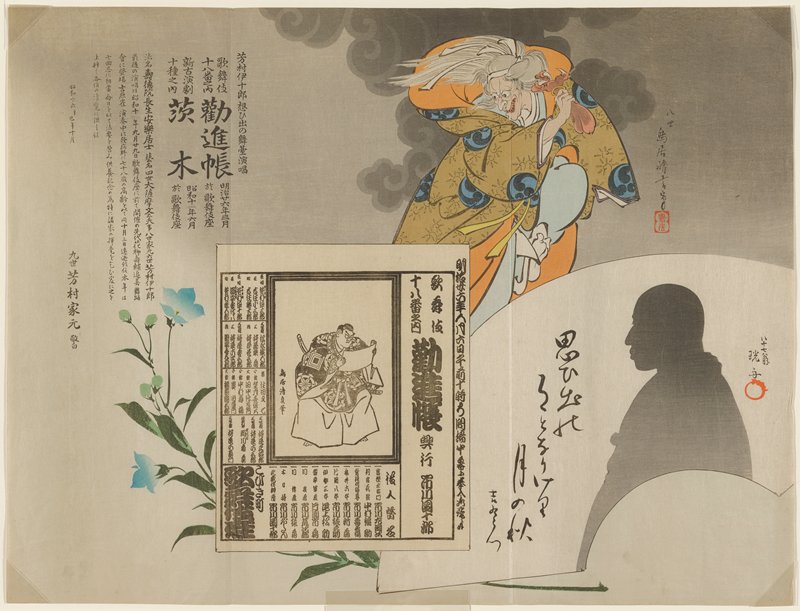
Alongside his printmaking, Kotondo maintained a career as a nihonga painter, exhibiting regularly at major exhibitions and accepting commissions for paintings. His paintings, primarily bijin-ga subjects, demonstrate the same refinement and technical mastery visible in his prints, executed in mineral pigments and ink on silk. He also continued the Torii school tradition of creating Kabuki theater posters and billboards, a commercial activity that connected him to the school's centuries-old role as the official artistic studio of the Kabuki world.
In his later years, Kotondo devoted increasing attention to his responsibilities as head of the Torii school and to the preservation of traditional Japanese painting techniques. He taught students, maintained the school's artistic traditions, and worked to ensure that the knowledge accumulated over generations would be passed on to future practitioners. He died in 1976 at the age of seventy-six, having served as a guardian of one of Japan's most venerable artistic lineages while simultaneously creating some of the most beautiful and sought-after prints of the modern era.
The legacy of Torii Kotondo rests on the paradox of extraordinary quality combined with extreme rarity. His twenty-one prints constitute one of the smallest bodies of work by any major Japanese print artist, yet each individual print is a masterwork that stands comparison with the finest productions of the shin-hanga movement or indeed of the entire Japanese woodblock print tradition. His prints are held in the collections of the Museum of Fine Arts Boston, the Honolulu Museum of Art, the British Museum, the Art Institute of Chicago, and other major institutions, though many are so rare that they are seldom exhibited. For collectors, a Kotondo print represents one of the ultimate acquisitions in the field of Japanese prints, combining extreme rarity with transcendent beauty and the imprimatur of one of Japan's most distinguished artistic lineages.
Key Facts
- Active Period
- 1900–1976
- Nationality
- 🇯🇵Japan
- Movement
- Shin-hanga
- Works Indexed
- 130
Frequently Asked Questions
What is Torii Kotondo known for?
Torii Kotondo, born in 1900 in Tokyo, was a Japanese woodblock print artist and painter who created one of the most exquisite and rarified bodies of work in the entire shin-hanga movement. Known for his luminous bijin-ga (beautiful women prints), Kotondo produced only approximately twenty-one woodblock prints during his lifetime — a remarkably small output that has made his works among the rarest and most sought-after of all modern Japanese prints. Despite this limited production, the extraordinary quality and refined beauty of his prints have secured him a place among the most admired artists of the twentieth century.
When was Torii Kotondo active?
Torii Kotondo was active from 1900 to 1976. They were associated with the Shin-hanga movement.
What artistic movements influenced Torii Kotondo?
Torii Kotondo's work was shaped by the Shin-hanga tradition in Japanese woodblock printmaking. Shin-hanga: The "new prints" movement (c.
What subjects did Torii Kotondo depict?
Torii Kotondo's prints frequently feature temples & shrines, portraits, landscapes, night scenes, autumn foliage, rivers & lakes.
Where can I see Torii Kotondo's original prints?
Original prints by Torii Kotondo can be found in collections including Art Institute of Chicago, Chazen Museum of Art, Japanese Art Open Database, Minneapolis Institute of Art.
How much do Torii Kotondo prints cost?
Torii Kotondo prints are among the most valuable and sought-after bijin-ga (beautiful women) prints of the 20th century. He created only 21 woodblock print designs during his career, each in limited editions, making his work genuinely scarce. Prices range from $2,000 for posthumous editions to $20,000+ for lifetime impressions of his most famous compositions. All of Kotondo's prints were published by Watanabe Shozaburo. Since his career began after the 1923 earthquake, there is no pre-earthquake vs. post-earthquake distinction as with other Watanabe artists. The key edition types are: lifetime editions (printed during Kotondo's active period with Watanabe, roughly 1929–1940s): $5,000–$20,000+. Posthumous Watanabe editions: $2,000–$5,000. Look for the Watanabe publisher seal and the quality of the bokashi (color gradation) printing, which is exceptionally demanding in Kotondo's designs. His prints feature some of the most complex printing in all of shin-hanga — some designs required 50 or more separate impressions to complete. His most famous print, "Keshosuru Onna" (Woman Applying Makeup), is considered a masterpiece of the genre and commands the highest prices. Other highly sought subjects include "Kami" (Combing Hair) and "Asa" (Morning). The rarity of his output — just 21 designs — ensures that any Kotondo print appearing at auction attracts serious collector attention. Lifetime editions in fine condition with strong bokashi and unfaded colors are increasingly scarce and represent strong long-term collectibles.
External Resources
Woodblock Prints by Torii Kotondo (130)

Beni (Rouge) 42/100
1930
Woodblock print

Morning Hair 18/100
1930
Woodblock print

Nap 52/100
1930
Woodblock print

Japanese Art Open Database
1930
Woodblock print

Fragrance of the Hot Spring — 湯の香
1930
Drawing

Head of the Hydrangea Mansion — あぢさい舎主人像
circa 1930-1960
Woodblock print

Daruma Doll Game
1930
Watercolor

Hazy Moon in the Spring (Oboroharu)
1930
Woodblock print

Fragrance of the Hot Springs (Yu no ka)
1930
Woodblock print

Make-up (At the Mirror) — 化粧
1930
Woodblock print

Make-up (At the Mirror) — 化粧
1930
Woodblock print

Applying Powder
Summer 1930
Woodblock print, ink and color on paper with mica
Snowy Evening — 雪の夕
1931
Woodblock print

Morning Hair - Asa Negami — 朝寝髪
1931
Woodblock print

Peony Snow (Botan Yuki)
1931
Woodblock print

Iris Kimono - あやめゆかた
1932
Woodblock print

In a Light Summer Kimono with Irises
1932
Woodblock print

Tipsy (Horoyoi)
1932
Color woodblock print

No. 2 - Iris Kimono - あやめゆかた
1932
Woodblock print

Lip Rouge
January 1932
Woodblock print, ink and color on paper with mica
No. 3 - Misty Spring Moon - おぼろ春
1932 1980s)
Woodblock print

Rouge- lipstick — くち紅
1932
Woodblock print

Misty Spring (Oboro Haru)
1932
Woodblock print

No. 6 - Lipstick - 口紅
1932 1980s)
Woodblock print

Summer Kimono - Ayame Yukata — 菖蒲ゆかた
1932
Woodblock print

Lipstick - 口紅
1932
Woodblock print

Tipsy — ほろ酔
1932
Woodblock print

Rouge- lipstick — Beni
1932
Woodblock print

After a Bath (Yugaeri)
1933
Woodblock print

Utatane- A nap- V1 — うたっ寝
1933
Woodblock print

Napping
February 1933
Woodblock print, ink and color on paper
Peony Snowflakes — 牡丹雪
1933
Woodblock print

No. 9 - Peony Snowflakes - 牡丹雪
1933
Woodblock print

Utatane- A nap- Version 2 — うたっ寝
1933
Woodblock print

Summer Geisha- Natsuko — 夏妓
1934
Woodblock print

No. 5 - Summer Geisha - 夏奴
1934
Woodblock print

Plum Blossoms at Night — 夜の梅
1934
Woodblock print

Summer Geisha (Natsuko)
ca. 1934
Woodblock print

Kanjincho
1935
Painting

Seated Woman
1936
Woodblock print

Fine Weather in Early-summer
May 1936
Woodblock printed book page, ink and color on paper

Yoshimura Ijūrō VI’s Memorable Stage Concerts
1941
Woodblock print, ink and color on paper

Kabuki Actor Print (1)
1950
Woodblock print

Kabuki Actor
Circa 1954
Woodblock print

Kotondo
Circa 1954
Woodblock print

Kabuki Actors
Circa 1954
Woodblock print

Mongaku at Nachi no Taki
Circa 1954
Woodblock print

Kuruwa Sayaate
Circa 1954
Woodblock print

Shuzenji Monogatari
Circa 1954
Woodblock print

Moon - 月
1980
Woodblock print

Torii, Kotondo
Edition of 100, 1980
Woodblock print

12 Aspects of Women, YUKI (Snow)
Edition of 100, 1980
Woodblock print

12 Aspects of Women, Morning Hair
Edition of 100, 1980
Woodblock print

Autumn - 秋
1980
Woodblock print

Flower - 花
1980
Woodblock print

Spring - 春
1982
Woodblock print

Woman in a crane patterned kimono in front of a flowering plum tree
Not set
Woodblock print

Moral Instruction — 国史美談教訓画蒐
Not set
Woodblock print

Actor and Umbrella with Cherry Blossoms
Not set
Woodblock print

Kabuki print 1
Not set
Woodblock print