![Spring Snow at Kiyomizu Temple, Kyoto (Haru no yuki [Kyoto Kiyomizu]) by Kawase Hasui — Japanese Color woodblock print; oban, April, 1932](https://www.artic.edu/iiif/2/07f4e5b6-3545-ecef-6d04-6f5741e62c38/full/843,/0/default.jpg)
Spring Snow at Kiyomizu Temple, Kyoto (Haru no yuki [Kyoto Kiyomizu])
Haru no yuki [Kyoto Kiyomizu]
by Kawase Hasui
- Date:
- April, 1932
- Medium:
- Color woodblock print; oban
- Format:
- Oban
- Dimensions:
- 23.7 × 36.2 cm
- Publisher:
- Watanabe Shozaburo
- Edition:
- Published by Watanabe Shozaburo
- Source:
- Art Institute of Chicago
Description
Spring Snow at Kiyomizu Temple, Kyoto portrays one of Japan's most famous temples in a rare and transient moment — a late spring snowfall that dusts the iconic wooden terrace and surrounding cherry trees with white. Created in 1932 and published by Watanabe Shozaburo, this print captures Kiyomizu-dera's celebrated main hall with its dramatic wooden stage projecting out over the hillside, supported by massive timber pillars. The juxtaposition of spring blossoms and unexpected snow creates a poignant visual metaphor for the Japanese aesthetic concept of mono no aware — the bittersweet awareness of impermanence.
Kiyomizu-dera, whose name means "Pure Water Temple," was founded in 778 and has been a UNESCO World Heritage Site since 1994. Its main hall, rebuilt in 1633 without the use of a single nail, features the famous butai stage that extends out over the forested Otowa hillside, offering panoramic views of Kyoto. Hasui's choice to depict this well-known subject during a spring snowfall — an unusual meteorological event that occurs perhaps once or twice in a given year — demonstrates his constant search for the extraordinary moment within the familiar landscape.
The technical execution required exceptional skill from the print craftsmen. The delicate balance between the pink tones of cherry blossoms and the white of fresh snow demanded precise color mixing and careful printing pressure. The architectural complexity of the temple buildings, with their layered rooflines and intricate timber construction, required detailed carving work, while the atmospheric effect of falling snow over the entire scene was achieved through overprinting techniques. This print belongs to a group of Kyoto subjects that Hasui produced throughout his career, documenting the ancient capital's temples, gardens, and streets across all seasons. Spring Snow at Kiyomizu Temple stands out within this group for its unusual seasonal combination and its masterful evocation of a fleeting natural phenomenon.
Current Listings
$16,000
More Prints by Kawase Hasui
More Snow Scenes Prints
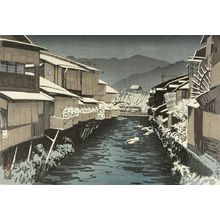
Fair Weather After Snow at Yamato Bridge, Kyoto (Yamato bashi no yukibare), Taishô period, dated 1924
Woodblock print

The Compound of the Tenman Shrine at Kameido in the Snow (Kameido Tenmangu keidai no yuki), from the series "Famous Places in the Eastern Capital (Toto meisho)"
c. 1832/38
Color woodblock print; oban

Miyajima in Snow (Yuki no Miyajima)
Yuki no Miyajima
1929
Color woodblock print; oban
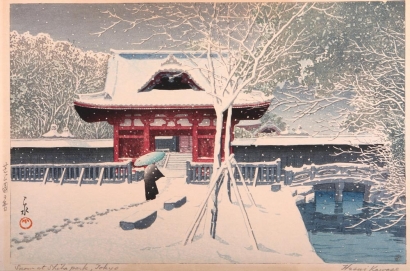
Evening Snow at Shiha Park, Tokyo
1932
Woodblock print
Featured in Collections
Curated cross-cuts that include this print.
Frequently Asked Questions
Spring Snow at Kiyomizu Temple, Kyoto (Haru no yuki [Kyoto Kiyomizu]) (Haru no yuki [Kyoto Kiyomizu]) was created by Kawase Hasui (川瀬巴水) in April, 1932.
Spring Snow at Kiyomizu Temple, Kyoto (Haru no yuki [Kyoto Kiyomizu]) uses Bokashi, Karazuri, and Nishiki-e, on color woodblock print; oban.
Spring Snow at Kiyomizu Temple, Kyoto (Haru no yuki [Kyoto Kiyomizu]) was published by Watanabe Shozaburo (April, 1932).
Spring Snow at Kiyomizu Temple, Kyoto (Haru no yuki [Kyoto Kiyomizu]) depicts snow scenes, temples & shrines, and spring, set at Kyoto, Kiyomizu Temple.
Spring Snow at Kiyomizu Temple, Kyoto (Haru no yuki [Kyoto Kiyomizu]) measures 23.7 × 36.2 cm (Oban format).