
Biography
Utagawa Kuniyoshi (歌川国芳, 1798–1861) stands as one of the most inventive and technically accomplished artists of the ukiyo-e tradition, a figure whose restless imagination pushed the boundaries of Japanese woodblock printing in directions that continue to surprise viewers today. Known variously by his art name Ichiyusai, he was a master of warrior prints, a pioneer of landscape composition, a satirist of uncommon wit, and perhaps history's most devoted artistic chronicler of cats. His work anticipated the visual language of modern manga, graphic novels, and anime with a dynamism that feels startlingly contemporary.
Kuniyoshi was born on January 1, 1798, in Edo (present-day Tokyo), the son of Yanagiya Kichiemon, a silk dyer. Originally named Yoshisaburo, the boy grew up surrounded by the bold patterns and vivid colors of his father's trade — an early immersion in the world of textile design that would later find expression in the rich, elaborate patterns that characterize his woodblock prints. By some accounts, the young Kuniyoshi assisted his father as a pattern designer, an experience that gave him an intuitive understanding of how color, form, and repetitive motifs could create powerful visual effects.
At approximately age twelve, around 1811, Kuniyoshi entered the studio of Utagawa Toyokuni I, the leading master of the Utagawa school and the most commercially successful ukiyo-e artist of his generation. Toyokuni's bold figural style and theatrical compositions deeply shaped Kuniyoshi's early development. This placed Kuniyoshi among a cohort of students that included Utagawa Kunisada (later Toyokuni III), who would become his lifelong professional rival. Where Kunisada gravitated toward the lucrative market for actor portraits and beauty prints, eventually becoming the most commercially successful ukiyo-e artist of his era, Kuniyoshi would carve out a distinctly different territory — more adventurous, more experimental, and more varied in its subject matter.
The early years of Kuniyoshi's independent career were marked by prolonged struggle and near-destitution. After receiving his art name and beginning to publish around 1814, he found little commercial success for over a decade. The market was dominated by Kunisada's actor portraits and Keisai Eisen's bijin-ga, and Kuniyoshi's early efforts in these genres failed to distinguish themselves. By some accounts he was so poor during this period that he supplemented his meager income by selling used tatami mats and repairing household goods. The long years of hardship tested his resolve but may also have sharpened his hunger for the dramatic breakthrough that would eventually come.
The breakthrough arrived in 1827, when Kuniyoshi began publishing his series "108 Heroes of the Popular Suikoden" (Tsuzoku Suikoden Goketsu Hyakuhachinin no Hitori), depicting the legendary Chinese bandits of the classical novel "Water Margin" (Shuihu Zhuan). These prints were a revelation. Each hero was rendered as a figure of explosive dynamism — muscles rippling beneath elaborate full-body tattoos, weapons raised against swirling backgrounds of water, flame, and storm. The series brilliantly tapped into a contemporary craze for tattooing among Edo's townspeople, and the prints themselves became reference designs for tattoo artists, a role they continue to serve nearly two centuries later. The elaborate, interlocking tattoo designs that Kuniyoshi invented for his Suikoden heroes — featuring dragons, tigers, waves, cherry blossoms, and mythological scenes wrapping around the heroes' torsos, arms, and backs — established visual conventions for the Japanese tattoo tradition (irezumi) that persist to this day in tattoo parlors from Tokyo to New York. The series made Kuniyoshi famous almost overnight and established the warrior print (musha-e) as his signature genre.
Through the 1830s and 1840s, Kuniyoshi produced an extraordinary body of warrior prints that remain unsurpassed in their dramatic power and compositional daring. His depictions of samurai battles, mythological combats, and scenes from Japanese history combined meticulous period detail with a sense of kinetic energy entirely new to the medium. He drew his subjects from the great military chronicles — the "Tale of the Heike" (Heike Monogatari), the "Rise and Fall of the Minamoto and Taira" (Genpei Seisuiki), and other tales of feudal warfare — bringing to them a visual intensity that made historical events feel urgently present. He was particularly innovative in his use of the triptych format, composing scenes across three joined sheets to create panoramic images of remarkable sweep and complexity that were designed to be viewed as unified compositions rather than three separate prints. The panoramic format allowed him to stage battles of epic scale, with waves of combatants surging across the picture plane, supernatural forces erupting from darkness, and heroes performing feats of superhuman strength.
His most famous single composition, "Takiyasha the Witch and the Skeleton Spectre" (Soma no Furudairi, c. 1844), depicts the sorceress Princess Takiyasha — daughter of the rebel warlord Taira no Masakado — summoning a gigantic skeletal apparition that crashes through the tattered blinds of an abandoned palace to menace the imperial agent Oya no Mitsukuni. Masakado himself had been a provincial warlord who attempted to establish a rival court in the eastern provinces before being defeated and killed by imperial forces in the mid-tenth century. In Kuniyoshi's print, the enormous skeleton, spread across two of the three sheets with its bony fingers reaching forward out of a terrifying black void, is one of the most arresting images in all of printmaking — an image so striking that it has become the defining visual icon of supernatural horror in Japanese art. Other important warrior series include "Stories of Wise and Brave Heroines" (Kenjo Reppu Den), which depicted female warriors and heroines from Japanese history, and "The Faithful Samurai" (Seichu Gishi Den), which portrayed the famous forty-seven ronin.
Kuniyoshi was also a significant landscape artist, though this aspect of his work is sometimes overshadowed by his warrior prints. His landscape prints reveal a sophisticated engagement with Western art, which he studied through Dutch and other European engravings that entered Japan via Nagasaki — a notable interest for an artist working in a country that had been largely closed to foreign contact for over two centuries. He incorporated Western single-point perspective, chiaroscuro shading, and atmospheric effects into his compositions, sometimes producing landscapes that hover in a striking intermediate space between European and Japanese pictorial conventions. His landscape triptychs of the Tokaido and other scenic routes show a willingness to experiment with spatial depth and light that distinguishes them from the work of his contemporaries.
Kuniyoshi's engagement with the supernatural extended well beyond the Skeleton Spectre. He produced numerous prints depicting ghosts, demons, shape-shifting foxes and tanuki, and other creatures from Japanese folklore and legend. His depictions of the undersea world — including the famous Dragon Palace triptychs showing the mythological palace of the sea god — combined natural observation of marine life with fantastical invention in compositions of remarkable visual complexity. His prints of giant sea creatures, enormous carp, and battling octopi demonstrate an imagination that delighted in the monstrous and the marvelous, pushing the conventions of the ukiyo-e medium into territory that no previous artist had explored.
Kuniyoshi was also a skilled designer of bijin-ga (beauty prints), though he is less celebrated in this genre than Utamaro or Eisen. His depictions of women tend to be more robust and dynamic than the languorous beauties favored by other artists — his female figures often appear in active roles, working, traveling, or engaged in seasonal activities, and his series depicting women from different provinces of Japan combined ethnographic observation with characteristic vigor. His prints of women from historical and legendary sources — including female warriors, ghost women, and supernatural temptresses — blur the boundaries between the beauty print and the warrior print genres in ways that are distinctively his own.
Among Kuniyoshi's most enduring and beloved works are his humorous prints (giga) and his depictions of cats. He was famously devoted to felines — contemporary accounts describe his studio as perpetually overrun with cats, and he reportedly kept so many that visitors struggled to find a place to sit. He produced numerous prints featuring cats in anthropomorphic roles: cats forming the shapes of human faces in visual puzzles, cats mimicking kabuki actors in parodies of famous plays, cats dressed as people going about daily business, and cats studying, dancing, and engaging in all manner of human activity. These prints display a warmth, humor, and observational precision that reveal an artist who genuinely loved and studied his subjects.
Beyond their charm, Kuniyoshi's animal prints served a serious purpose in an era of increasing government censorship. The Tempo Reforms of 1841–1843, initiated by the senior councilor Mizuno Tadakuni, attempted to address economic crisis by restricting public displays of luxury and wealth. Prints depicting kabuki actors, courtesans, and other subjects deemed to promote extravagance were officially banned. Kuniyoshi responded with characteristic ingenuity, producing prints that appeared to depict cats, tanuki (raccoon dogs), sparrows, and goldfish but contained veiled political commentary and satirical references to current events that were readily legible to his Edo audience. Some of these prints were thinly disguised caricatures of shogunal officials — his 1843 design showing Minamoto no Yorimitsu haunted by the Earth Spider and its demons was widely understood as a satirical attack on the Tempo reforms. These works made Kuniyoshi a folk hero among the politically dissatisfied townspeople of Edo, and he was reportedly summoned and reprimanded by the authorities, though the charges were apparently dropped.
Kuniyoshi's studio was one of the most productive training grounds in the history of ukiyo-e. He trained numerous students, many of whom went on to distinguished careers. Among his most notable pupils were Tsukioka Yoshitoshi, widely regarded as the last great master of ukiyo-e, whose powerful prints carried his teacher's dramatic sensibility into the Meiji era and pushed the boundaries of the medium toward the narrative intensity that would characterize manga; Utagawa Yoshitora, who became an important chronicler of the foreign settlement at Yokohama; Utagawa Yoshiiku, a pioneer of newspaper illustration who helped adapt woodblock techniques for the new medium of printed journalism; and Kawanabe Kyosai, who although not a formal pupil absorbed much of Kuniyoshi's spirit of irreverence and comic invention.
Kuniyoshi's influence on Western art, while less extensively documented than that of Hokusai or Hiroshige, was nonetheless real. His prints reached the West after the opening of Japan and contributed to the wave of enthusiasm for Japanese art known as Japonisme. The dynamic energy of his compositions — particularly his depictions of movement, combat, and supernatural transformation — offered European artists a visual vocabulary that had no Western equivalent.
The breadth of Kuniyoshi's subject matter means that his prints appeal to a wide range of interests — from martial arts enthusiasts and tattoo artists drawn to the warrior prints, to admirers enchanted by his feline compositions, to historians of political satire interested in his coded critiques of the Tokugawa government. His cat prints in particular have developed a devoted following, prized for their humor and accessibility.
Beyond his prints, Kuniyoshi was an accomplished painter who produced works on silk and paper for private patrons. His painted works, which include large-scale depictions of mythological subjects and intimate studies of animals, demonstrate a facility with the brush that complemented his mastery of the printed medium. He was also known for his distinctive personal style — he reportedly decorated his studio with cat accessories and ephemera, wore unconventional clothing, and maintained a boisterous household that was a gathering place for students, friends, and admirers. His personality, which combined fierce artistic ambition with warmth, humor, and generosity toward his students, made him one of the most beloved figures in the Edo art world.
Kuniyoshi suffered a stroke around 1856 that partially paralyzed him and severely limited his ability to work. He produced a reduced number of designs in his final years, though some of these late works retain the energy and imagination of his prime. He died on April 14, 1861, in Edo, just seven years before the Meiji Restoration would sweep away the feudal order that had shaped the world of ukiyo-e.
Kuniyoshi's works are held in major museum collections worldwide. The British Museum holds one of the most comprehensive collections of his prints outside Japan, including fine impressions of the Suikoden heroes, the Skeleton Spectre triptych, and many of his cat compositions. The Victoria and Albert Museum, the Metropolitan Museum of Art, the Art Institute of Chicago, the Los Angeles County Museum of Art, the Museum of Fine Arts Boston, the Honolulu Museum of Art, and the Tokyo National Museum all hold significant collections of his prints.
Kuniyoshi's legacy resides not merely in the enormous volume of his output but in the range and daring of his artistic vision. His warrior prints defined the visual iconography of the samurai for subsequent generations and continue to inspire tattoo artists, graphic novelists, video game designers, and filmmakers around the world. The elaborate full-body tattoos he designed for his Suikoden heroes became the foundation of the Japanese irezumi tradition, and contemporary tattoo artists in Japan and internationally continue to use his compositions as source material — a living artistic legacy that extends from the printed page to human skin. His humorous works anticipated modern cartooning and graphic design, and his anthropomorphic cat prints in particular have found new audiences through social media, where they are widely shared and celebrated.
His engagement with Western techniques helped bridge the visual cultures of East and West at a moment of historic transition. The Museum of Fine Arts Boston staged the exhibition "Showdown! Kuniyoshi vs. Kunisada" in 2017, exploring the productive rivalry between these two masters of the late Utagawa school and demonstrating that Kuniyoshi's critical reputation has risen steadily in recent decades while Kunisada's — though more commercially successful in his own lifetime — has remained more static. Among the last great masters of ukiyo-e, Kuniyoshi was also the most forward-looking, an artist whose work speaks across centuries with undiminished vitality.
Key Facts
- Active Period
- 1798–1861
- Movement
- Ukiyo-e
- Works Indexed
- 308
Frequently Asked Questions
Utagawa Kuniyoshi (歌川国芳, 1798–1861) stands as one of the most inventive and technically accomplished artists of the ukiyo-e tradition, a figure whose restless imagination pushed the boundaries of Japanese woodblock printing in directions that continue to surprise viewers today. Known variously by his art name Ichiyusai, he was a master of warrior prints, a pioneer of landscape composition, a satirist of uncommon wit, and perhaps history's most devoted artistic chronicler of cats. His work anticipated the visual language of modern manga, graphic novels, and anime with a dynamism that feels startlingly contemporary.
Utagawa Kuniyoshi was active from 1798 to 1861. They were associated with the Ukiyo-e movement.
Utagawa Kuniyoshi's work was shaped by the Ukiyo-e tradition in Japanese woodblock printmaking. Ukiyo-e: ## What is ukiyo-e? Ukiyo-e ([浮世絵](/glossary/ukiyo-e)) — literally "pictures of the floating world" — is the Edo-period Japanese print and painting tradition that flourished from roughly 1660 to 1868, depicting the pleasures of urban life in Edo (modern Tokyo): courtesans, kabuki actors, sumo wrestlers, famous landscapes, and seasonal beauties.
Utagawa Kuniyoshi's prints frequently feature warriors, figures, landscapes, heroes & warriors, suikoden (water margin), portraits.
Original prints by Utagawa Kuniyoshi can be found in collections including Minneapolis Institute of Art, Art Institute of Chicago, Art Gallery of Greater Victoria, Victoria and Albert Museum.
External Resources
Series by Utagawa Kuniyoshi
One Hundred and Eight Heroes of the Popular Suikoden
1827–1830 · 108 prints
Elegant Women's Water Margin
1830–1841
Eight Hundred Heroes of the Japanese Water Margin
1836–1840
Famous Places in the Eastern Capital (Toto meisho)
3 prints
Twenty-four Paragons of Filial Piety as a Mirror for Children (Nijushiko doji kagami)
5 prints
People Who Like the Latest Fashions and Manners
1 print
Famous Places on the Fifty-three Stations of the Tokaido, Three Stations (Tokaido gojusan eki sanshuku meisho)
1 print
Famous Places on the Fifty-three Stations of the Tokaido, Five Stations (Tokaido gojusan eki goshuku meisho)
4 prints
Sketches of the Life of the Great Priest
1 print
Treasury of Loyal Retainers (Chushingura)
1 print
Views of the Eastern Capital (Toto no zu)
1 print
Lives of Wise and Heroic Women
1 print
Five Views of Mount Fuji (Fuji goban no uchi)
1 print
Concise Illustrated Biography of the Great Priest [Nichiren] (Koso go ichidai ryakuzu)
3 prints
Ogura Versions of the One Hundred Poets (Ogura nazorae Hyakunin isshu)
2 prints
Heroes for the Twelve Animals of the Zodiac (Buyu mitate junishi)
1 print
One Hundred Poems by One Hundred Poets
1 print
Thirty-six Views of Mount Fuji Seen from the Eastern Capital (Toto Fujimi sanjurokkei)
1 print
Famous Views of the Fifty-three Stations of the Tōkaidō Road
1 print
Famous Places on the Fifty-three Stations of the Tokaido, Four Stations (Tokaido gojusan eki yonshuku meisho)
2 prints
Woodblock Prints by Utagawa Kuniyoshi (308)

Lu Zhishen, Originally Named Lu Da (Kaosho Rochishin shomei Rotatsu), from the series "One Hundred and Eight Heroes of the Popular Water Margin (Tsuzoku Suikoden goketsu hyakuhachinin no hitori)"
c. 1827
Color woodblock print; oban

Ma Lin (Tettekisen Barin), from the series "One Hundred and Eight Heroes of the Popular Water Margin (Tsuzoku Suikoden goketsu hyakuhachinin no hitori)"
c. 1827/30
Color woodblock print; oban

Zhang Qing (Botu'usen Chosei), from the series "One Hundred and Eight Heroes of the Popular Water Margin (Tsuzoku Suikoden goketsu hyakuhachinin no hitori)"
c. 1827/30
Color woodblock print; oban

Sun Li (Byo'utchi Sonritsu), from the series "One Hundred and Eight Heroes of the Popular Water Margin (Tsuzoku Suikoden goketsu hyakuhachinin no hitori)"
c. 1827/30
Color woodblock print; oban
![Wu Song (Seikaken no san Busho), from the series "One Hundred and Eight Heroes of the [Popular] Water Margin ([Tsuzoku] Suikoden goketsu hyakuhachinin no hitori)" by Utagawa Kuniyoshi](https://www.artic.edu/iiif/2/517bdaa5-8b45-dbd1-030d-e6896bc46b65/full/843,/0/default.jpg)
Wu Song (Seikaken no san Busho), from the series "One Hundred and Eight Heroes of the [Popular] Water Margin ([Tsuzoku] Suikoden goketsu hyakuhachinin no hitori)"
c. 1827/30
Color woodblock print; oban

Li Kui (Kokusenpu Riki, ichimei Ritetsugyu), from the series "One Hundred and Eight Heroes of the Popular Water Margin (Tsuzoku Suikoden goketsu hyakuhachinin no hitori)"
c. 1827
Color woodblock print; oban

Bai Sheng (Hakujisso Hakusho), from the series "One Hundred and Eight Heroes of the Popular Water Margin (Tsuzoku Suikoden goketsu hyakuhachinin no hitori)"
c. 1827/30
Color woodblock print; oban

Zheng Tianshou (Hakumenrokun Teitenja), from the series "One Hundred and Eight Heroes of the Popular Water Margin (Tsuzoku Suikoden goketsu hyakuhachinin no hitori)"
c. 1827/30
Color woodblock print; oban

Ensei
c. 1828–30
Woodblock print (surimono), ink and color on paper

Distant View of Mount Fuji at Dawn from Hakone
c. 1828/30
Color woodblock print; shikishiban, surimono
![Gen Shogo [Ruan Xiaowu]; Five-sheet print of Collecting Brine, no. 5 by Utagawa Kuniyoshi](https://1.api.artsmia.org/800/82218.jpg)
Gen Shogo [Ruan Xiaowu]; Five-sheet print of Collecting Brine, no. 5
c. 1828–30
Woodblock print (surimono), ink and color on paper

Low Tide at Susaki - A Set of Five (Shiohi goban no uchi)
c. 1828-30
Color woodblock prints; shikishiban pentaptych, surimono
Genshōshichi, from the series Elegant Women's The Water Margin: From One Hundred and Eight Figures (Fuzoku onna Suikoden: Ippyaku-hachinin no uchi)
c. 1828-1832
Woodblock print (surimono); ink, color, and metallic pigments on paper
Ro Shungi (Chinese: Lu Junyi), from the series Elegant Women's The Water Margin: From One Hundred and Eight Figures (Fuzoku onna Suikoden: Ippyaku-hachinin no uchi)
c. 1828-1832
Woodblock print (surimono); ink, color, and metallic pigments on paper
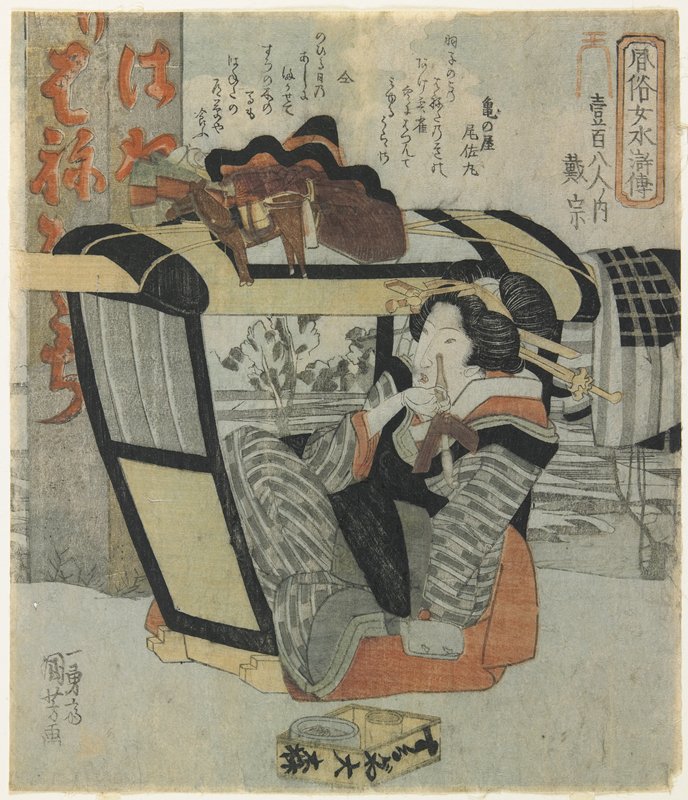
Woman as the Hero Taisō in Palanquin Holding a Pipe
c. 1830
Woodblock print (surimono), ink and color on paper
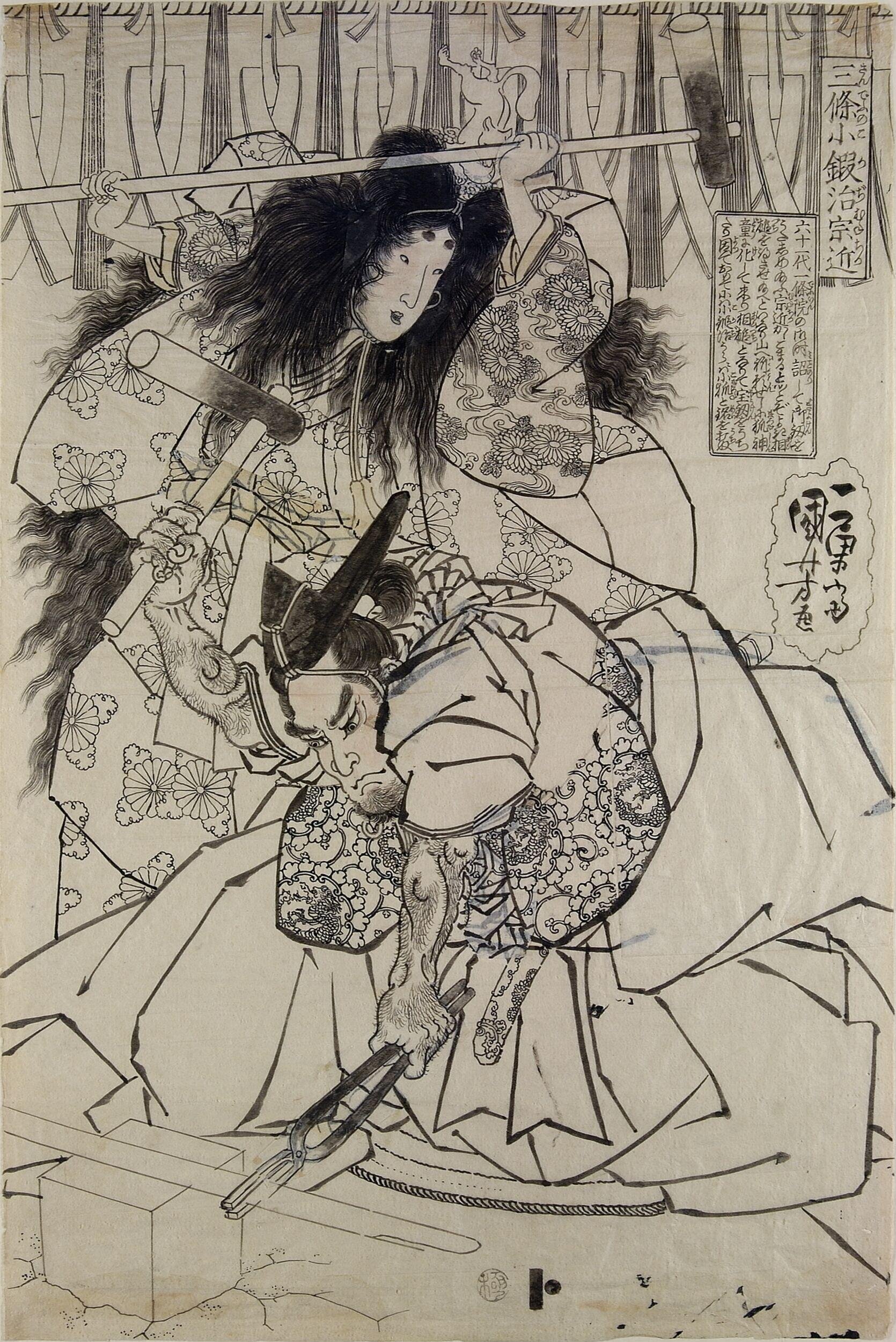
Sanjō no Kokaji Munechika
Mid-1830s
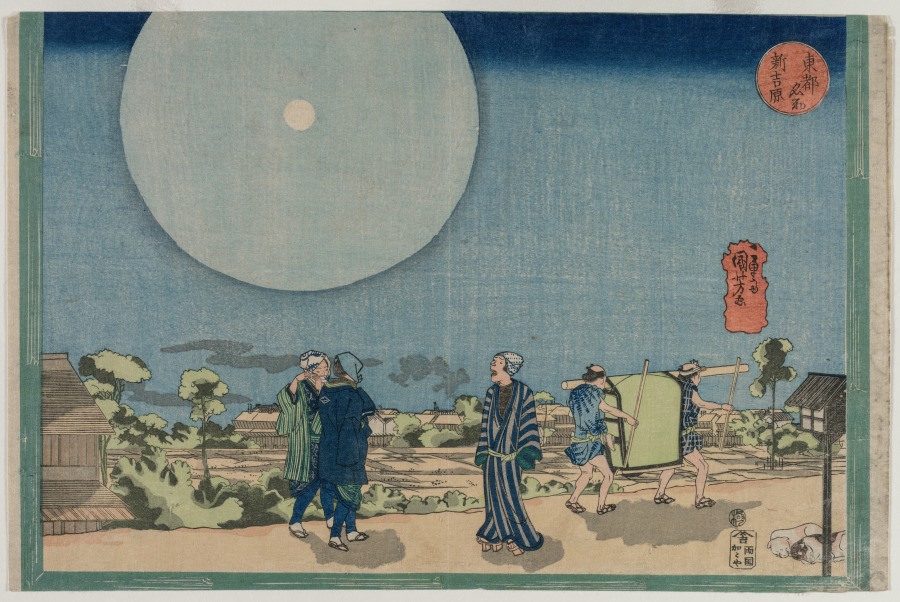
New Yoshiwara (Shin Yoshiwara), from the series Famous Places in the Eastern Capital
early 1830s
color woodblock print

View of Mitsumata in the Eastern Capital (Toto Mitsumata no zu), from the series "Views of the Eastern Capital (Toto no zu)"
early 1830s
Color woodblock print; oban

Flowers: Onoe Kikugoro III, from an untitled series of actors representing snow, moon, and flowers
c. 1830s
Color woodblock print; shikishiban, surimono

Nihonbashi, Shinagawa, Kawasaki, and Kanagawa, from the series "Famous Places on the Fifty-three Stations of the Tokaido, Four Stations (Tokaido gojusan eki yonshuku meisho)"
c. 1830/35
Color woodblock print; oban
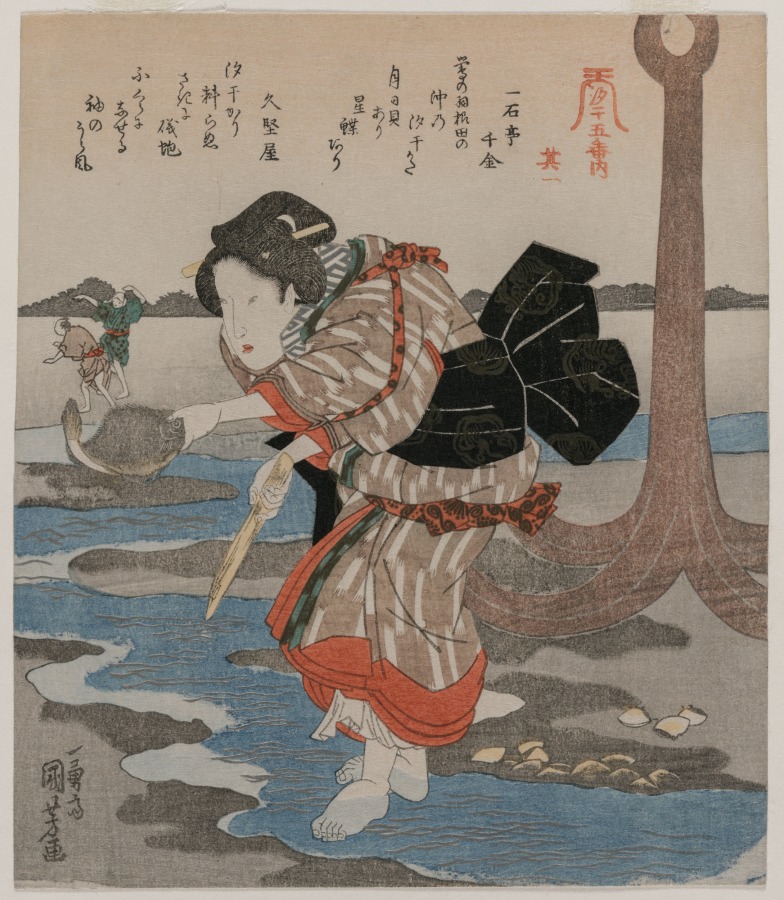
A Low Tide Pentaptych
c. 1830
Pentaptych of color woodblock prints
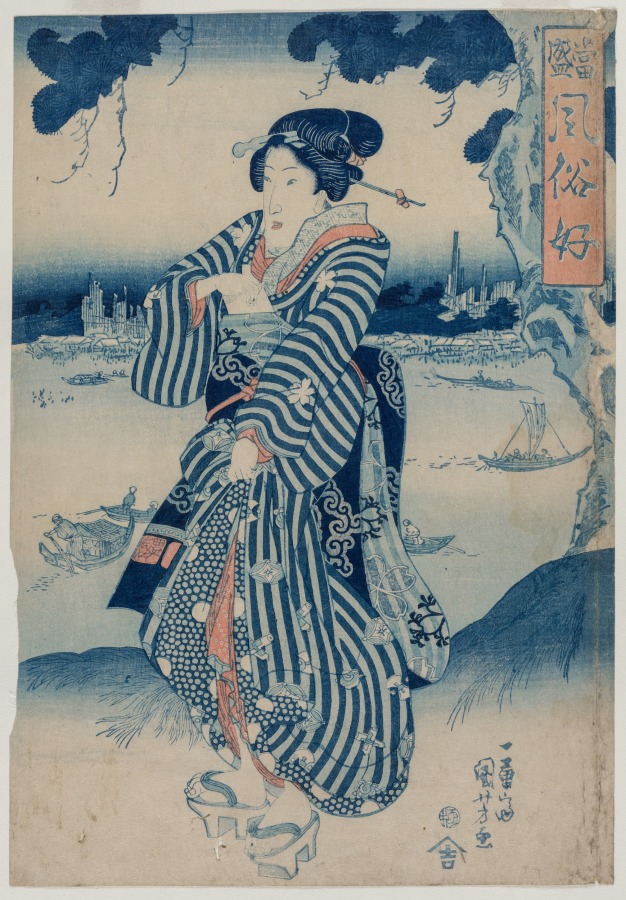
Geisha Standing on the Bank of the Sumida River (from the series People Who Like the Latest Fashions and Manners)
early 1830s
color woodblock print

Akasaka, Fujikawa, Okazaki, Chiryu, and Narumi, from the series "Famous Places on the Fifty-three Stations of the Tokaido, Five Stations (Tokaido gojusan eki goshuku meisho)"
c. 1830/35
Color woodblock print; oban
Kasumigaseki
c. 1830–35
Woodblock print (nishiki-e), ink and color on paper