
Biography
Utagawa Toyokuni I (1769-1825) stands as one of the most consequential figures in the history of Japanese woodblock printmaking, the founder of the Utagawa school's dominant actor-print tradition and the artistic patriarch from whom virtually every major nineteenth-century ukiyo-e designer descended. Born in Edo in 1769, Toyokuni came of age during the late golden era of ukiyo-e, when designers such as Kitagawa Utamaro, Toshusai Sharaku, and Torii Kiyonaga were redefining the boundaries of figural representation in print. Toyokuni would absorb those innovations, synthesize them, and pass them forward through a teaching lineage so prolific that his pupils Utagawa Kunisada and Utagawa Kuniyoshi went on to define the very face of nineteenth-century ukiyo-e.
Toyokuni was born Kurahashi Kumakichi, the son of an Edo doll carver whose shop reportedly stood near that of the printmaker Utagawa Toyoharu. Through this neighborhood proximity, the young Kumakichi entered Toyoharu's studio as a pupil, probably in his early teens. Toyoharu (1735-1814), the founder of the Utagawa school, was best known for his perspective prints (uki-e) influenced by Western and Chinese landscape conventions, and he taught Toyokuni the disciplined draftsmanship and compositional precision that would underpin his student's mature work. Toyokuni adopted the Utagawa surname from his master and the Toyo- prefix that designated members of the school, taking the go (art name) Toyokuni around the time of his earliest published designs in the mid-1780s.
Toyokuni's first decade as a designer was experimental and varied. He produced bijin-ga (pictures of beautiful women), book illustrations, and ambitious large-format multi-sheet compositions in which fashionable women of Edo were arranged across diptychs, triptychs, and even pentaptychs against settings drawn from the pleasure quarters, the seasonal landscape, and the daimyo's mansion. These prints absorbed the elongated, attenuated bijin proportions popularized by Kiyonaga in the 1780s, but Toyokuni gradually pushed the figures toward greater individuality of pose and gesture. By the early 1790s he had begun to develop a distinctly theatrical sensibility, with mitate (parody) subjects that recast classical Noh dramas and historical legends in contemporary dress, often as a vehicle for showing off Edo's evolving fashions.
The pivotal moment of Toyokuni's career came in 1794 with the publication of Yakusha Butai no Sugata-e (Pictures of Actors on Stage), a series of full-length kabuki actor portraits issued over roughly two years through 1796. The series appeared concurrently with Toshusai Sharaku's now-celebrated okubi-e (large-head actor portraits), and although Sharaku's productions have come to dominate later critical reception, it was Toyokuni's series that conquered the contemporary Edo market. Where Sharaku's images probed psychological intensity to the point of caricature, Toyokuni's prints offered idealized, theatrically composed figures shown in the climactic mie poses that audiences came to the kabuki theatre to see. The series made Toyokuni the leading actor-print designer of the 1790s and established the visual template (full-length figure, isolated against a colored background, identifiable by costume mon and pose) that would govern kabuki print design for the next half-century.
Through the late 1790s and early 1800s Toyokuni produced actor prints at extraordinary volume, working with virtually every Edo publisher of consequence and depicting the major stars of the Kabuki stage including the Ichikawa, Onoe, Bando, Iwai, Segawa, and Nakamura lines. His designs were prized for their accurate likenesses (nigao-e) of named performers and for their crisp shorthand of the actor's stage business: the hand on the sword hilt, the cocked head of a maiden role, the half-turned glance of a villain. He also continued to produce ambitious bijin-ga, courtesan portraits, surimono (privately commissioned prints), and parody compositions, drawing freely on classical literature, Noh drama, and the legends of the warrior past.
Toyokuni's most enduring contribution, however, was institutional rather than individual. He took on an enormous number of students and ran what was effectively the largest design atelier in Edo. His pupils included Utagawa Kunimasa, Utagawa Kuninao, Utagawa Kunimaru, Utagawa Toyoshige (later Toyokuni II), and most consequentially Utagawa Kunisada (Toyokuni III) and Utagawa Kuniyoshi. The great landscape master Hiroshige, though bound to the same Utagawa lineage, descended not from Toyokuni himself but through Toyokuni's fellow Toyoharu pupil Utagawa Toyohiro. Through these students the Utagawa school came to dominate ukiyo-e production for the rest of the Edo period and into the Meiji era. By the mid-nineteenth century, an Edo print buyer could go an entire month without encountering an actor or warrior print designed outside the Toyokuni lineage.
When Toyokuni I died in 1825, the Toyokuni name passed to his son-in-law and senior pupil Toyoshige, who signed thereafter as Toyokuni II. Kunisada eventually asserted his own claim to the name and signed as Toyokuni III from 1844 onward, and the lineage continued. The succession was sometimes contested, but the very fact that the name was fought over speaks to its prestige: in early-nineteenth-century Edo, the name Toyokuni was the closest thing the floating world had to a brand of guaranteed quality.
Major public collections of Toyokuni I's prints are held by the Art Institute of Chicago, the Museum of Fine Arts, Boston, the British Museum, the Metropolitan Museum of Art, the Honolulu Museum of Art, and the Edo-Tokyo Museum. He remains a pillar of any serious survey of Edo kabuki actor prints, of the Utagawa school, and of the wider history of ukiyo-e in its mature commercial form. For collectors of Japanese woodblock prints, an early Toyokuni I actor print or bijin triptych is among the most treasured of late-Edo designs — both as a work of art in its own right and as the genealogical root of so much that followed.
Key Facts
- Active Period
- 1769–1825
- Nationality
- 🇯🇵Japan
- Movement
- Ukiyo-e
- Works Indexed
- 228
Frequently Asked Questions
Utagawa Toyokuni I (1769-1825) stands as one of the most consequential figures in the history of Japanese woodblock printmaking, the founder of the Utagawa school's dominant actor-print tradition and the artistic patriarch from whom virtually every major nineteenth-century ukiyo-e designer descended. Born in Edo in 1769, Toyokuni came of age during the late golden era of ukiyo-e, when designers such as Kitagawa Utamaro, Toshusai Sharaku, and Torii Kiyonaga were redefining the boundaries of figural representation in print. Toyokuni would absorb those innovations, synthesize them, and pass them forward through a teaching lineage so prolific that his pupils Utagawa Kunisada and Utagawa Kuniyoshi went on to define the very face of nineteenth-century ukiyo-e.
Utagawa Toyokuni I was active from 1769 to 1825. They were associated with the Ukiyo-e movement.
Utagawa Toyokuni I's work was shaped by the Ukiyo-e tradition in Japanese woodblock printmaking. Ukiyo-e: ## What is ukiyo-e? Ukiyo-e ([浮世絵](/glossary/ukiyo-e)) — literally "pictures of the floating world" — is the Edo-period Japanese print and painting tradition that flourished from roughly 1660 to 1868, depicting the pleasures of urban life in Edo (modern Tokyo): courtesans, kabuki actors, sumo wrestlers, famous landscapes, and seasonal beauties.
Utagawa Toyokuni I's prints frequently feature birds & flowers, sumo, mount fuji, spring, fish, children.
Original prints by Utagawa Toyokuni I can be found in collections including ukiyo-e.org, Art Institute of Chicago, Metropolitan Museum of Art, Cleveland Museum of Art.
Woodblock Prints by Utagawa Toyokuni I (228)

The Fifth Month, a Set of Three (Gogatsu sambukutsui), from the series "Twelve Months by the Twin Brushes of Toyohiro and Toyokuni (Toyohiro Toyokuni ryoga juni ko)"
c. 1798
Color woodblock prints; oban triptych

Portrait of Eijudo at Seventy-One
1798
Color woodblock print; oban

Yamatoya: Iwai Hanshiro IV as Katanaya Ohana, from the series "Portraits of Actors on Stage (Yakusha butai no sugata-e)"
1794
Color woodblock print; oban
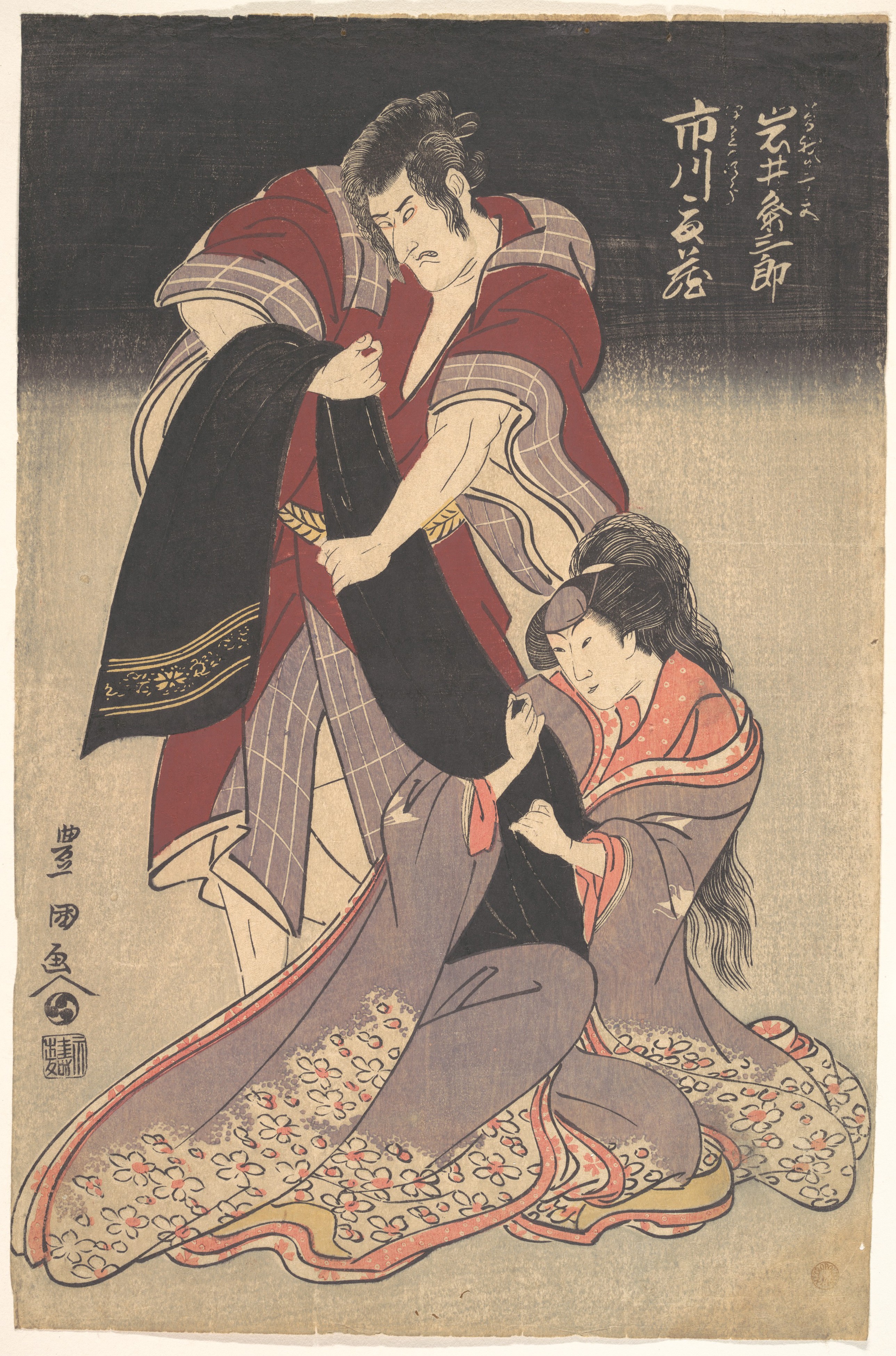
Scene from a Drama
ca. 1804
Woodblock print; ink and color on paper

Actor Bandō Mitsugorō II as Ishii Genzō
1794
Woodblock print (nishiki-e), ink and color on paper with mica

Toraya: Arashi Ryuzo II as the monk Tojibo in the play "Hatsu Akebono Kaomise Soga," from the series "Portraits of Actors on Stage (Yakusha butai no sugata-e)"
1794
Color woodblock print; oban

Actor Ichikawa Monnosuke II as Soga Jūrō
1794
Woodblock print (nishiki-e), ink and color on paper with mica

Masatsuya: Otani Oniji III as Ono Sadakuro, from the series "Portraits of Actors on Stage (Yakusha butai no sugata-e)"
1794
Color woodblock print; oban
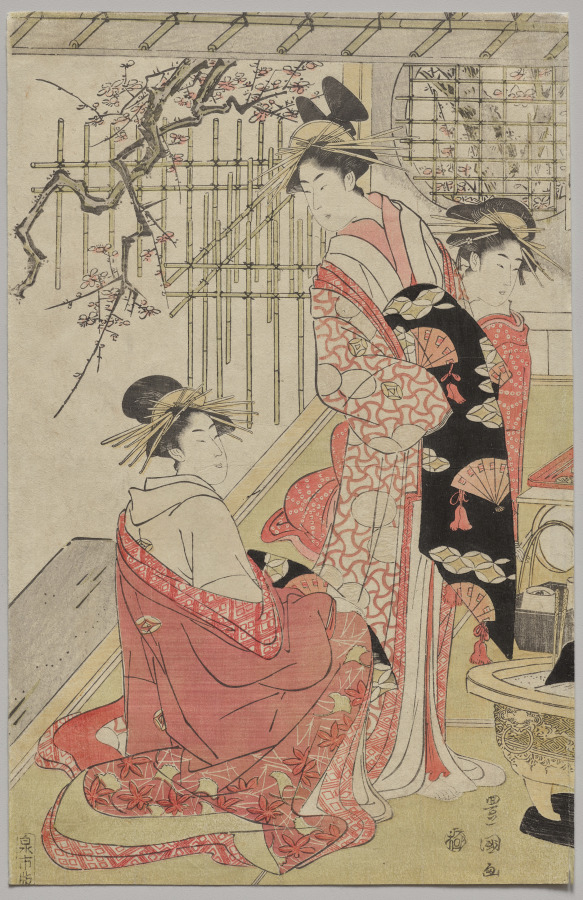
Courtesans of the Ōgiya on a Spring Outing
mid- or late 1790s
One of a triptych of woodblock prints

The actor Ichikawa Danjuro VI as Sukeroku in the play "Omiura Date no Nebiki," performed at the Nakamura Theater in the third month, 1799
c. 1799
Color woodblock print; oban

Tachibanaya: Ichikawa Yaozo III as Fuwa Banzaemon, from the series "Portraits of Actors on Stage (Yakusha butai no sugata-e)"
1794
Color woodblock print; oban

Actor Onoe Matsusuke as Ōboshi Yuranosuke
1795
Woodblock print (nishiki-e), ink and color on paper

Yamatoya: Iwai Hanshiro IV as Okaru, from the series "Portraits of Actors on Stage (Yakusha butai no sugata-e)"
1795
Color woodblock print; oban

Hamamuraya: Segawa Kikunojo III as the courtesan Koman, from the series "Portraits of Actors on Stage (Yakusha butai no sugata-e)"
1795
Color woodblock print; oban

The actor Sawamura Sojuro III as Oboshi Yuranosuke in the play "Edo no Hana Ako no Shiogama," performed at the Kiri Theater in the fourth month, 1796
1796
Color woodblock print; oban

Cherry Blossoms in the Wind
late 1790s
woodblock print, ink and color on paper

Segawa Kikunojō III as the Shop Boy Chōkichi
1796
Woodblock print (nishiki-e), ink and color on paper

A princess traveling with her attendants descends from a palanquin
c. 1801/04
Color woodblock print; oban triptych

A seaside outing
c. 1801/04
Color woodblock print; oban triptych

The actors Kataoka Nizaemon VII as Iyo no Taro and Iwai Hanshiro IV as Kojoro-gitsune of Okazaki in the play "Seiwa Nidai Oyose Genji," performed at the Miyako Theater in the eleventh month, 1796
1796
Color woodblock print; oban
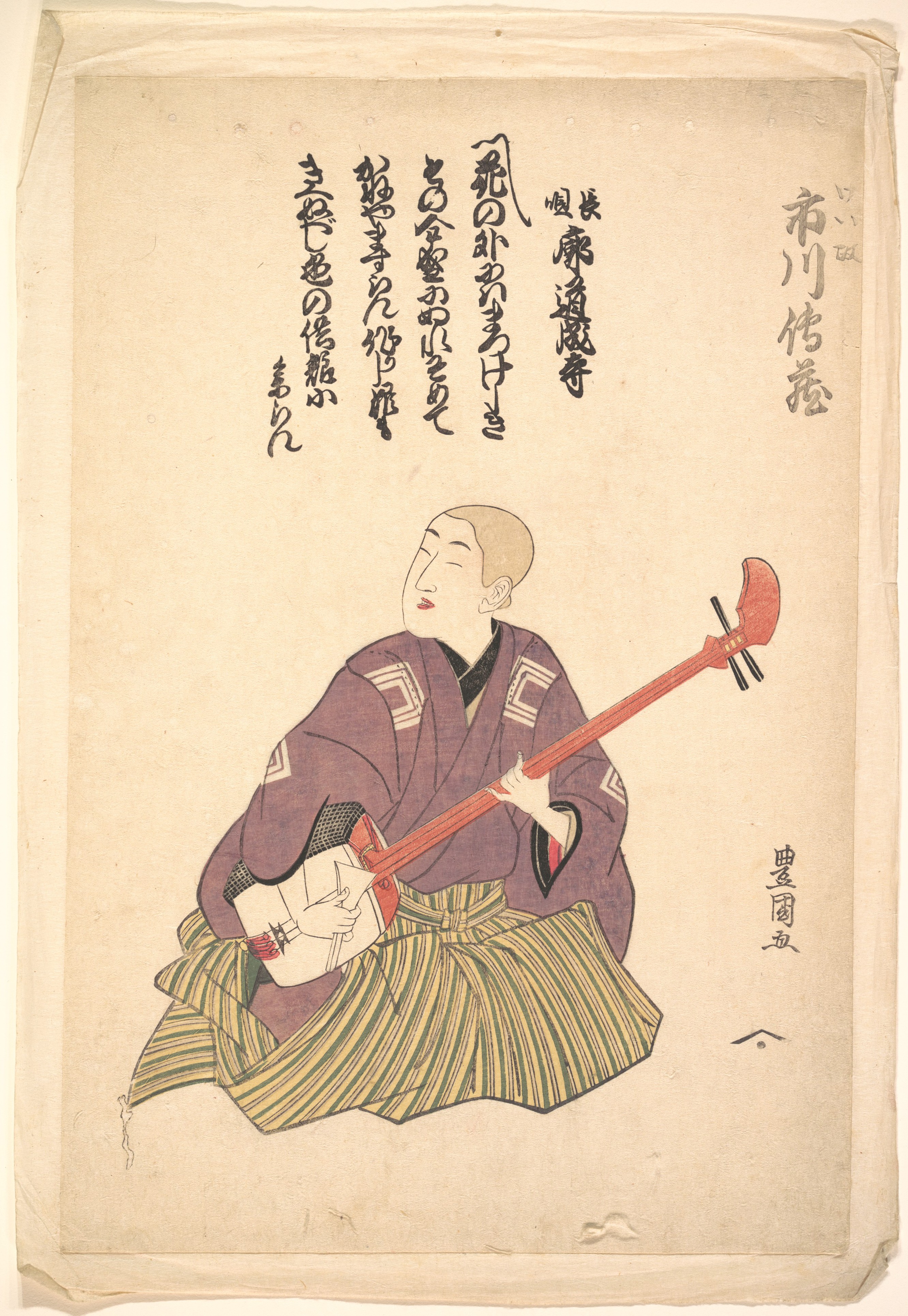
Keisei Ichikawa Denzo
ca. 1797–1800
Woodblock print; ink and color on paper
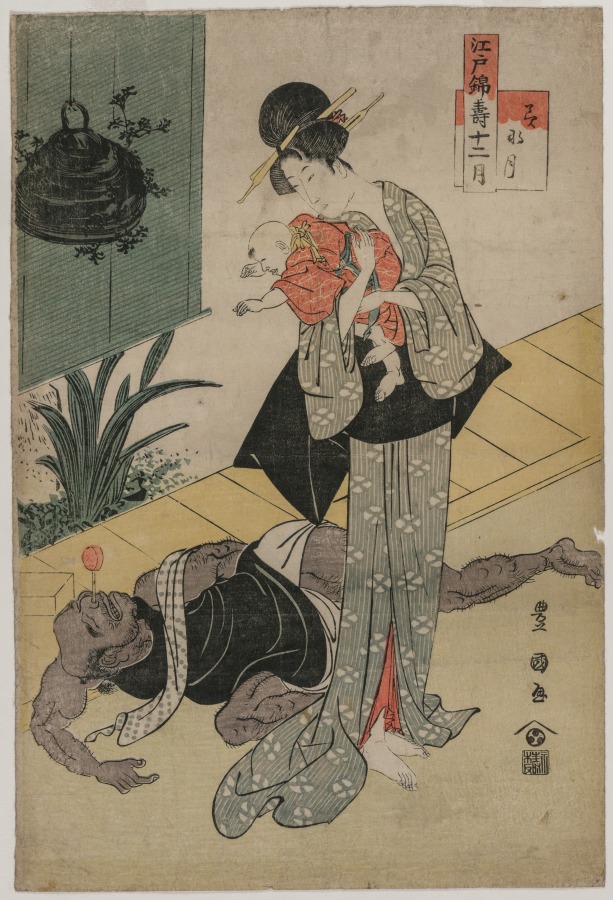
The Sixth Month (from the series The Twelve Felicitous Months in Edo Brocades)
c. late 1790s
color woodblock print
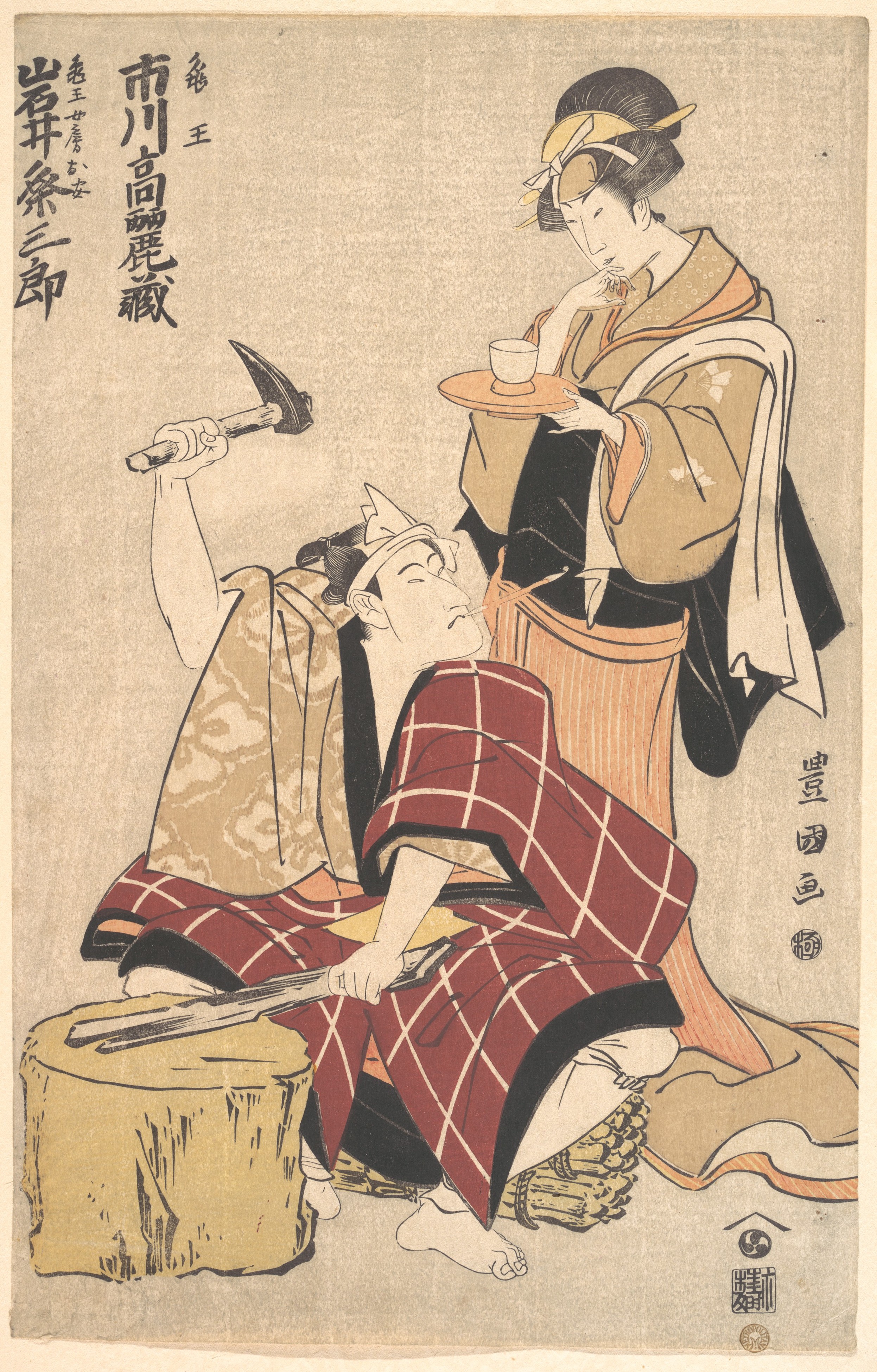
Ichikawa Komazō III in the Role of Kameō with Iwai Kumesaburō in the Role of Kameō's Wife, Oyasu, from the Play Shunkan futatsu omokage
1798–99
Woodblock print; ink and color on paper

The actors Ichikawa Komazo III as Akuhachiro Tokikage and Nakayama Tomisaburo I as Yushide, the sister of Rokurozaemon, in the play "Hana to Mimasu Yoshino no Miyuki," performed at the Nakamura Theater in the eleventh month, 1798
1798
Color woodblock print; oban