Hanga

Daily Life Prints (881)

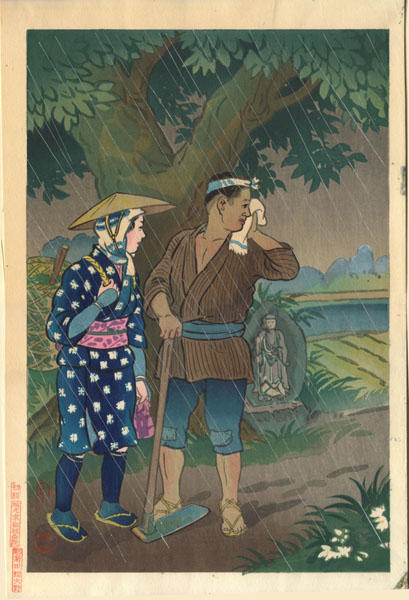
Daily life scenes (fuzoku-ga) document the ordinary activities, occupations, and domestic routines of Japanese people across centuries. This genre transforms mundane subjects — cooking, farming, fishing, bathing, shopping, child-rearing — into compositions that reveal both the aesthetic sensibilities of their makers and the social realities of their era. The ukiyo-e tradition's depiction of daily life centered on the entertainment districts and merchant culture of Edo, with artists documenting the routines and pleasures of townspeople. Utamaro's domestic scenes of women at their toilette or caring for children showed intimate moments with unprecedented tenderness. Hokusai's "Manga" (1814-1878) sketched daily life across all social classes with encyclopedic range, from artisans at their workbenches to children at play. Shin-hanga and sosaku-hanga artists of the twentieth century brought new perspectives to daily life subjects. While shin-hanga tended toward idealized depictions of traditional activities — tea ceremony, ikebana, kimono dressing — sosaku-hanga artists engaged more directly with contemporary life, depicting factory workers, city commuters, and modern domestic settings. These prints serve as invaluable social documents, preserving customs, costumes, and environments that rapid modernization has transformed beyond recognition.

Artists Known for Daily Life

Woman Holding a Baby by Kaoru Kawano

Woman Holding a Baby

Woodblock print

young girl holding a small Japanese fan by Kaoru Kawano

young girl holding a small Japanese fan

Woodblock print

young girl with a mask by Kaoru Kawano

young girl with a mask

Woodblock print

May; Boy's Festival by Yoshitoshi Mori

May; Boy's Festival

Woodblock print

Girl and Fan by Ogata Gekko

Girl and Fan

Woodblock print

Girl and Fan by Ogata Gekko

Girl and Fan

Woodblock print

You Girls in Higashinaka — 東中君 咲けば藤花の習いや君のせ界 by Ogata Gekko

You Girls in Higashinaka — 東中君 咲けば藤花の習いや君のせ界

Woodblock print

Captain Higuchi, in the Midst of the Attack, Personally Holds a Lost Chinese Child (Higuchi taii shingeki no toji mizukara Seishi no ishi o hôji suru no zu) by Ogata Gekko

Captain Higuchi, in the Midst of the Attack, Personally Holds a Lost Chinese Child (Higuchi taii shingeki no toji mizukara Seishi no ishi o hôji suru no zu)

Woodblock print

Dancing girl by Takehisa Yumeji

Dancing girl

Woodblock print

Image No.6 Motherhood (1) by Takehisa Yumeji

Image No.6 Motherhood (1)

Woodblock print

Girl holding Red Fan by Maekawa Senpan

Girl holding Red Fan

1952

Color woodblock print with traces of mica

Young Girl of Jaluit, Marshalls 100/150 by Paul Jacoulet

Young Girl of Jaluit, Marshalls 100/150

1939

Woodblock print

Girl in Kimono by Ebina Masao

Girl in Kimono

Woodblock print

Village Children Playing Baseball by Sumio Kawakami

Village Children Playing Baseball

1936

Woodblock print, ink on paper

Girl and Irises, Shôwa period, dated 1952 by Okiie Hashimoto

Girl and Irises, Shôwa period, dated 1952

Woodblock print

Maiko Girl, doing Tea Ceremony by Hasegawa Sadanobu III

Maiko Girl, doing Tea Ceremony

Woodblock print

Maiko Girl playing Hand-Drum by Hasegawa Sadanobu III

Maiko Girl playing Hand-Drum

Woodblock print

All Japan Boy Scouts Jamboree by Kawase Hasui

All Japan Boy Scouts Jamboree

Woodblock print

All Japan Boy Scouts Jamboree by Kawase Hasui

All Japan Boy Scouts Jamboree

Woodblock print

All Japan Boy Scouts Jamboree by Kawase Hasui

All Japan Boy Scouts Jamboree

Woodblock print

Childrens Day — こどもの日記念 by Kawase Hasui

Childrens Day — こどもの日記念

Woodblock print

Childrens Day — こどもの日記念 by Kawase Hasui

Childrens Day — こどもの日記念

Woodblock print

Childrens Day — こどもの日記念 by Kawase Hasui

Childrens Day — こどもの日記念

Woodblock print

Childrens Day — こどもの日記念 by Kawase Hasui

Childrens Day — こどもの日記念

Woodblock print

Childrens Fair — 犬山こども博 by Kawase Hasui

Childrens Fair — 犬山こども博

Woodblock print

Childrens Fair — 犬山こども博 by Kawase Hasui

Childrens Fair — 犬山こども博

Woodblock print

Childrens Fair — 犬山こども博 by Kawase Hasui

Childrens Fair — 犬山こども博

Woodblock print

Happi Boy 2 by Kunio Kaneko

Happi Boy 2

20/100, 2004

Woodblock print

Happi Girl by Kunio Kaneko

Happi Girl

117/200, 1996

Woodblock print

Girl 122 - A by Fumio Fujita

Girl 122 - A

Woodblock print

Children's Day, child with samurai helmet by Hasegawa Sadanobu III

Children's Day, child with samurai helmet

Woodblock print

GIRL PLAYING HANETSUKI GAME by Hasegawa Sadanobu III

GIRL PLAYING HANETSUKI GAME

Woodblock print

Girl with Drum by Hasegawa Sadanobu III

Girl with Drum

Woodblock print

Maiko Girl, dancing by Hasegawa Sadanobu III

Maiko Girl, dancing

Woodblock print

The Kitchen by Kitagawa Utamaro

The Kitchen

Woodblock print

The Fountain Outside the Art Museum at the Second Exhibition for the Promotion of Domestic Industry by Kobayashi Kiyochika

The Fountain Outside the Art Museum at the Second Exhibition for the Promotion of Domestic Industry

Woodblock print

The Kitchen Utensil Foundry at Kawaguchi — 川口鍋釜製造図 by Kobayashi Kiyochika

The Kitchen Utensil Foundry at Kawaguchi — 川口鍋釜製造図

Woodblock print

Kitchen File by Yukari Maeda

Kitchen File

Etching, aquatint, collagraph

Two Domestic geese by Ohara Koson

Two Domestic geese

Mokuhanga (Japanese woodblock)

Domestic scene by Ito Shinsui

Domestic scene

Mokuhanga (Japanese woodblock)

Domestic scene by Hiyoshi Mamoru

Domestic scene

Mokuhanga (Japanese woodblock)

Related Subjects

Frequently Asked Questions

Daily life scenes (fuzoku-ga) document the ordinary activities, occupations, and domestic routines of Japanese people across centuries. This genre transforms mundane subjects — cooking, farming, fishing, bathing, shopping, child-rearing — into compositions that reveal both the aesthetic sensibilities of their makers and the social realities of their era.

Kaoru Kawano, Hiyoshi Mamoru, and Miyagawa Shuntei are among the artists most associated with daily life in our collection. Browse the full list of artists who explored this subject above.

Hanga currently catalogues 881 prints tagged with daily life, spanning ukiyo-e, shin-hanga, and sōsaku-hanga traditions where applicable.