
Biography
Kishio Koizumi (小泉癸巳男, 1893–1945) occupied a singular position between the shin-hanga and sōsaku-hanga movements, combining the topographic subject matter of the former with the self-reliance of the latter. He designed, carved, and printed every block himself — fulfilling the sōsaku-hanga ideal of the artist as sole creator — yet his subjects were the temples, bridges, rivers, and modern landmarks of Tokyo that belonged to the shin-hanga landscape tradition. That synthesis culminated in his masterwork, the series One Hundred Views of Great Tokyo in the Shōwa Era (Shōwa Dai-Tōkyō Hyaku Zue), produced between 1928 and 1940.
Born in Shizuoka Prefecture in 1893, Koizumi studied Western-style painting and worked in oil and watercolor — training that included study under Ishii Hakutei and Maruyama Banka at the Japan Watercolour Institute — before gravitating toward printmaking; he joined the Japan Creative Print Association (Nihon Sōsaku Hanga Kyōkai) in 1919. He settled in Tokyo and immersed himself in the city's rapid modernization, much of it a rebuilding of the districts leveled by the Great Kantō Earthquake of 1923, watching steel-frame office buildings and concrete bridges replace the wooden structures depicted by earlier artists. The One Hundred Views series captured that transformation in real time: early prints depict canal-side warehouses and wooden torii gates, while later entries show the streamlined ferro-concrete of the rebuilt Nihonbashi district and other newly risen modern landmarks.
Koizumi's technique balanced precision with atmospheric mood. He carved fine lines that defined architectural edges cleanly, then layered translucent color washes to evoke weather and time of day — fog over the Sumida River, twilight behind the silhouette of Sensōji's pagoda, rain slanting across the iron girders of a railway bridge. His palette leaned toward cool blues, muted greens, and warm grays, with occasional punches of vermillion on shrine gates and autumn maple leaves.
Working over twelve years, Koizumi handled every stage of the series' production and distribution himself, selling prints directly and through a small network of dealers sympathetic to the sōsaku-hanga cause. He completed the hundred designs in 1940 and afterward added nine further prints, bringing the finished set to one hundred and nine.
His work attracted renewed scholarly attention in the later twentieth century as historians recognized that the One Hundred Views series constitutes an irreplaceable visual document of interwar Tokyo, much of which was obliterated by wartime firebombing in 1945. Prints from the series are held by the Art Institute of Chicago, the British Museum, and the Spencer Museum of Art at the University of Kansas.
Key Facts
- Active Period
- 1893–1945
- Nationality
- 🇯🇵Japan
- Movements
- Shin-hangaSōsaku-hanga
- Works Indexed
- 77
Frequently Asked Questions
Kishio Koizumi (小泉癸巳男, 1893–1945) occupied a singular position between the shin-hanga and sōsaku-hanga movements, combining the topographic subject matter of the former with the self-reliance of the latter. He designed, carved, and printed every block himself — fulfilling the sōsaku-hanga ideal of the artist as sole creator — yet his subjects were the temples, bridges, rivers, and modern landmarks of Tokyo that belonged to the shin-hanga landscape tradition. That synthesis culminated in his masterwork, the series One Hundred Views of Great Tokyo in the Shōwa Era (Shōwa Dai-Tōkyō Hyaku Zue), produced between 1928 and 1940.
Kishio Koizumi was active from 1893 to 1945. They were associated with the Shin-hanga and Sōsaku-hanga movements.
Kishio Koizumi's work was shaped by the Shin-hanga and Sōsaku-hanga traditions in Japanese woodblock printmaking. Shin-hanga: ## What is Shin-hanga? Shin-hanga (新版画), literally "new prints," is the early twentieth-century revival of the collaborative Japanese woodblock workshop, organized between roughly 1915 and 1960 by the Tokyo publisher Watanabe Shōzaburō (1885–1962) and a handful of competing houses. Sōsaku-hanga: ## What is sōsaku-hanga? Sōsaku-hanga (創作版画, "creative prints") was a twentieth-century Japanese print movement defined by a single commitment: the artist must design, carve, and print every work alone.
Kishio Koizumi's prints frequently feature temples & shrines, rivers & lakes, landscapes, gardens, snow scenes, winter.
Original prints by Kishio Koizumi can be found in collections including Art of Japan, Japanese Art Open Database, Art Institute of Chicago, Minneapolis Institute of Art.
Series by Kishio Koizumi
Woodblock Prints by Kishio Koizumi (77)

Mt Fuji from Lake Suwa
Mokuhanga (Japanese woodblock)

Mount Fuji in clouds
Mokuhanga (Japanese woodblock)

River Scene
Mokuhanga (Japanese woodblock)

Near the Top
Mokuhanga (Japanese woodblock)

Nanushi Waterfall
Mokuhanga (Japanese woodblock)

Meiji Memorial Picture gallery
Mokuhanga (Japanese woodblock)

Lake Chuzenji
Mokuhanga (Japanese woodblock)

Mt Fuji from Lake Suwa
Mokuhanga (Japanese woodblock)

Manchurian scene
Mokuhanga (Japanese woodblock)

Hamacho Park
Mokuhanga (Japanese woodblock)

Dead field in winter
Mokuhanga (Japanese woodblock)

Lumberyards At Kiba in snow
Mokuhanga (Japanese woodblock)

Komagata Bridge and Steamer Terminal
Mokuhanga (Japanese woodblock)

Hie Shrine
Mokuhanga (Japanese woodblock)

Haystacks
Mokuhanga (Japanese woodblock)

Blue Fuji
Mokuhanga (Japanese woodblock)
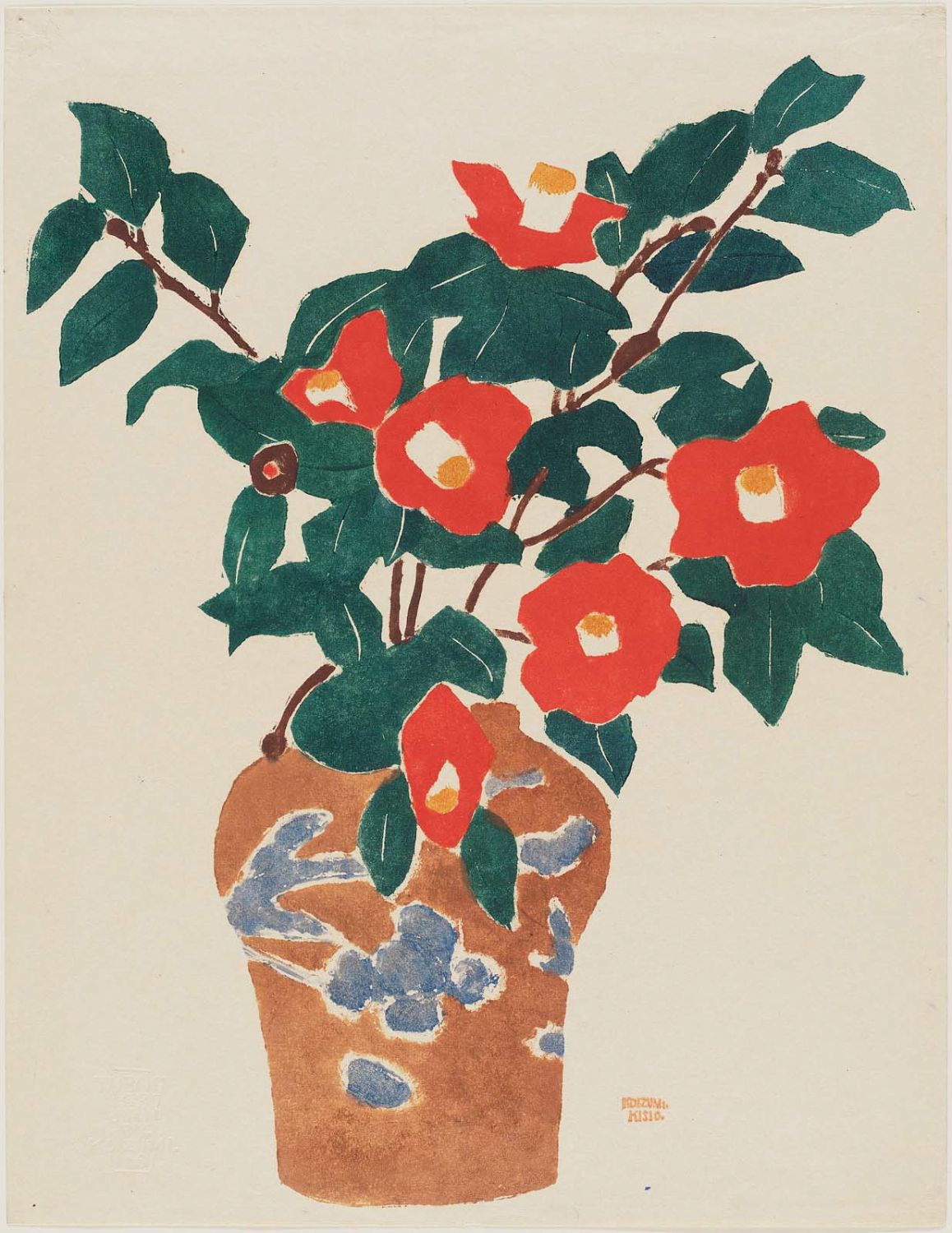
Camellia
Woodblock print
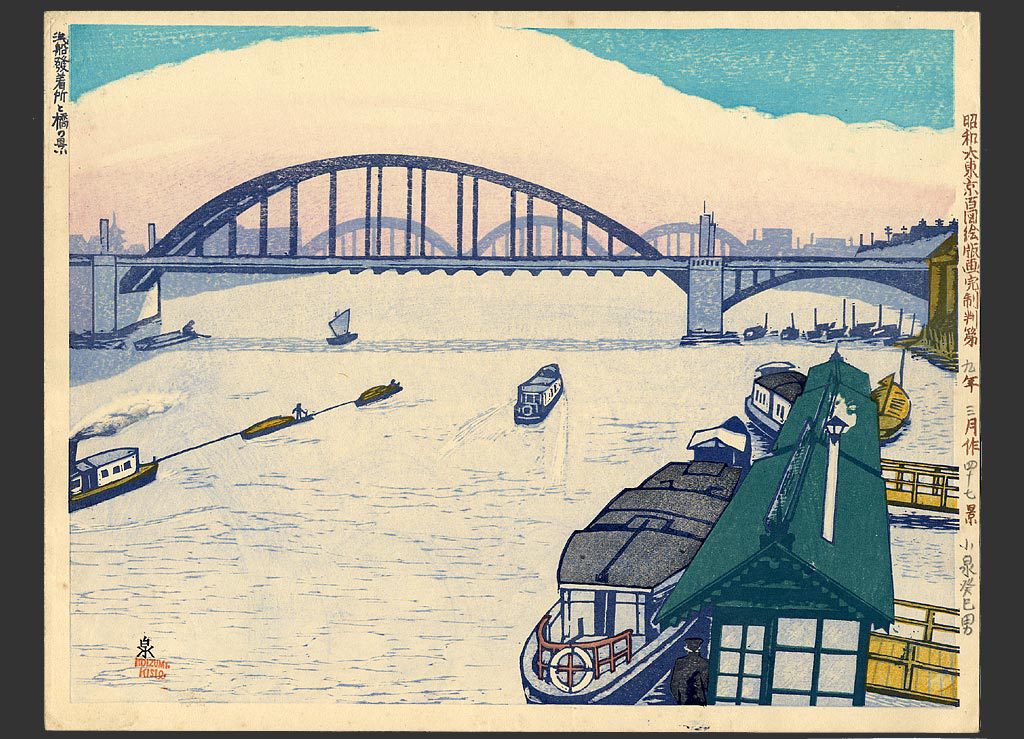
"#47 Komagata Bridge & the steamship port"
Woodblock print

Woman Seated in front of a mirror
Mokuhanga (Japanese woodblock)

Torii In the snow at Nikko
Mokuhanga (Japanese woodblock)

New Diet Building
Mokuhanga (Japanese woodblock)

Waseda Dye factory
Mokuhanga (Japanese woodblock)

Fall festival at Yasukuni shrine
Mokuhanga (Japanese woodblock)

Taki River and Otonashi River at Kongôji Temple
Mokuhanga (Japanese woodblock)