
Biography
Hishikawa Moronobu (c. 1618-1694) is widely recognized as the founder of the single-sheet ukiyo-e woodblock print tradition, the artist who transformed a craft of book illustration into an independent pictorial art form that would dominate Japanese popular visual culture for the next two centuries. While Edo woodblock printing existed before him as a means of reproducing texts and decorative ehon, it was Moronobu who did the most to establish the woodblock print as a standalone artwork worthy of display, collection, and aesthetic attention. Every subsequent ukiyo-e master, from Sukenobu and Masanobu to Harunobu, Utamaro, Hokusai, and Hiroshige, worked in a medium whose foundational vocabulary he helped invent.
Moronobu was born around 1618 in the village of Hoda in Awa province (present-day Chiba prefecture, on the Boso Peninsula), into a family of professional embroiderers and textile dyers. His father was a well-respected embroiderer who worked gold and silver thread into rich textiles for temples and wealthy patrons. This upbringing surrounded the young Moronobu with the language of pattern, contour, and decorative composition, training his eye in the bold, flat, linear sensibility that would later define his prints. The discipline of designing embroidery patterns gave him an intuitive command of silhouette and negative space, qualities that distinguish his mature woodblock work from anything that preceded it.
Sometime in the 1660s Moronobu moved to Edo, the burgeoning shogunal capital where a newly affluent merchant class, the chonin, was generating unprecedented demand for affordable popular art. There he studied painting in both the courtly Tosa school's narrative yamato-e tradition and the more austere Kano school's ink line, and he synthesized these inheritances with the contemporary energy of urban Edo life. He began producing illustrations for ehon, the woodblock-printed books that flooded the city's growing publishing industry. Between roughly 1670 and his death he produced more than a hundred sets of illustrations, by some counts approaching 150, a staggering output covering erotic albums, courtesan critiques, classical poetry collections, warrior and samurai themes, and bird-and-flower compendia.
Moronobu's transformative contribution came in the 1670s when he began signing his book illustrations, an unusual assertion of authorial identity in a medium that had treated illustrators as anonymous craftsmen. Even more consequentially, he began producing ichimai-e, single-sheet woodblock prints designed not to accompany text but to stand alone as pictures. These early single sheets were sumizuri-e, printed only in black ink from a single block and sometimes hand-colored afterward with tan (orange-red lead) and other pigments. The technical simplicity of sumizuri-e belies the sophistication of Moronobu's draftsmanship; his confident, supple line could describe an entire courtesan's silken kimono, the cascade of her hair, the architectural setting of a Yoshiwara teahouse, and the emotional charge between figures, all within a single print.
His subject matter established the iconographic foundations of ukiyo-e for generations. The Yoshiwara, Edo's licensed pleasure quarter, became one of his great themes, and his Yoshiwara no tei series (ca. 1680) is among his best-known works. His depictions of beautiful women helped pioneer the bijin-ga genre that would preoccupy every major ukiyo-e artist who followed him; his single most celebrated work, the painting Beauty Looking Back (Mikaeri Bijin), remains the definitive early image of the type. Equally foundational were his shunga, the erotic albums whose explicit imagery he treated with the same compositional dignity as his portraits of courtesans in promenade. His seasonal scenes of urban leisure, such as the cherry-blossom-viewing parties at Ueno, established the iconography of the floating world's seasonal entertainments, while his genre scenes documented the pageantry of shogunal Edo and his bird-and-flower subjects adapted the kacho-ga tradition to popular printed format.
Moronobu founded the Hishikawa school, the first dedicated ukiyo-e atelier, training a generation of followers including his eldest son and pupil Hishikawa Morofusa and his most accomplished pupil Sugimura Jihei, who carried the style into the 1690s. The Hishikawa school established the master-pupil studio model that would structure ukiyo-e production for centuries, with later lineages such as the Torii, Katsukawa, Utagawa, and Kitao schools all descending conceptually from Moronobu's example. His characteristic style, marked by full-bodied, fluid figures in elaborate brocaded robes set against minimal but suggestive grounds, became the baseline against which all later innovations were measured.
He died in Edo on 25 July 1694, at approximately 76 years of age. By then the woodblock print had been firmly established as an independent art form with its own conventions, market, and audience. Within a generation, Torii Kiyonobu, Okumura Masanobu, and Nishikawa Sukenobu would build directly on his vocabulary; within two generations, polychrome nishiki-e would emerge with Harunobu in the 1760s; within three, the great period of Utamaro, Sharaku, Hokusai, and Hiroshige would unfold. Today his work survives primarily in major museum collections, including holdings at the Art Institute of Chicago, the British Museum, and the Tokyo National Museum, where his prints and ehon are treasured as founding documents of one of the world's great popular art traditions.
Key Facts
- Active Period
- 1618–1694
- Nationality
- 🇯🇵Japan
- Movement
- Ukiyo-e
- Works Indexed
- 50
Frequently Asked Questions
Hishikawa Moronobu (c. 1618-1694) is widely recognized as the founder of the single-sheet ukiyo-e woodblock print tradition, the artist who transformed a craft of book illustration into an independent pictorial art form that would dominate Japanese popular visual culture for the next two centuries. While Edo woodblock printing existed before him as a means of reproducing texts and decorative ehon, it was Moronobu who did the most to establish the woodblock print as a standalone artwork worthy of display, collection, and aesthetic attention. Every subsequent ukiyo-e master, from Sukenobu and Masanobu to Harunobu, Utamaro, Hokusai, and Hiroshige, worked in a medium whose foundational vocabulary he helped invent.
Hishikawa Moronobu was active from 1618 to 1694. They were associated with the Ukiyo-e movement.
Hishikawa Moronobu's work was shaped by the Ukiyo-e tradition in Japanese woodblock printmaking. Ukiyo-e: ## What is ukiyo-e? Ukiyo-e ([浮世絵](/glossary/ukiyo-e)) — literally "pictures of the floating world" — is the Edo-period Japanese print and painting tradition that flourished from roughly 1660 to 1868, depicting the pleasures of urban life in Edo (modern Tokyo): courtesans, kabuki actors, sumo wrestlers, famous landscapes, and seasonal beauties.
Hishikawa Moronobu's prints frequently feature birds & flowers, rain, mount fuji, autumn foliage.
Original prints by Hishikawa Moronobu can be found in collections including Metropolitan Museum of Art, Art Institute of Chicago, Victoria and Albert Museum, Cleveland Museum of Art.
Woodblock Prints by Hishikawa Moronobu (50)
Yamato shinoe zukushi
1686
Woodblock printed book
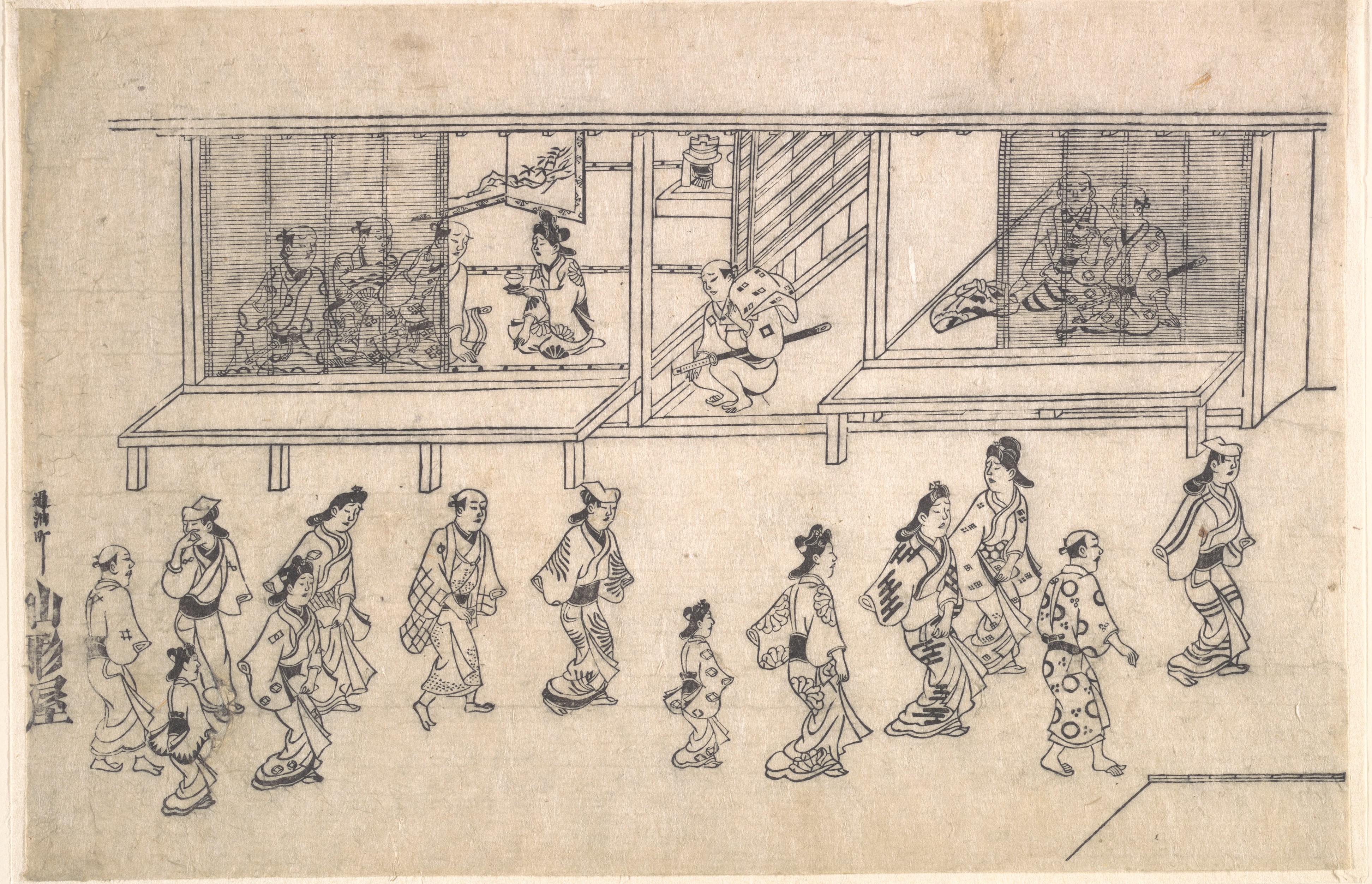
Street Scene in the Yoshiwara
Monochrome woodblock print; ink on paper
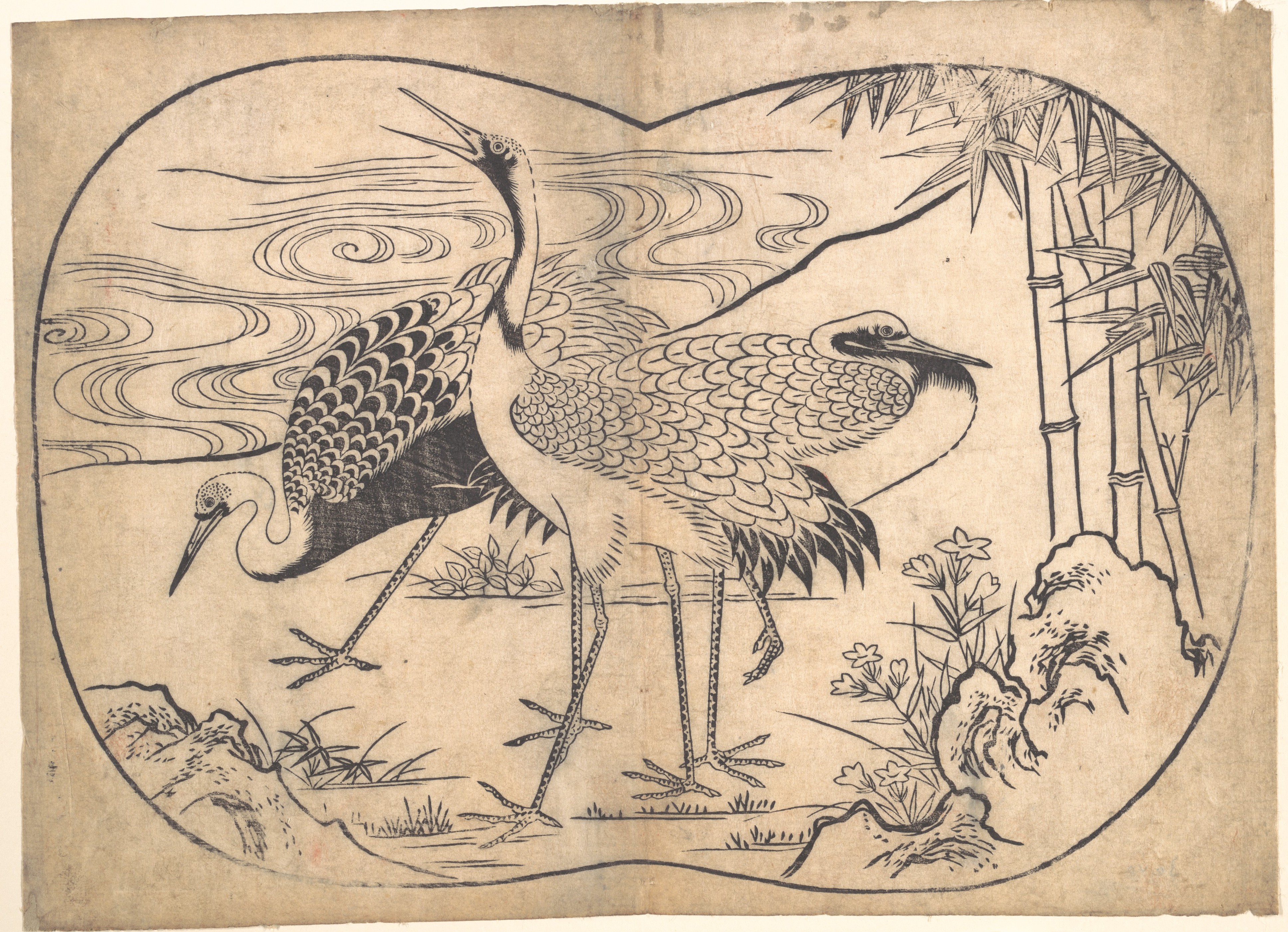
Cranes
Monochrome woodblock print; ink on paper

A sheet from a shunga album
1680s
Woodblock print; sumizuri-e
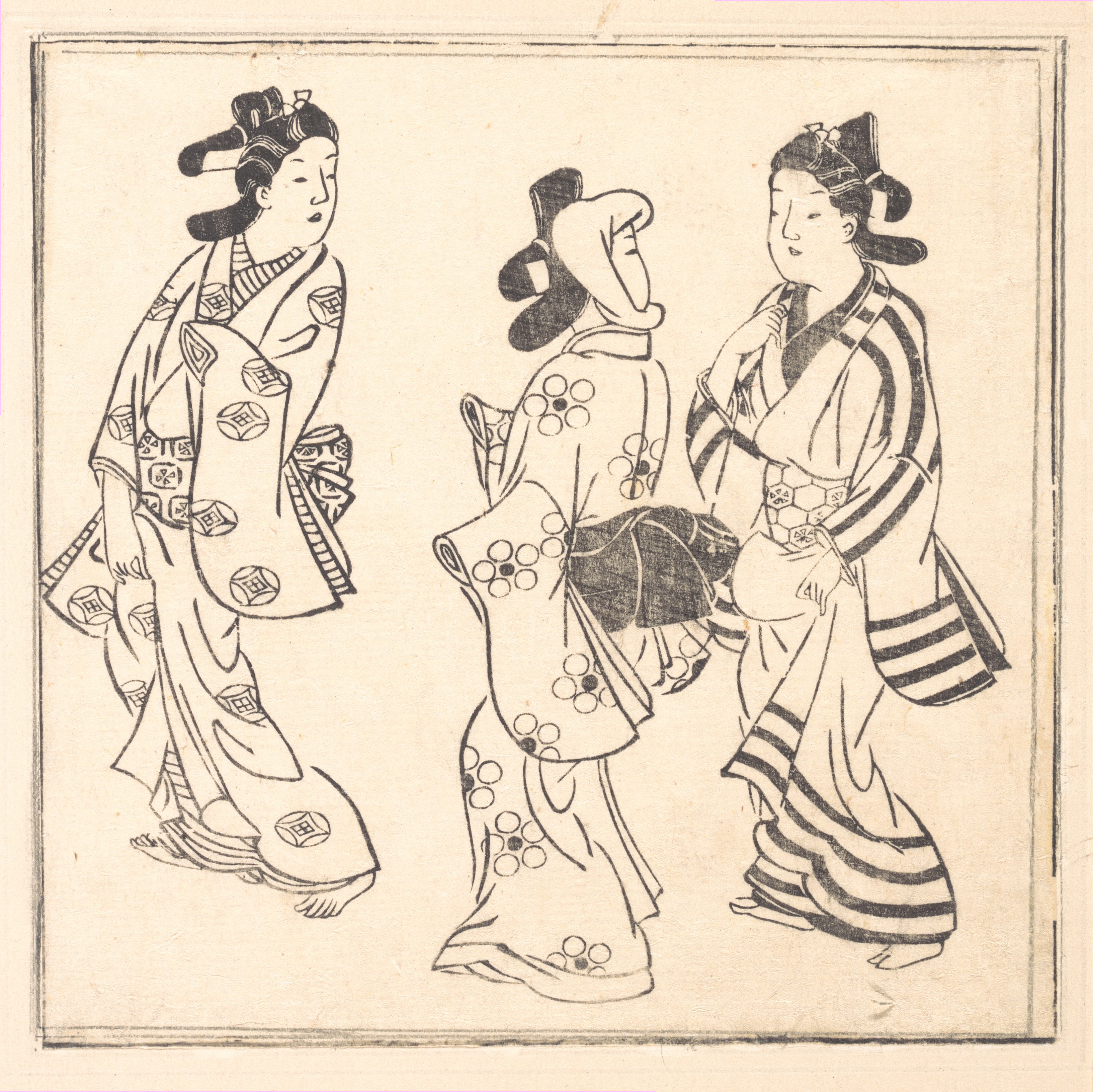
Leaf from a Book Entitled: Wakoku Hiaku-jo: One Hundred Japanese Women
Monochrome woodblock print; ink on paper
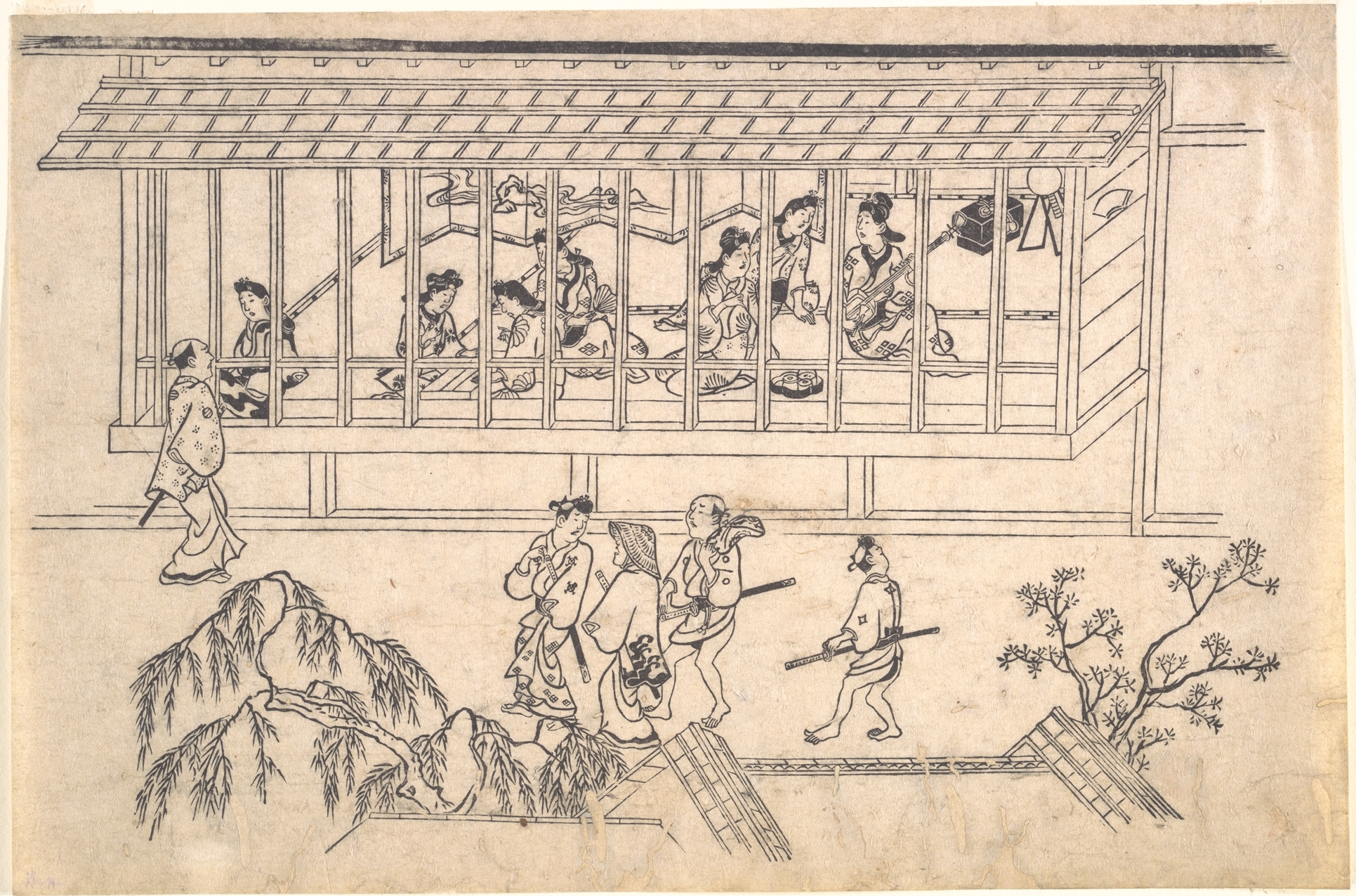
The Sixth Scene from Scenes of the Pleasure Quarter at Yoshiwara in Edo
late 17th century
Monochrome woodblock print; ink on paper
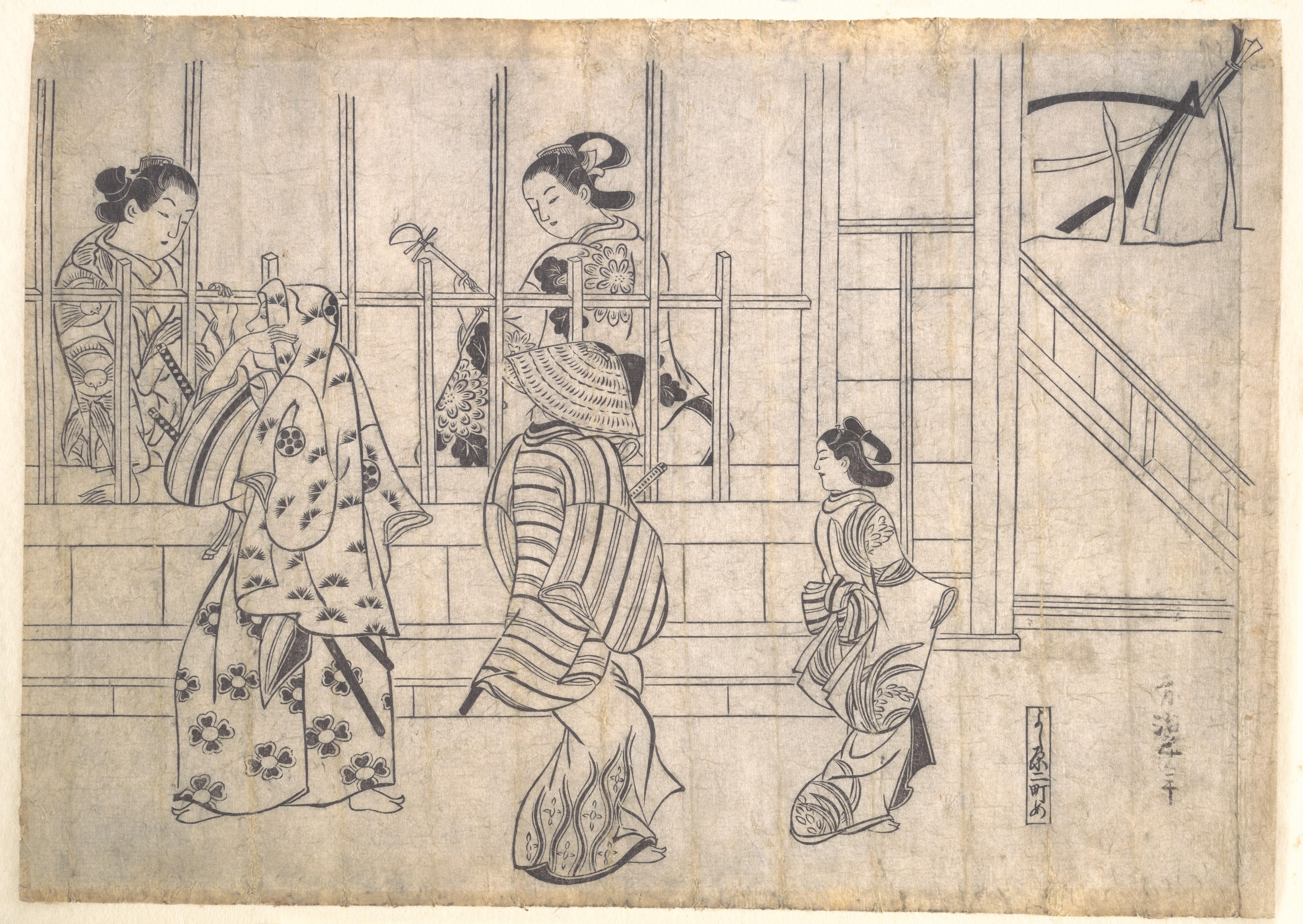
Street Scene in Yoshiwara
late 17th century
Monochrome woodblock print; ink on paper

Behind the Screen
c. 1673/81
Woodblock print; sumizuri-e, oban yoko-e

Pleasure with the Beauties of Japan (Wakoku bijin asobi)
c. 1673
Woodblock-printed book, sumizuri-e

Lovers in the Garden, from an Untitled Series of Erotic Prints
c. 1673/81
Woodblock print; oban, sumizuri-e

Flirting Lovers
c. 1673/81
Woodblock print; sumizuri-e, oban yoko-e

After a little music, from an untitled series of 12 erotic prints
c. 1673/81
Woodblock print; oban, sumizuri-e

A Courtesan with Her Client, the first sheet of an untitled erotic picture album
c. 1673/81
Woodblock print; sumizuri-e, oban yoko-e
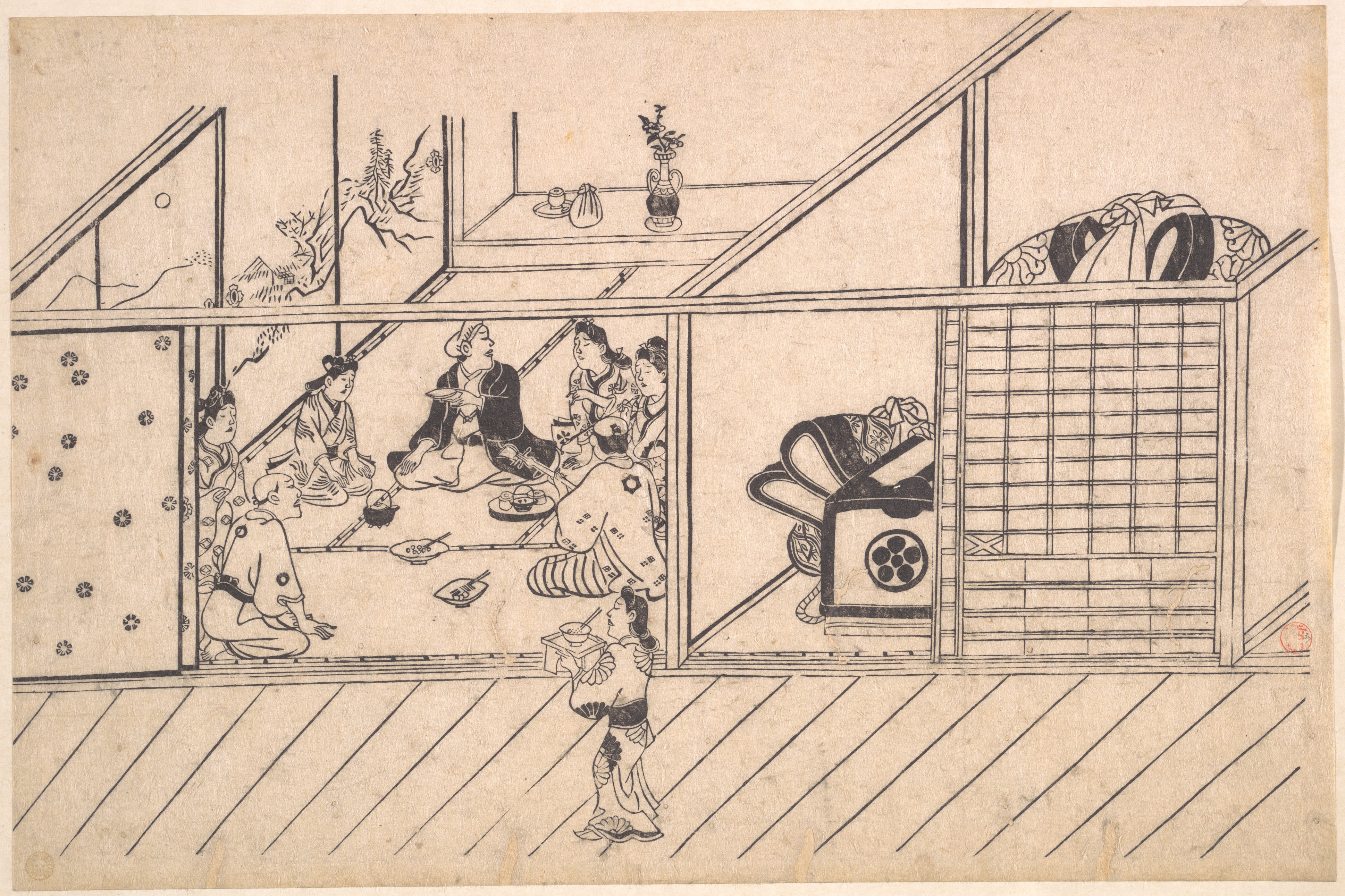
A Banquet in a Joroya
ca. 1680
Monochrome woodblock print; ink and color on paper

Sei Shonagon, from the illustrated book "Collection of Pictures of Beauties (Bijin e-zukushi)"
c. 1683
Hand-colored woodblock print; double-page illustration cut from a book
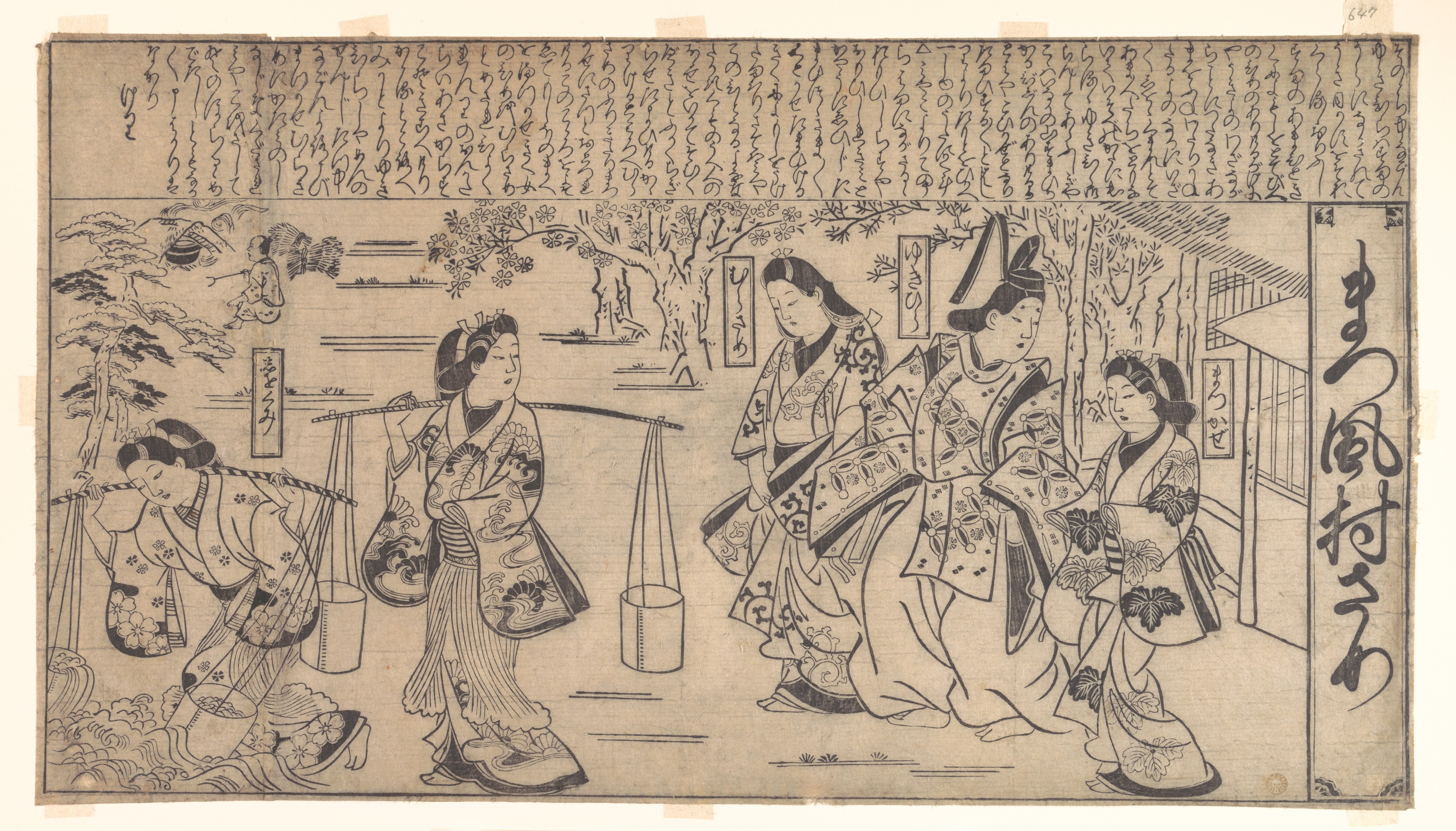
Matsukaze Murasame
ca. 1675–80
Woodblock print; ink and color on paper (sumi-e (ink print)

A Collection of Japanese Paintings (Yamato e-zukushi)
1680
Woodblock printed book, sumizuri-e
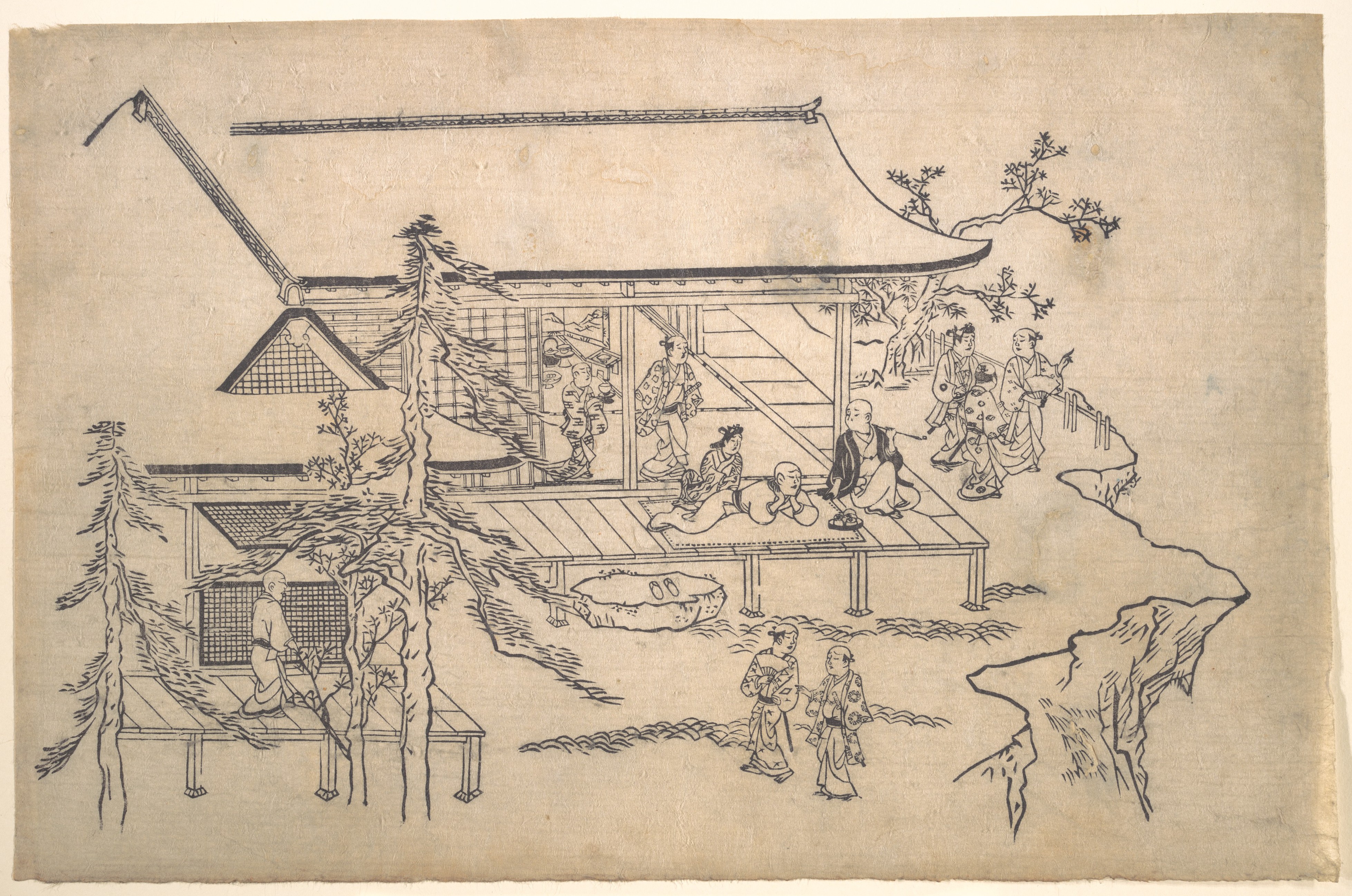
Flower-Viewing Scene
ca. 1685
Monochrome woodblock print (sumie); ink on paper
![Patterns by Hishikawa [Hishikawa moyō] by Hishikawa Moronobu](https://framemark.vam.ac.uk/collections/2014HH3420/full/full/0/default.jpg)
Patterns by Hishikawa [Hishikawa moyō]
1675-1685

Flower-Viewing Party with Crest-Bearing Curtain, from the series "Flower Viewing at Ueno (Ueno hanami no tei)"
c. 1681/84
Woodblock print; oban, sumizuri-e

A House of Courtesans, from the series "The Appearance of Yoshiwara (Yoshiwara no tei)"
c. 1681/84
Hand-colored woodblock print; oban, sumizuri-e

Emon Hill, from the series "The Appearance of Yoshiwara (Yoshiwara no tei)"
c. 1681/84
Woodblock print; oban, sumizuri-e

A Passing Palanquin, from the series "Scenes of Flower-viewing at Ueno (Ueno hanami no tei)"
c. 1681/84
Woodblock print; oban, sumizuri-e

Scene in the Yoshiwara, from the series "Views of Yoshiwara"
About 1680
Woodblock print; sumizuri-e, oban