Biography
Takahashi Shotei, also known as Takahashi Hiroaki, was one of the most prolific and versatile Japanese woodblock print artists of the late Meiji, Taisho, and early Showa periods. Born in 1871 in Tokyo, Shotei created hundreds of print designs over a career spanning several decades, producing atmospheric landscapes, seasonal scenes, and views of traditional Japan that rank among the finest achievements of early twentieth-century Japanese printmaking. His work occupies a unique position in the history of Japanese prints, bridging the gap between the waning ukiyo-e tradition of the nineteenth century and the emerging shin-hanga movement of the twentieth.
Shotei was born into a family with artistic connections. His uncle was Matsumoto Fuko, a respected Japanese-style (nihonga) painter known for historical subjects who had trained in the lineage of Kikuchi Yosai, and it was Fuko who gave the young Takahashi his art name, Shotei. Growing up in an environment steeped in traditional Japanese artistic culture, Shotei began his artistic training at a young age, studying Japanese-style painting under Matsumoto Fuko himself. This training gave him a thorough grounding in traditional Japanese painting techniques, including the use of ink wash, mineral pigments, and the conventions of Japanese landscape and figure painting. As a young man he worked for the Imperial Household copying ceremonial designs, and in 1889 he was among the founders of the Japan Youth Painting Society, established together with the painter Terazaki Kogyo.
Shotei's woodblock print career began in 1907, when the Tokyo publisher Watanabe Shozaburo recruited him to design prints for his new venture in revived, artist-driven printmaking. This was a period when the traditional ukiyo-e woodblock print industry was in steep decline. Photography and Western-style lithographic printing had undermined the commercial viability of hand-printed woodblock images, and many of the skilled carvers and printers who had sustained the tradition were struggling to find work. Into this environment Shotei entered as a designer of print images that combined the atmospheric sensitivity of traditional Japanese painting with a fresh, modern sensibility that appealed to both Japanese and Western buyers.
His prints were produced under the name Shotei, which he used for the majority of his career. Working first and most extensively for Watanabe Shozaburo, he designed as many as five hundred landscape and seasonal subjects before 1923. In later years he also worked for other Tokyo publishers, among them Fusui Gabo, who is said to have allowed him greater creative freedom than Watanabe. Prints produced for different publishers sometimes show distinct stylistic characteristics, reflecting the different carving and printing teams employed by each house. His Watanabe prints tend to be the most refined in technique, benefiting from the publisher's access to the finest craftsmen, while his works for other publishers sometimes have a more vigorous, less polished quality that has its own distinct appeal.
Around 1921, Shotei adopted the additional art name Hiroaki, which he used for some of his work. The relationship between the names Shotei and Hiroaki has long been a source of confusion among collectors and scholars. Both names belong to the same artist, but generally Shotei is associated with his earlier works while Hiroaki appears on later ones. The distinction is not entirely consistent, however, and the two names are sometimes found in overlapping use.
Shotei's artistic output was remarkably varied. His landscape prints depict scenes from throughout Japan, including views of Mount Fuji, Lake Biwa, the temples of Kyoto and Nara, the canals of Tokyo, and the countryside of various provinces. He was particularly skilled at rendering atmospheric effects — rain, snow, mist, moonlight, and the warm glow of lanterns and windows at night — that give his prints their characteristic mood of poetic nostalgia. Many of his compositions depict traditional Japan at twilight or in the rain, evoking a world that was rapidly disappearing under the pressures of modernization.
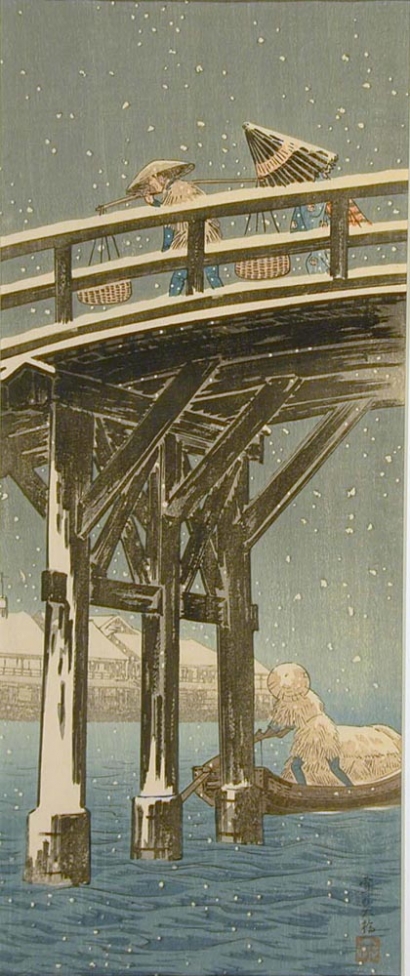
Among his most celebrated works are his snow scenes, which demonstrate his mastery of the difficult technique of suggesting falling or accumulated snow through the woodblock medium. A print such as "Snow on the Ayase River" (1915) captures the hushed, transformed quality of the Japanese landscape under snow with exceptional atmospheric sensitivity. The muffled silence of a snowy night, the warm glow of windows glimpsed through falling flakes, and the pure white blanket covering familiar scenes are rendered with a subtlety that ranks these works among the finest snow prints in the Japanese tradition.
Shotei's night scenes are equally admired. His depictions of moonlit landscapes, lantern-lit streets, and the warm glow of traditional Japanese interiors create a world of intimate, atmospheric beauty. The technical challenge of rendering the subtle effects of artificial and natural light in the woodblock medium is considerable, and Shotei's success in this area demonstrates both his artistic vision and his ability to communicate that vision to the carvers and printers who realized his designs.
In addition to landscapes, Shotei produced prints of flowers, birds, and figures. His flower prints show the influence of traditional Japanese botanical painting, while his figure prints, typically depicting women in traditional dress, belong to the bijin-ga tradition; a number of the bijin-ga and other subjects he designed in his later years became popular with collectors.
The Great Kanto Earthquake of 1923 had a significant impact on Shotei's career, as it did on virtually all artists and publishers working in Tokyo. Fire following the earthquake destroyed Watanabe's premises, including the woodblocks for all of Shotei's designs to that date. In the aftermath, Shotei set about creating new designs and recreating lost subjects — producing some two hundred and fifty new prints in the years that followed — but the earthquake marked a watershed in his career and in the broader history of Japanese printmaking.
Shotei continued working through the 1930s and into the early 1940s, producing prints well into his seventies. The quality of his later work varies, with some prints maintaining the atmospheric beauty of his best earlier work while others show signs of declining energy. He died in early 1945, during the final year of World War II and the same year as Ohara Koson.
The legacy of Takahashi Shotei has undergone a significant reappraisal in recent decades. Once considered a minor artist who produced competent but unremarkable commercial prints, Shotei is now recognized as one of the most important transitional figures in the history of Japanese printmaking. His best works — particularly the snow scenes and night views — are considered masterpieces of atmospheric printmaking that bear comparison with the finest works of the shin-hanga movement. His prints are held in major public collections, including the Museum of Fine Arts Boston, the Art Institute of Chicago, and the Rijksmuseum. His large output ensures that his work remains widely represented in museums and private collections alike, from later impressions to the prized early editions that rank among the finest atmospheric prints of their era.
Key Facts
- Active Period
- 1871–1945
- Nationality
- 🇯🇵Japan
- Movement
- Shin-hanga
- Works Indexed
- 183
Frequently Asked Questions
Takahashi Shotei, also known as Takahashi Hiroaki, was one of the most prolific and versatile Japanese woodblock print artists of the late Meiji, Taisho, and early Showa periods. Born in 1871 in Tokyo, Shotei created hundreds of print designs over a career spanning several decades, producing atmospheric landscapes, seasonal scenes, and views of traditional Japan that rank among the finest achievements of early twentieth-century Japanese printmaking. His work occupies a unique position in the history of Japanese prints, bridging the gap between the waning ukiyo-e tradition of the nineteenth century and the emerging shin-hanga movement of the twentieth.
Takahashi Shotei was active from 1871 to 1945. They were associated with the Shin-hanga movement.
Takahashi Shotei's work was shaped by the Shin-hanga tradition in Japanese woodblock printmaking. Shin-hanga: ## What is Shin-hanga? Shin-hanga (新版画), literally "new prints," is the early twentieth-century revival of the collaborative Japanese woodblock workshop, organized between roughly 1915 and 1960 by the Tokyo publisher Watanabe Shōzaburō (1885–1962) and a handful of competing houses.
Takahashi Shotei's prints frequently feature landscapes, bokashi, night scenes, rivers & lakes, snow scenes, rain.
Original prints by Takahashi Shotei can be found in collections including Japanese Art Open Database, Victoria and Albert Museum, Art Gallery of Greater Victoria, ukiyo-e.org.
External Resources
Woodblock Prints by Takahashi Shotei (183)

Bridge in snow
ca. 1915
Snow at Shiba Zojoji Temple
芝増上寺の雪
c. 1920
Color woodblock print
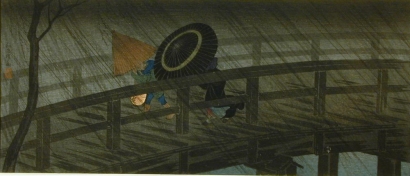
Night at Nihonbashi
日本橋の夜
c. 1920
Color woodblock print

Moon at Sekiguchi
関口の月
c. 1920
Color woodblock print
Snow at Sakurada
1920s
Woodblock print, ink and color on paper
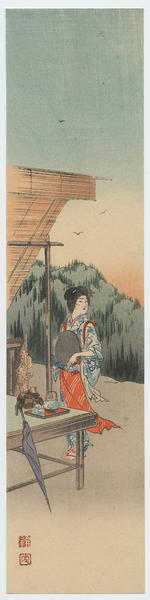
Autumn at Arayu
新湯の秋
c. 1920
Color woodblock print
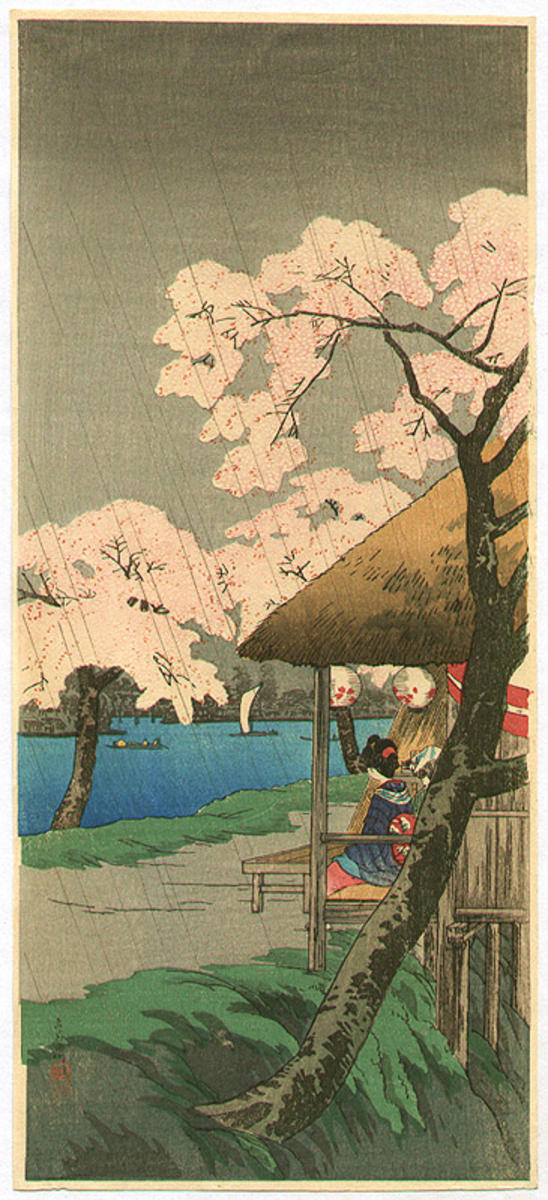
Rain on the Sumida River
隅田川の雨
c. 1920
Color woodblock print
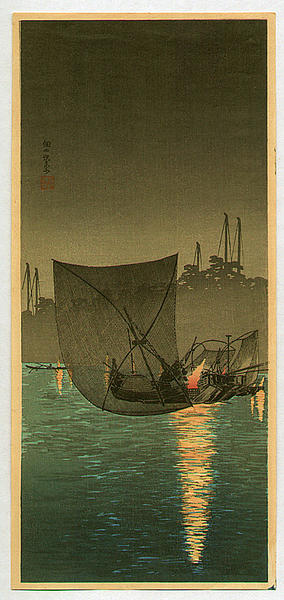
Fishing Boats at Tsukuda
佃の漁船
c. 1920
Color woodblock print

Rain at Maekawa
前川の雨
c. 1920
Color woodblock print
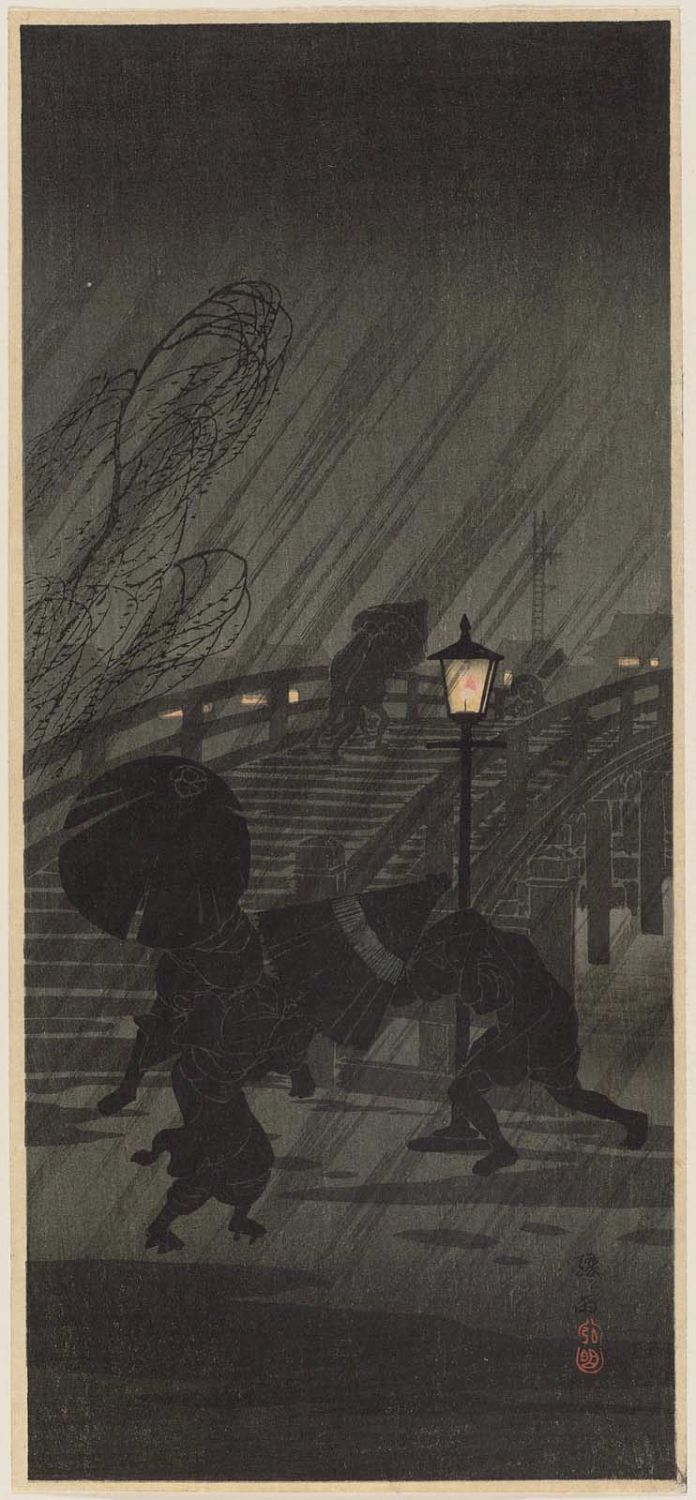
Sudden Rain at Atago
愛宕のにわか雨
c. 1920
Color woodblock print

Moon at Arakawa River
荒川の月
c. 1924
Color woodblock print
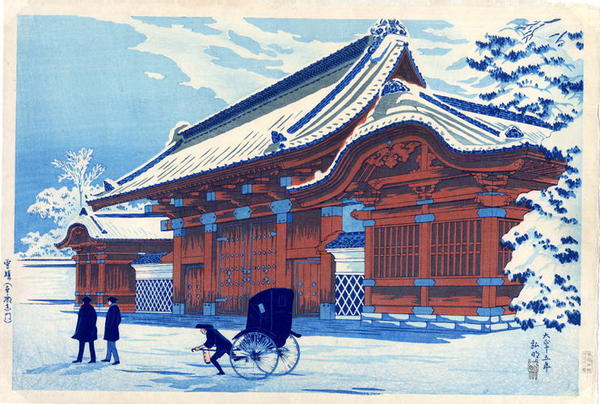
Snowfall at Edo River
江戸川の雪
c. 1924
Color woodblock print

Cherry Blossoms at Ueno
上野の桜
c. 1925
Color woodblock print
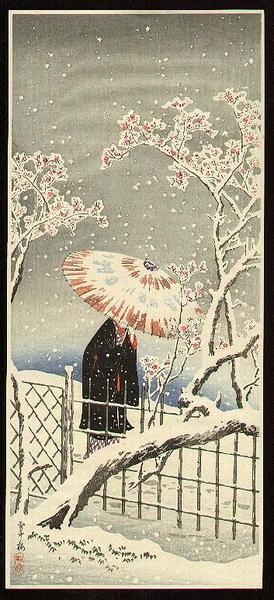
Plum Garden at Kameido
亀戸の梅園
c. 1925
Color woodblock print

Inatori Bay in Izu
1926
Color woodblock print; oban

Mice, Radish, and Carrot
1926
Color woodblock print; oban
Rats and Radishes
1926
Woodblock print; ink and color on paper

Izumi Bridge in Rain (Izumibashi no ame)
c. 1932
Color woodblock print

Mount Fuji from Mizukubo
1930s
Color woodblock print; oban
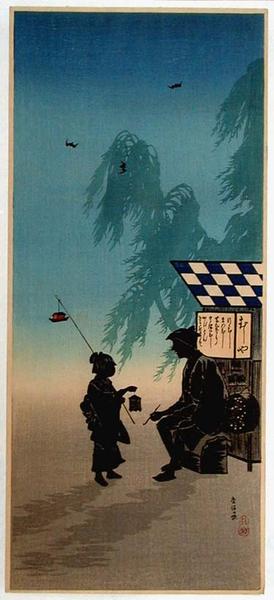
Evening at Ushibori
牛堀の夕
c. 1930
Color woodblock print
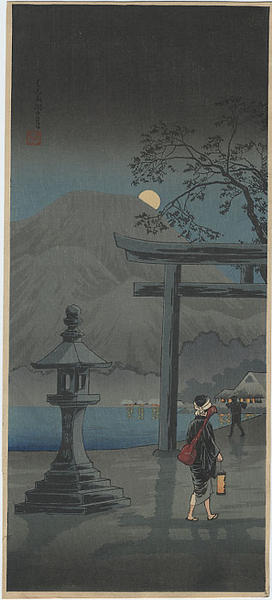
Lake Chuzenji in Autumn
中禅寺湖の秋
c. 1930
Color woodblock print

Men moving a cart at night
1930s
Woodblock print, ink and color on paper
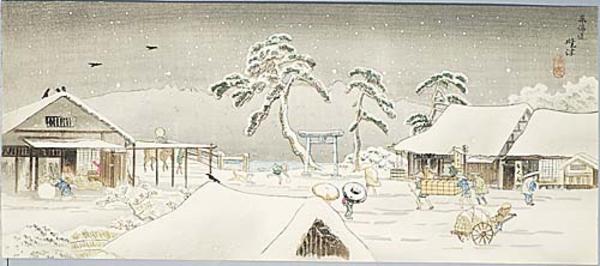
Snow on the Tokaido
東海道の雪
c. 1930
Color woodblock print

Spring Snow (Shunsetsu)
c. 1936
Color woodblock print