
Biography
Utagawa Kunisada (1786-1865), who took the prestigious art name Toyokuni III in 1844, was the most commercially successful and prolific ukiyo-e designer of the nineteenth century. Across a career that spanned roughly sixty years, Kunisada is estimated to have produced between twenty thousand and twenty-five thousand woodblock print designs, an output that dwarfs that of any other Edo-period print artist. He was the dominant figure of the late Edo Utagawa school, the publishing powerhouse behind the kabuki actor print (yakusha-e) industry, and a central architect of the visual culture that defined ukiyo-e in its final great commercial phase before the Meiji Restoration.
Born Sumida Shogoro in 1786 in the Honjo district of Edo (modern Tokyo), Kunisada came from a family with modest cultural credentials: his father was an amateur poet who died when his son was still a child. Around 1800-1801, the young Sumida entered the studio of Utagawa Toyokuni I, the leading ukiyo-e master of the day and head of the Utagawa school. He emerged as Toyokuni's premier student, adopting the studio name Kunisada and producing his first published prints around 1807-1808. His earliest yakusha-e and bijin-ga designs already showed the assured draftsmanship and theatrical flair that would define his mature style, and by the late 1810s he had established himself as one of Edo's most sought-after print designers.
Kunisada's command of kabuki actor portraiture was the engine of his career. From the 1820s through the 1860s he was the undisputed leader of yakusha-e, designing the bulk of the bust portraits, full-figure stage scenes, theater triptychs, and surimono privately commissioned by poetry clubs and theater fans. He knew every leading actor of the era by sight and by stage name, and his prints document an extraordinarily detailed pictorial record of Edo theater: the Ichikawa Danjuro lineage, the Onoe Kikugoro lineage, Bando Mitsugoro III, Segawa Kikunojo V, Iwai Kumesaburo II, Sawamura Tanosuke, Nakamura Shikan, Kataoka Nizaemon, and dozens of others appear across his oeuvre in role after role. Many of his prints can be dated to specific theater productions because the actors, costumes, and props match documented runs at the Edo licensed theaters.
In 1844 Kunisada formally took the name Toyokuni III, in recognition of his position as senior heir to the Utagawa school. (There had been an intervening Toyokuni II, Toyoshige, the son-in-law of Toyokuni I, but Kunisada and his admirers regarded that succession as questionable and Kunisada signed many later prints as the rightful Toyokuni II before settling on the now-standard Toyokuni III. Modern scholarship follows the conventional Toyokuni III designation.) From 1844 until his death in 1865 he signed prints variously as Kunisada, Toyokuni, Toyokuni III, and Ichiyosai Toyokuni, sometimes alternating signatures within a single series.
Beyond yakusha-e, Kunisada was a master of bijin-ga (pictures of beautiful women), producing graceful portraits of courtesans, geisha, and townswomen that competed with the work of his contemporary Keisai Eisen and shaped late-Edo standards of feminine beauty. He was also one of the great popularizers of mitate-e, a sophisticated genre of "parody" or visual analogy prints that paired contemporary actors and beauties with classical literary, poetic, or natural themes. His mitate series invited viewers to decode allusions to The Tale of Genji, Heian poetry anthologies, the Thirty-six Immortal Poets, the Suikoden (Water Margin) heroes, and seasonal flowers, and they functioned as both decorative prints and literate cultural games for a sophisticated Edo audience.
Kunisada's most celebrated literary collaboration was the long-running series of prints based on Ryutei Tanehiko's bestselling novel "Nise Murasaki Inaka Genji" (A Country Genji by a Fake Murasaki), a contemporary reworking of Murasaki Shikibu's Tale of Genji. The novel and its print spinoffs, collectively known as Genji-e, were a publishing sensation from the late 1820s through the 1830s, and Kunisada designed both the original book illustrations and an enormous body of standalone Genji-e single-sheet prints. The protagonist, Mitsuuji, the dandified contemporary stand-in for Prince Genji, became one of the most recognizable visual icons of late-Edo print culture, and Kunisada's elegant compositions defined how generations of Edo readers pictured the Genji world.
Throughout his career Kunisada collaborated regularly with the leading publishers of Edo, including Tsutaya Kichizo, Iseya Rihei, Sanoya Kihei, Kawaguchiya Shozo, and Ibaya Senzaburo. He also collaborated on triptychs and joint projects with his Utagawa-school colleagues Hiroshige and Kuniyoshi, producing combined landscape-and-figure prints that capitalized on each artist's specialty. As the head of the school's actor-print branch he trained a large studio of pupils whose names began with the Kuni- prefix, including Kunichika, Kunisada II, Kunihisa, and many others. Through them the Utagawa-school visual idiom dominated Edo and early Meiji print publishing well beyond his death.
Kunisada's style evolved with the times. His early Bunka- and Bunsei-era prints (1804-1830) are characterized by slender, elegant figures, delicate color, and refined surimono techniques including embossing (karazuri) and metallic pigments. His mid-career work from the 1830s and 1840s expanded into more theatrical compositions, denser patterning, and dramatic close-up okubi-e (large-head portraits) of actors in role. His late prints from the 1850s and 1860s, signed Toyokuni III, show the saturated reds (especially the aniline red imported after 1860), bold outline, and almost expressionistic intensity that characterized the final great phase of Edo print culture before the Meiji Restoration ended ukiyo-e's commercial reign.
For SEO and discovery purposes, Utagawa Kunisada is best searched under the names Kunisada, Toyokuni III, Ichiyosai Toyokuni, and Kochoro Kunisada. His prints occupy a central place in any major museum collection of Japanese woodblock prints, including the Art Institute of Chicago, the Museum of Fine Arts Boston, the British Museum, the Honolulu Museum of Art, the Tokyo National Museum, and the Edo-Tokyo Museum. For collectors and students of ukiyo-e, kabuki actor prints, Edo theater history, Genji-e, and the late Utagawa school, Kunisada's work is indispensable, and the sheer breadth of his surviving output means that fresh attributions, dated impressions, and previously unrecorded states still emerge from museum and private collections.
Key Facts
- Active Period
- 1786–1865
- Nationality
- 🇯🇵Japan
- Movement
- Ukiyo-e
- Works Indexed
- 233
Frequently Asked Questions
Utagawa Kunisada (1786-1865), who took the prestigious art name Toyokuni III in 1844, was the most commercially successful and prolific ukiyo-e designer of the nineteenth century. Across a career that spanned roughly sixty years, Kunisada is estimated to have produced between twenty thousand and twenty-five thousand woodblock print designs, an output that dwarfs that of any other Edo-period print artist. He was the dominant figure of the late Edo Utagawa school, the publishing powerhouse behind the kabuki actor print (yakusha-e) industry, and a central architect of the visual culture that defined ukiyo-e in its final great commercial phase before the Meiji Restoration.
Utagawa Kunisada was active from 1786 to 1865. They were associated with the Ukiyo-e movement.
Utagawa Kunisada's work was shaped by the Ukiyo-e tradition in Japanese woodblock printmaking. Ukiyo-e: ## What is ukiyo-e? Ukiyo-e ([浮世絵](/glossary/ukiyo-e)) — literally "pictures of the floating world" — is the Edo-period Japanese print and painting tradition that flourished from roughly 1660 to 1868, depicting the pleasures of urban life in Edo (modern Tokyo): courtesans, kabuki actors, sumo wrestlers, famous landscapes, and seasonal beauties.
Utagawa Kunisada's prints frequently feature birds & flowers, mount fuji, winter, spring, sumo, autumn foliage.
Original prints by Utagawa Kunisada can be found in collections including Art Institute of Chicago, Metropolitan Museum of Art, ukiyo-e.org, Cleveland Museum of Art.
Woodblock Prints by Utagawa Kunisada (233)

The actor Seki Sanjuro II as Stuttering Matahei (Domo no Matahei)
1826
Color woodblock print; left sheet of oban diptych (right: 1937.270)

Actor Ichikawa Danjûrô VII
c. 1821
Woodblock print (nishiki-e), ink and color on paper

Landscape in Mist (Muchu no sansui), from an untitled series of landscapes
c. 1832
Color woodblock print; oban

The actors Onoe Kikugoro III (R) as Nagoya Sanza and Iwai Kumesaburo II (L) as the courtesan Katsuragi in the play "Oichiza Soga no Shimadai," performed at the Kawarazaki Theater in the first month, 1827
1827
Color woodblock print; right and center sheets of shikishiban triptych, surimono

The actors Ichikawa Danjuro VII as Soga Goro and Bando Mitsugoro III as Kobayashi no Asahina
1827
Color woodblock print; shikishiban, surimono

Second Illustration of Calligraphy and Painting Party on the Upper Floor of the Manpachiro Restaurant (Manpachiro jo shoga kaiseki no zu, onajiku sono ni)
1827
Color woodblock print; chuban, surimono
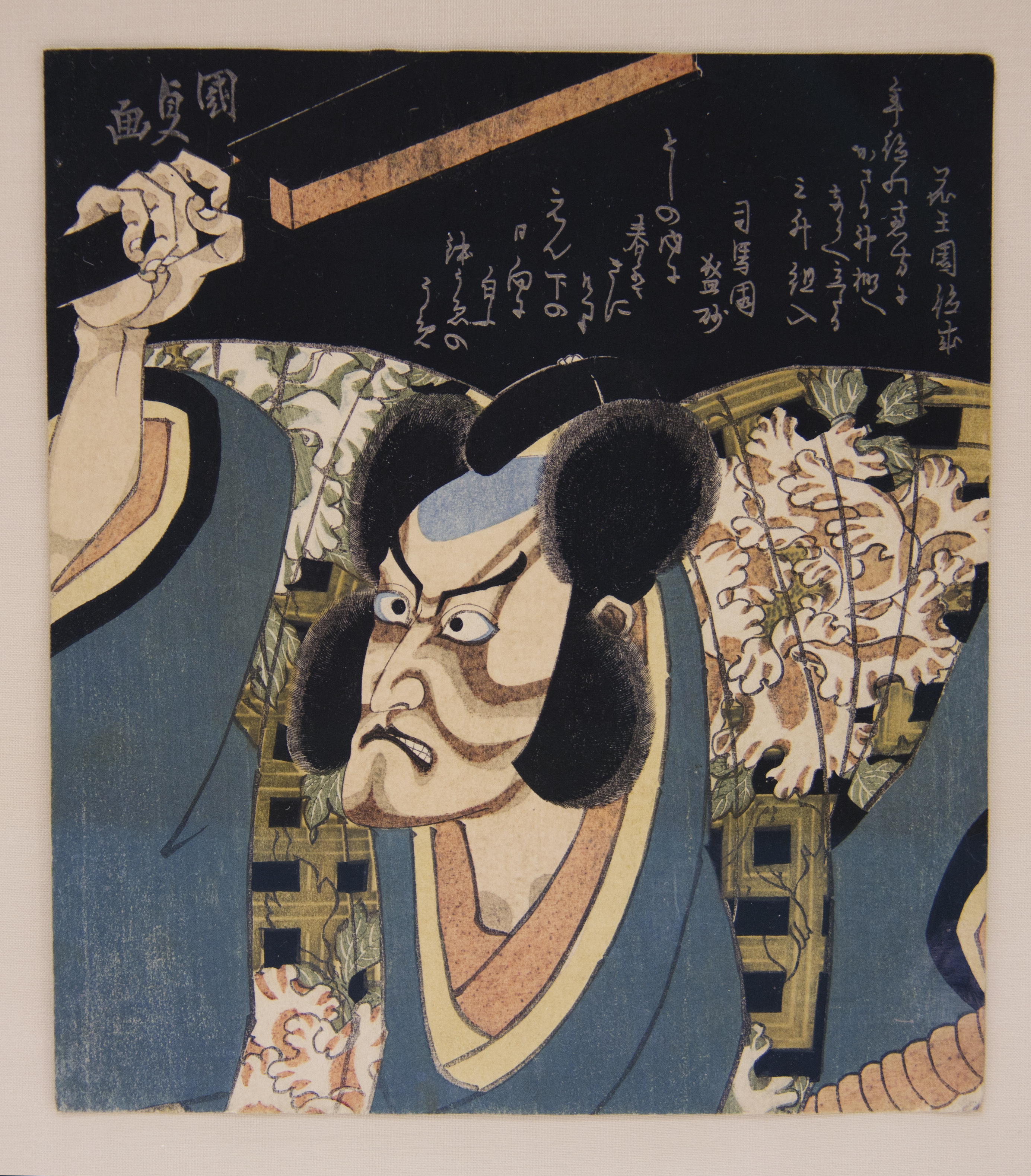
Ichikawa Danjūrō VII as Arajishi Otokonosuke
1829
Woodblock print (surimono); ink and color on paper; shikishiban
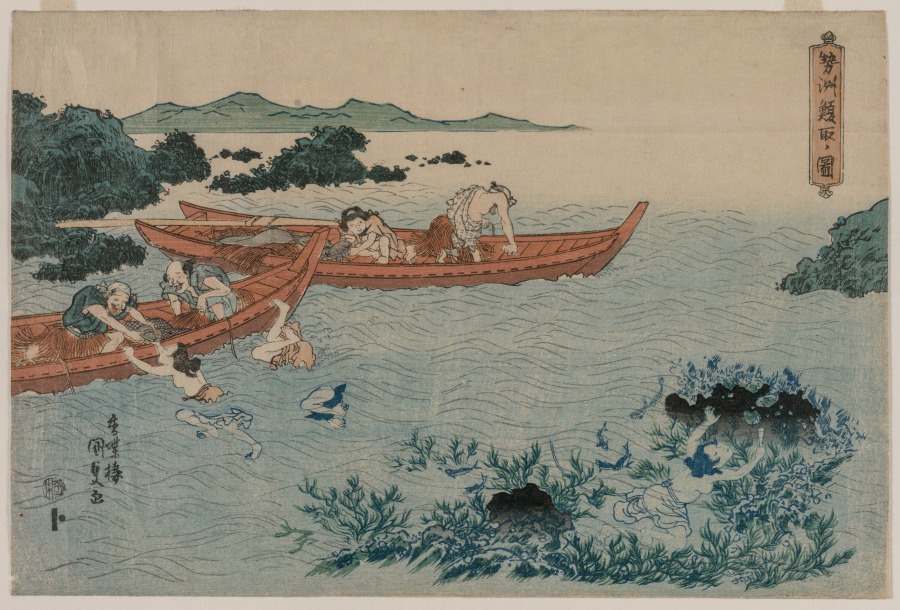
Abalone Divers off the Coast of Ise, from an Untitled Landscape Series
early 1830s
color woodblock print

Umegae and Genta in the Bell of Hell Scene from Jо̄ruri Drama Hiragana Seisuiki, New Edition, Part I
ca.1830-35

Crouching tiger
1830
Color woodblock print; shikishiban, surimono
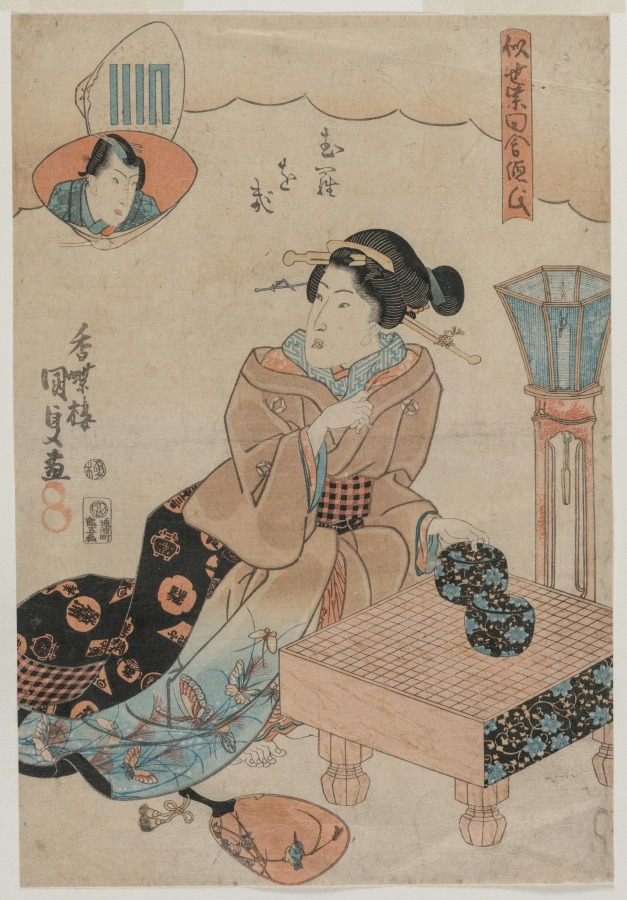
Muraogi, from the series The False Murasaki's Rustic Genji (Nise Murasaki Inaka Genji)
1830s
color woodblock print

Viewing Maple Trees
1835
Color woodblock print

Woman on her way to visit a shrine
early 1830s
Color woodblock print; shikishiban, surimono
The actor Ichikawa Dajuro VII and a woman watching boy write first calligraphy of the New Year
1831
Color woodblock print; shikishiban, surimono

The actors Ichikawa Danjuro VII as Kan Shojo (Sugawara Michizane) and Segawa Kikunojo V as Umeomaru in the play "Sugawara Denju Tenarai Kagami," performed at the Kawarazaki Theater in the ninth month, 1832
1832
Color woodblock print; vertical shikishiban diptych, surimono

Chidori Jewel River, Famous Place of Mutsu Province: Yamatoya Baiga (Mutsu meisho chidori no tamagawa Yamatoya Baiga)
ca. 1832-1833

The actors Iwai Hanshiro VI, Ichikawa Danjuro VIII as Kintoki, and Ichikawa Ebizo V as the woodcutter Nekko no Yokizo
1833
Color woodblock print; shikishiban, surimono

Ichikawa Danjūrō VII as Watanabe no Tsuna and Segawa Kikunojō V as the Female Demon, in “Modori Bridge” (Modoribashi)
1833
Color woodblock print; surimono

Actor in riding garb
1834
Color woodblock print; shikishiban, surimono
.jpg)
Mitsuuji with Mountain Roses (Yamabuki), from the series “Six Jewel Faces” (Mu tama-gao)
mid- to late 1830s
Uncut fan print; ink and color on paper
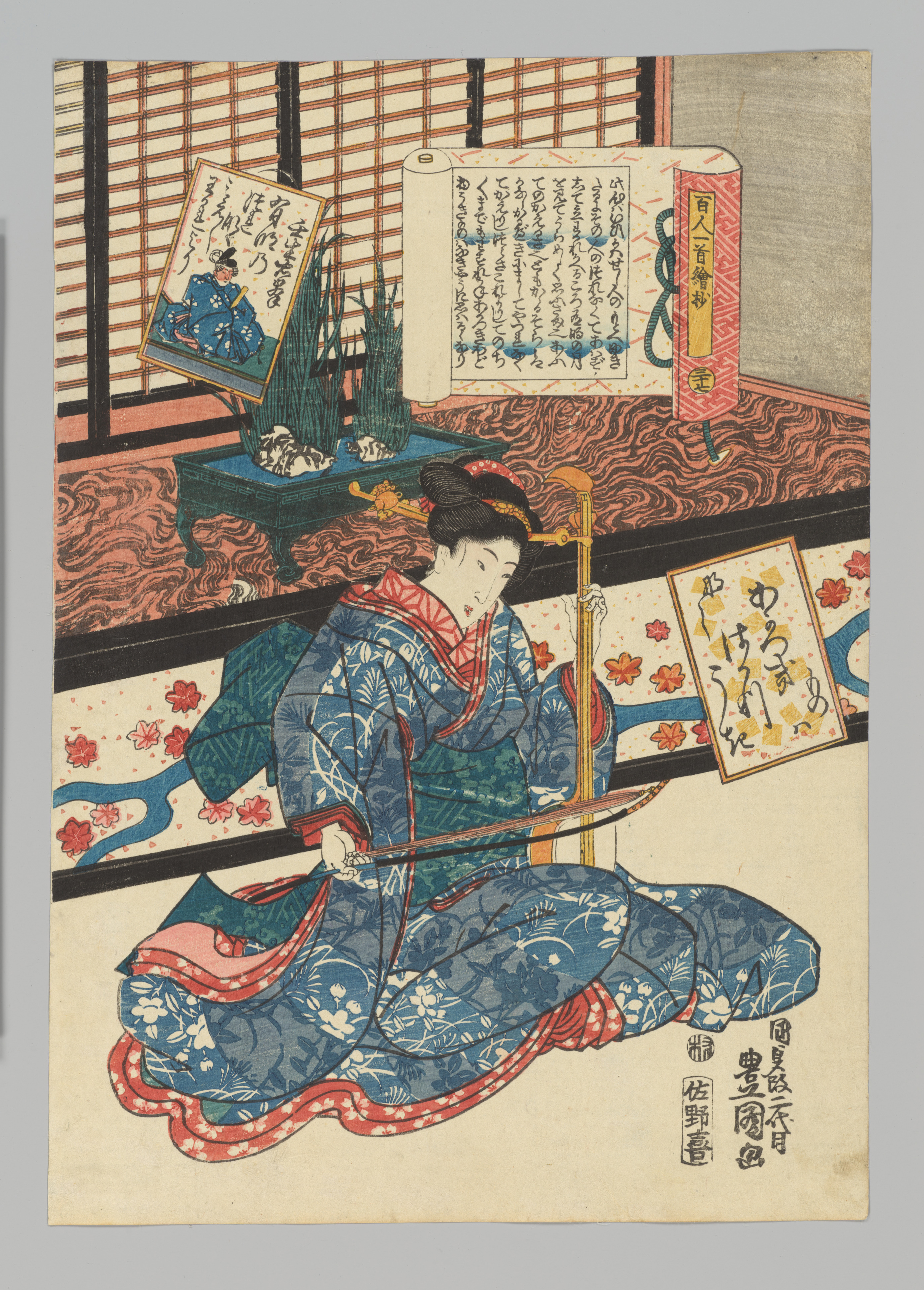
Mibu no Tadamine (no. 37), from the series A Pictorial Commentary on One Hundred Poems by One Hundred Poets (Hyakunin isshu eshō: Mibu no Tadamine)
ca. 1844
Woodblock print (nishiki-e); vertical oban; ink and color on paper
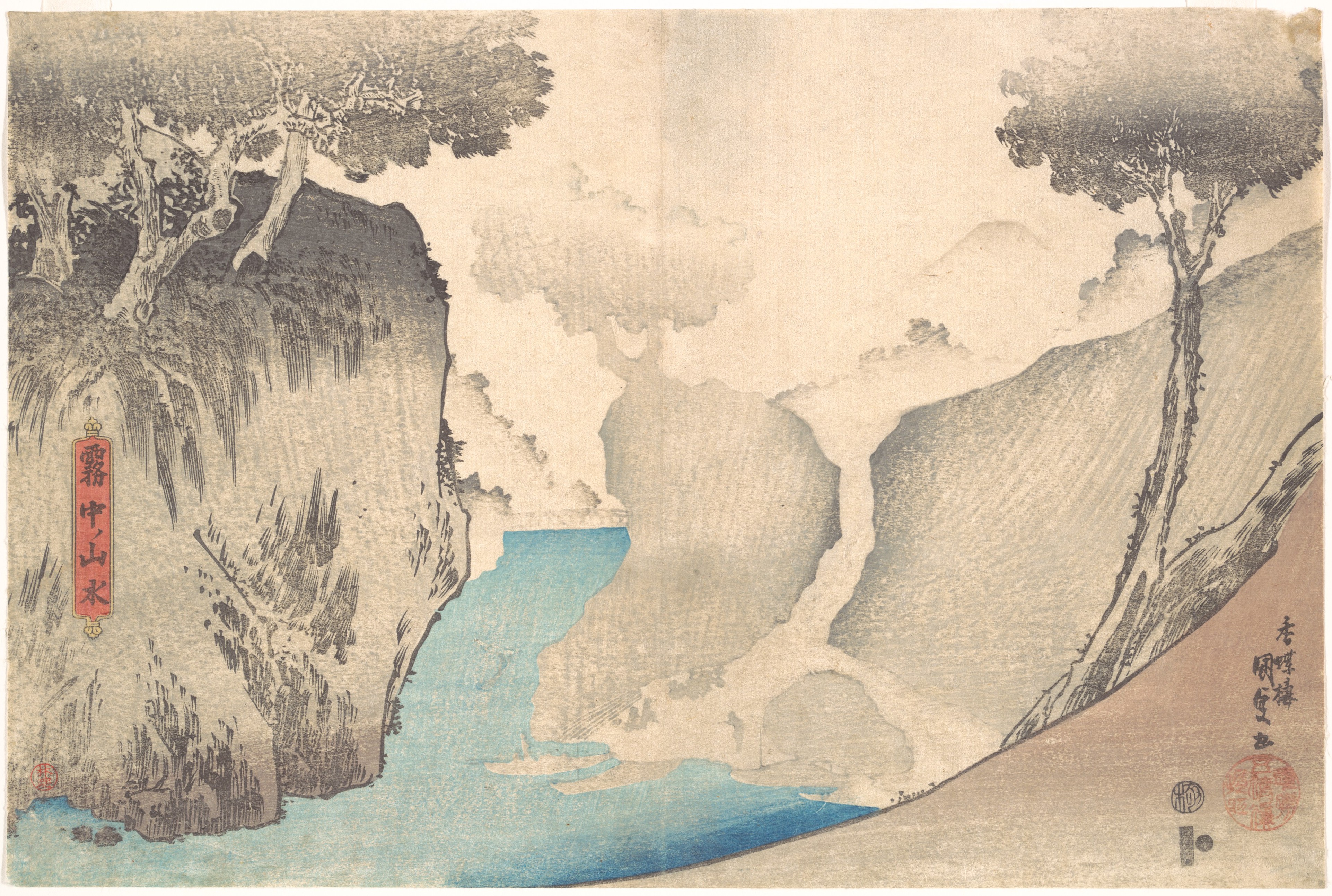
Ochanomizu in the Mist
mid-19th century
Woodblock print; ink and color on paper

The Thirty-Six Immortals of Poetry as Kabuki Actors (Yakusha sanjūrokkasen) 役者三十六歌仙
1835, first month (Tempō 6)
Woodblock printed book; ink and color on paper

The actor Ichikawa Ebizo V as Asahina Tobei
c. 1841
Color woodblock print; oban