
Biography
Yoshijiro Urushibara (漆原木虫, 1888–1953) was a Japanese woodblock printmaker who achieved international recognition for his remarkable collaboration with the British artist Sir Frank Brangwyn, producing color woodblock prints that represent one of the most successful artistic partnerships between Japanese and Western artists in the twentieth century. Working primarily in London, Urushibara brought Japanese woodblock technique to the service of Western artistic vision, creating prints of extraordinary technical quality and visual richness.
Born in Tokyo in 1888, Urushibara trained as a young man in the traditional Japanese woodblock printing techniques, learning the skills of both block carving and printing — the demanding craft that required years of apprenticeship to master.
The turning point in Urushibara's career came when he traveled to London in connection with the Japan-British Exhibition of 1910, where he was among a group of craftsmen who demonstrated Japanese woodblock printing. He settled in London, and by 1912 was engaged by the British Museum to mount and restore old prints and paintings. In time he began collaborating with English and French designers, most famously Sir Frank Brangwyn, one of the most prominent British artists of the era, renowned for his large-scale murals, etchings, and paintings. Brangwyn was fascinated by Japanese woodblock printing and saw in Urushibara the master craftsman who could realize his artistic visions in the medium, and their partnership would produce some of the most technically accomplished color woodcuts in the history of British printmaking.
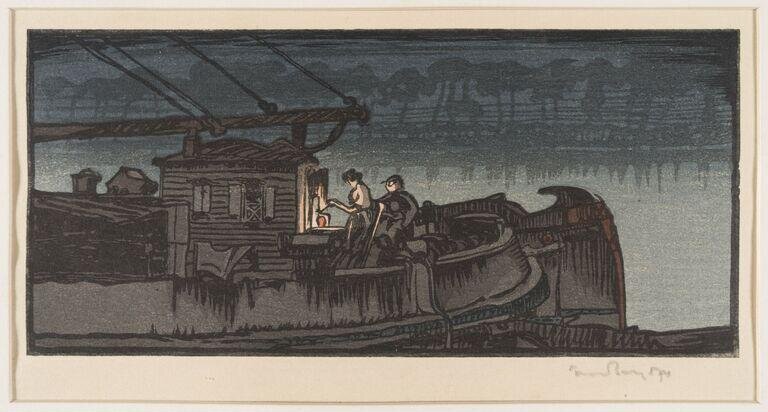
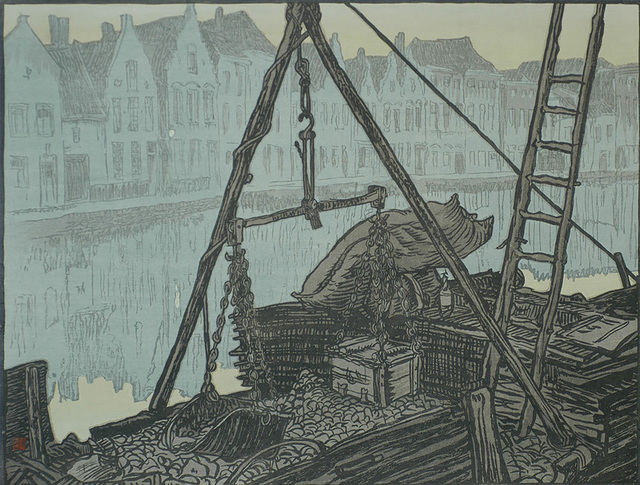
The Brangwyn–Urushibara collaboration involved Urushibara carving and printing woodblocks from Brangwyn's designs. The process required Urushibara not merely to reproduce Brangwyn's paintings mechanically but to interpret them for the woodblock medium, making artistic decisions about how to translate painterly effects into carved and printed form. His ability to achieve complex color harmonies, atmospheric gradations, and textural effects through the woodblock medium was extraordinary, and the resulting prints are remarkable for their richness of color. Among the fruits of the partnership were the Bruges portfolio of 1919 and the 1924 collection Ten Woodcuts by Yoshijiro Urushibara after Designs by Frank Brangwyn.
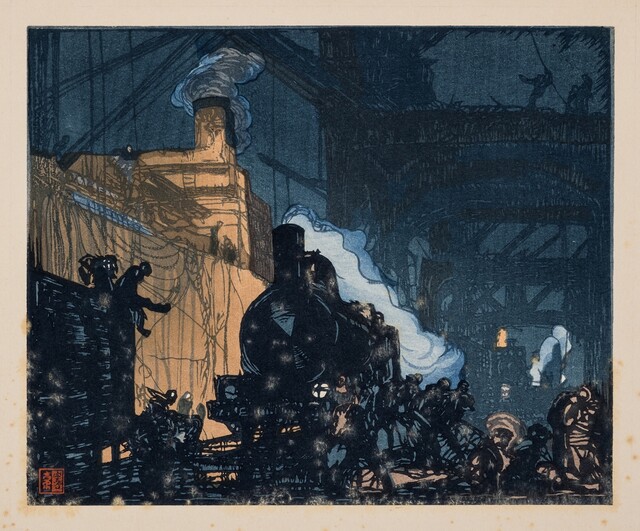
The prints produced through this collaboration depict a wide range of subjects drawn from Brangwyn's repertoire — architectural views, harbor scenes, bridges, and landscapes from locations across Europe. They demonstrate the partnership's ability to convey the atmosphere of European scenes through the Japanese woodblock medium, creating images that are simultaneously Western in subject and Eastern in technique.
Beyond his work with Brangwyn, Urushibara collaborated with other Western designers and produced prints from his own designs, depicting Japanese and London subjects that reveal his own artistic sensibility alongside his technical mastery. He also gave demonstrations of Japanese woodblock printing, helping to educate British audiences about the technique, and his work earned recognition on the Continent, including an honorable mention at the Salon of the Société des Artistes Français in 1921.
Urushibara remained based in London for much of his career, becoming a respected figure in the British art world and an influential presence in the English revival of color woodblock printing during the 1920s and 1930s. He left London with his family in late 1940, returning to Japan during the Second World War, and died in 1953. His legacy rests on his extraordinary achievement in bridging Japanese and Western artistic traditions, demonstrating that the Japanese woodblock technique could serve as a vehicle for Western artistic expression without losing its distinctive character. His collaborations with Brangwyn produced prints that are prized by collectors of both Japanese and British printmaking, and his work is held in major public collections, including the British Museum.
Key Facts
- Active Period
- 1888–1953
- Nationality
- 🇯🇵Japan
- Movement
- Shin-hanga
- Works Indexed
- 63
Frequently Asked Questions
Yoshijiro Urushibara (漆原木虫, 1888–1953) was a Japanese woodblock printmaker who achieved international recognition for his remarkable collaboration with the British artist Sir Frank Brangwyn, producing color woodblock prints that represent one of the most successful artistic partnerships between Japanese and Western artists in the twentieth century. Working primarily in London, Urushibara brought Japanese woodblock technique to the service of Western artistic vision, creating prints of extraordinary technical quality and visual richness.
Yoshijiro Urushibara was active from 1888 to 1953. They were associated with the Shin-hanga movement.
Yoshijiro Urushibara's work was shaped by the Shin-hanga tradition in Japanese woodblock printmaking. Shin-hanga: ## What is Shin-hanga? Shin-hanga (新版画), literally "new prints," is the early twentieth-century revival of the collaborative Japanese woodblock workshop, organized between roughly 1915 and 1960 by the Tokyo publisher Watanabe Shōzaburō (1885–1962) and a handful of competing houses.
Yoshijiro Urushibara's prints frequently feature landscapes, rivers & lakes, urban scenes, animals, figures, architecture.
Original prints by Yoshijiro Urushibara can be found in collections including Victoria and Albert Museum, Honolulu Museum of Art, Harvard Art Museums, Japanese Art Open Database.
Woodblock Prints by Yoshijiro Urushibara (63)
Orchids, butterfly and ladybird.
1888-1934
Peonies
c 1900s
color woodcut

Bridge by the Quai Poterie
1919
Barge on the Canal de Damme, Bruges
ca. 1919
Bruges at Dawn
1919
Color woodcut

Quai du Miroir
1919

Le Quai Vert
1919

Quai St. Ann
1919

The Barge
1919

Quai Poterie
1919

Introduction, with vignette after Brangwyn
1919

Place Van Eyck
1919

Crayfish
c.1920

Butterfly
c.1920

Dawn
ca. 1920

Ponte S. Paternina, Venice (no. 24)
1920s

Grasshopper and Butterfly
ca. 1920s

Grand Canal, Venice (with clouds)
ca. 1921

Tulips in Vase
ca. 1921

Camblain L'Abbe
ca. 1923

The Resting Place, Scutari
1924
In the Docks
1924
Woodcut printed in colours
Untitled
1929

Crete-de-coq
early 1930s